

Commentary
Dmitri Trenin
{
  "authors": [
    "Dmitri Trenin"
  ],
  "type": "legacyinthemedia",
  "centerAffiliationAll": "",
  "centers": [
    "Carnegie Endowment for International Peace",
    "Carnegie Europe",
    "Carnegie Russia Eurasia Center"
  ],
  "collections": [],
  "englishNewsletterAll": "",
  "nonEnglishNewsletterAll": "",
  "primaryCenter": "Carnegie Russia Eurasia Center",
  "programAffiliation": "",
  "programs": [],
  "projects": [],
  "regions": [
    "Caucasus",
    "Russia",
    "Eastern Europe",
    "Europe"
  ],
  "topics": [
    "Foreign Policy"
  ]
}
Source: Getty
Since 2008, Russo-Polish relations have seen a positive transformation that has the potential to make this relationship one of the key pillars of stability and security in Europe.
Source: openDemocracy

What has been happening between Warsaw and Moscow since the fall of 2008 has been nothing short of astounding. First, in the wake of the Georgia war, the two countries engaged in diplomatic consultations, with the Russian side sending a signal to the Poles: we respect you and value your thoughts. Then, Prime Minister Putin came to Poland in 2009 to attend the solemn ceremony marking the 70th anniversary of the start of World War II. Before he came, he had authored a conciliatory article in a major Polish newspaper. While in Poland, he not only weathered the criticism directed at Soviet foreign policy, but also had a useful conversation with Prime Minister Tusk while walking with him alone along a Gdansk pier.
In the next act of reconciliation, again driven by the Russian side, Putin invited Tusk to come to Katyn in April 2010 for a joint ceremony to honour the slain Polish officers, 70 years after their deaths. Putin even kneeled, briefly, while laying a wreath to the memorial. Putin even kneeled, briefly, while laying a wreath to the memorial. It wasn't a grand "Brandt at the Warsaw Ghetto" moment, but that seemingly natural, even though unexpected, gesture was much appreciated. It was probably there and then that the ice was broken.
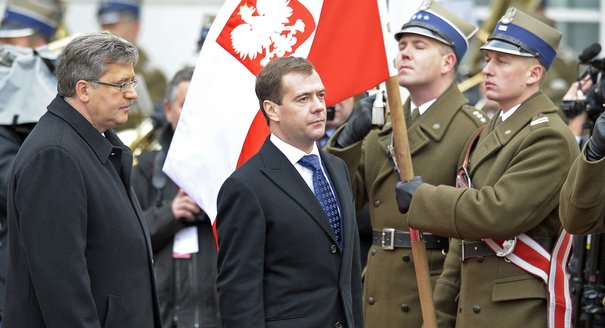
The budding relationship was put to the severest of tests three days later, as the Polish presidential plane carrying the first couple and scores of dignitaries crashed at Smolensk. The Russians, shaken as much as the Poles, literally went out of their way to cooperate with Warsaw. For the first time in living memory, they declared a national day of mourning to honour the foreign dead. Medvedev went to the funeral and clearly named Stalin and his henchmen as responsible for the murderous crime at Katyn.
In the months that followed, Moscow was satisfied with the outcome of the recent Polish presidential election and did not react at all to the accusations by some Poles that it – alongside with members of the Polish government – might have had a hand in the air crash at Smolensk. The accusations, of course, were preposterous, and evidently a reflection on Polish domestic politics, but Moscow was careful not to unleash anti-Polish sentiments in Russia. Instead, the Kremlin leaned on the Duma, usually a fount of Russian patriotism, to issue, ahead of Medevdev’s visit, an official statement recognizing, beyond any reasonable doubt, Stalin’s responsibility for the 1940 deaths. The stakes remain too high to let anyone spoil Russia’s Poland strategy.
The strategy Moscow has been pursuing with Warsaw had a lot do with Poland, but even more so with Europe. Especially under the Kaczynski Brothers’ tandem leadership, Warsaw made its dispute with Moscow into an obstacle for the wider EU-Russia relationship, blocking, among other things, the negotiation of a new partnership agreement. Russian attempts to lean on the Poles with a little help from its friends in Berlin and Paris were futile: such a breach of EU solidarity in favour of Moscow was never on the cards. In the end, the Kremlin realized there was no way around Warsaw.
However, the Russians needed a pragmatic Polish partner for a productive dialogue, and they saw an opening in the new government led by Donald Tusk, as they later would see one in Barack Obama. They also discovered that Foreign Minister Radek Sikorski was a modern Polish nationalist and not, as they had feared, an American stooge. Having found suitable partners, the Russians began to act to engage them.
Since 2008-9, the importance of the engagement has only grown. The global economic crisis, which hit Russia hard, pushed Moscow to look for ways to modernize its economy in order to remain a great power. Russian foreign policy was redesigned to furnish external resources for the country’s technological modernization. Since those resources were mainly to be found in the West, and predominantly in Europe, the importance of the EU relationship shot up. Warsaw, as the EU’s gatekeeper, had to be managed even more carefully.
Thus, it is clear that the engagement initiative was initiated by Moscow and that it was coming from the head, rather than the heart. This is not necessarily a bad thing. National interests are more solid grounds for relations than leaders’ feelings of empathy or remorse. Yet, it would be wrong to conclude that Russia’s present leaders cannot be moved at all when having to deal with the hideous crimes of Stalinism. Even a cynical value-less attitude stops in awe before them.
So, the issue is, where next? What kind of a relationship between Russia and Poland after the reconciliation? First of all, “difficult issues” from the two countries’ checkered history, as they are known to Polish and Russian diplomats, are not all done. They need to be brought to the surface, examined and honestly assessed. Second of all, the relationship needs to be made forward-looking. Polish and Russian youth should be allowed to rediscover each other. Thirdly, Russo-Polish political consultations should become even closer and cover a broad range of issues: Warsaw needs to feel Moscow treats it as a valued and even privileged partner in Europe.
At some point, Moscow will need to expand its policies of reconciliation to other difficult neighbours, starting with the Baltic States. Having recognized that Europe starts much closer than they had thought, Russian leaders need to pay some attention to Vilnius, Riga and Tallinn. Each Baltic country is different, and each will require a tailor-made approach. The experience of reconciliation with Poland can not be simply copied, but it can inspire. The most important thing that the Russian leaders are learning is that it is impossible to have good relations with the European Union as a whole while neglecting the immediate neighborhood.
There is something for the Balts to learn here, too. Exiting from an empire is a parallel effort for the former metropolis and its former subjects. It is a long process, not easy for either party. Russia may have reached out to Poland first, but not before Poland had matured as a new democracy and felt confident enough to engage its ex-hegemon. For a partnership to emerge, there must be partners – people with a strategic insight and some courage to ride ahead of their compatriots. This is also known as leadership.
Former Director, Carnegie Moscow Center
Trenin was director of the Carnegie Moscow Center from 2008 to early 2022.
Recent Work
Dmitri Trenin
Dmitri Trenin
Carnegie does not take institutional positions on public policy issues; the views represented herein are those of the author(s) and do not necessarily reflect the views of Carnegie, its staff, or its trustees.

But their "principal to principal" model will only be as effective as the political strength of each leader back home.

Damien Ma

U.S. unpredictability has allowed China to capitalize on its positioning as the “responsible great power”. Paradoxically, the more China wins the perception game, the more likely expectations will rise for Beijing to deliver not just words but to demonstrate with its deeds.

Chong Ja Ian

Hanoi and Beijing have long treated each other as distant cousins rather than comrades in arms. That might be changing as both sides draw closer to hedge against uncertainty and America’s erratic behavior.

Nguyễn Khắc Giang

Across Asia, China is better positioned to withstand energy shocks from the fallout of the Iran war. Its abundant coal capacity can ensure stability in the near term. Yet at the same time, the country’s energy transition away from coal will make it even less vulnerable during the next shock.
Damien Ma

Malaysia’s chairmanship sought to fend off short-term challenges while laying the groundwork for minimizing ASEAN’s longer-term exposure to external stresses.

Elina Noor