

Commentary
Dmitri Trenin
{
  "authors": [
    "Dmitri Trenin"
  ],
  "type": "commentary",
  "centerAffiliationAll": "",
  "centers": [
    "Carnegie Endowment for International Peace",
    "Carnegie Russia Eurasia Center"
  ],
  "collections": [],
  "englishNewsletterAll": "",
  "nonEnglishNewsletterAll": "",
  "primaryCenter": "Carnegie Russia Eurasia Center",
  "programAffiliation": "",
  "programs": [],
  "projects": [],
  "regions": [
    "North America",
    "United States",
    "East Asia",
    "Caucasus",
    "Russia",
    "Western Europe"
  ],
  "topics": [
    "Political Reform",
    "Democracy",
    "Security",
    "Foreign Policy"
  ]
}
Source: Getty
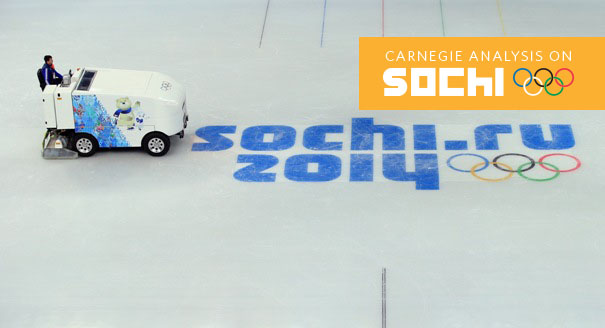
The Sochi Olympics are more politicized than any other Games in recent history. A number of world leaders have announced that they would not attend the Games. However, the Kremlin uses foreign criticism as proof of the West's perennial desire to hold Russia back, and keep it weak.
The Sochi Olympics, which start in ten days, are more politicized than any other Games in recent history. Parallels to the 1980 Moscow Olympics are not far-fetched. Then, the Games were boycotted by the United States and many of its allies, to punish the Soviet Union for the invasion of Afghanistan. Now, while there is no question of withdrawing national teams from the competition, a number of world leaders, led by U.S. President Barack Obama, have announced that they would not attend the Games as VIP spectators, a new fad among the global high and mighty.
The reason most often mentioned for this no-show is the newly adopted Russian legislation which bans gay propaganda to minors. This legislation, resulting from the Kremlin-led domestic swing toward conservatism, has aroused the LGBT community around the world. Russia stands accused by them as condoning discrimination and thus infringing on the Olympic spirit. Official Russian assurances that athletes have nothing to fear in Russia have failed to placate the LGBT activists, though few athletes have called off their participation on these grounds. What the LGBT campaign has actually done was to give more attention to Russia than it was accorded in the past decade.
This attention ranges from the record cost of the Games ($50 billion) and the inevitable issue of corruption to the situation in the North Caucasus where Sochi is located to the problem of security and, in particular, terrorism. What emerges under this critical scrutiny is a country which has been able to build impressive infrastructure in time for the Games, which was not a given when Sochi was awarded the Winter Olympics, but where roads, bridges, and airports cost much more than elsewhere in the world. What emerges is also a country which can ensure massive security presence in Sochi, but cannot protect its citizens everywhere from terrorist attacks.
This coverage, negative on balance, will be seen in Moscow as predictable. In reality, Russian leaders care even less about their image abroad than they claim. Rather, the Kremlin uses foreign criticism as proof of the West's perennial desire to hold Russia back, and keep it weak. The diplomatic quasi-boycott by the United States and its European allies will give even more prominence to the visit by China's leader Xi Jinping, his third to Russia in 12 months. Japan's Prime Minister Shinzo Abe is also expected to come, ahead of Vladimir Putin's visit to his country later this year. Not all Western visitors will stay away either. The Netherlands will be represented by the King Willem-Alexander, the Queen Máxima and the Prime Minister Mark Rutte. As for Barack Obama, Angela Merkel, David Cameron and François Hollande, they will not be able to escape Putin's hospitality in Sochi: four months after the Olympics kick-off, the Russian president will be hosting the G8 summit there.
Former Director, Carnegie Moscow Center
Trenin was director of the Carnegie Moscow Center from 2008 to early 2022.
Recent Work
Dmitri Trenin
Dmitri Trenin
Carnegie does not take institutional positions on public policy issues; the views represented herein are those of the author(s) and do not necessarily reflect the views of Carnegie, its staff, or its trustees.

The nuclear relationship between China and the United States is increasingly shaped by widening perception gaps rather than deliberate strategic design.

Tong Zhao

Chinese biotech companies have been on the receiving end of U.S. economic coercion. Yet their responses have differed significantly because firm and state interests are not uniformly aligned. For Washington, treating all Chinese tech firms the same, irrespective of their actual interests, risks pushing them farther into Beijing’s corner.

Xue Gong

But their "principal to principal" model will only be as effective as the political strength of each leader back home.

Damien Ma

U.S. unpredictability has allowed China to capitalize on its positioning as the “responsible great power”. Paradoxically, the more China wins the perception game, the more likely expectations will rise for Beijing to deliver not just words but to demonstrate with its deeds.

Chong Ja Ian

Hanoi and Beijing have long treated each other as distant cousins rather than comrades in arms. That might be changing as both sides draw closer to hedge against uncertainty and America’s erratic behavior.

Nguyễn Khắc Giang