

Commentary
Dmitri Trenin
{
  "authors": [
    "Dmitri Trenin"
  ],
  "type": "commentary",
  "centerAffiliationAll": "",
  "centers": [
    "Carnegie Endowment for International Peace",
    "Carnegie Russia Eurasia Center"
  ],
  "collections": [],
  "englishNewsletterAll": "",
  "nonEnglishNewsletterAll": "",
  "primaryCenter": "Carnegie Russia Eurasia Center",
  "programAffiliation": "",
  "programs": [],
  "projects": [],
  "regions": [
    "North America",
    "United States",
    "Russia",
    "Eastern Europe",
    "Ukraine",
    "Western Europe",
    "Germany"
  ],
  "topics": [
    "Security",
    "Foreign Policy"
  ]
}
Source: Getty
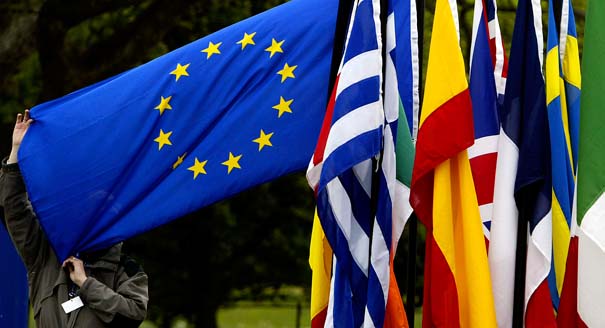
The continuing crisis over Ukraine has significantly hardened Western official and media attitudes toward Russia. However, with Washington leading the charge and NATO back in the saddle, the European Union is taking a back seat.
From my time in Europe last week, I have somewhat contradictory feelings. On the one hand, the continuing crisis over Ukraine has significantly hardened official and media attitudes toward Russia. In Eastern Europe, Russia is once again cast in the role of an historical adversary, and in much of the rest of the continent, it is painted as a 19th century power. On the other hand, regarding the issue of economic sanctions against Russia, there is a general lack of enthusiasm. Europeans are worried about the level of their energy dependency on their eastern neighbor, and they are highly reluctant to give up their export market in Russia—especially now, when the post-crisis recovery is far from complete.
At the same time, with the centenary of World War I on many people's minds, and Christopher Clark's 2012 book Sleepwalkers, a modern version of Barbara Tuchman's Guns of August, on many bestseller lists (also in its German translation), fears of a hot war underlie the talk about the new cold one. The scare last week about Russian forces purportedly poised to invade eastern Ukraine made quite a few Europeans nervous. The public is generally confused about Ukraine, a place almost indistinguishable in historical memory from Russia. There seems to be a consensus that whatever happens in Ukraine does not warrant Western military action.
With Washington leading the charge and NATO back in the saddle, the European Union is taking a back seat. Germany, its sole powerhouse, publicly supports U.S. rhetoric but is very cautious, so that the situation does not lead to an economic rupture with Russia. It is no wonder that Chancellor Angela Merkel, who has said that Vladimir Putin "lives in another world," has failed to become the Russian president's main interlocutor on Ukraine. The Kremlin has turned to the White House instead. Frank-Walter Steinmeier, Germany's social democratic foreign minister and a moderate on Russia, finds himself between the hammer of Moscow's resolve and the anvil of his own domestic critics. Again, Russian Foreign Minister Sergey Lavrov speaks mainly with U.S. Secretary of State John Kerry. The influential Eastern Committee of German Industry wants to protect the interests of 6,000-plus German companies which are doing business in Russia. Remarkably, Helmut Schmidt, Germany's 95-year-old elder statesman, in a wide-ranging interview with Die Zeit, said he "understood" Putin's motives on Crimea and, if he were to vote on Russia's behavior, would "abstain." For better or worse, Europe is not only back on Washington's radar screen, but also back in history. And history demands leadership.
Former Director, Carnegie Moscow Center
Trenin was director of the Carnegie Moscow Center from 2008 to early 2022.
Recent Work
Dmitri Trenin
Dmitri Trenin
Carnegie does not take institutional positions on public policy issues; the views represented herein are those of the author(s) and do not necessarily reflect the views of Carnegie, its staff, or its trustees.

But their "principal to principal" model will only be as effective as the political strength of each leader back home.

Damien Ma

U.S. unpredictability has allowed China to capitalize on its positioning as the “responsible great power”. Paradoxically, the more China wins the perception game, the more likely expectations will rise for Beijing to deliver not just words but to demonstrate with its deeds.

Chong Ja Ian

Hanoi and Beijing have long treated each other as distant cousins rather than comrades in arms. That might be changing as both sides draw closer to hedge against uncertainty and America’s erratic behavior.

Nguyễn Khắc Giang

Across Asia, China is better positioned to withstand energy shocks from the fallout of the Iran war. Its abundant coal capacity can ensure stability in the near term. Yet at the same time, the country’s energy transition away from coal will make it even less vulnerable during the next shock.
Damien Ma

Malaysia’s chairmanship sought to fend off short-term challenges while laying the groundwork for minimizing ASEAN’s longer-term exposure to external stresses.

Elina Noor