

Commentary
Thomas de Waal
{
  "authors": [
    "Thomas de Waal"
  ],
  "type": "commentary",
  "centerAffiliationAll": "",
  "centers": [
    "Carnegie Endowment for International Peace",
    "Carnegie Europe",
    "Carnegie Russia Eurasia Center"
  ],
  "collections": [],
  "englishNewsletterAll": "",
  "nonEnglishNewsletterAll": "",
  "primaryCenter": "Carnegie Europe",
  "programAffiliation": "",
  "programs": [],
  "projects": [],
  "regions": [
    "Caucasus",
    "Russia",
    "Georgia"
  ],
  "topics": [
    "Political Reform",
    "Foreign Policy"
  ]
}
Source: Getty
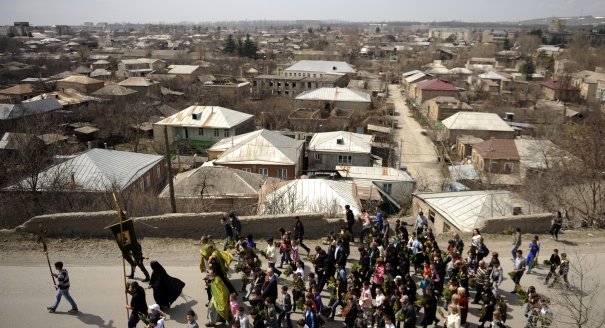
The new Russian legislation allowing regions of another country to seek to join the Russian Federation gives Moscow leverage over a number of regions. Georgians are worrying that South Ossetia could be one of these regions.
If President Vladimir Putin is planning a move against Georgia, where would it come?
That was the question I heard half of Tbilisi discussing earlier this month.
The new Russian legislation allowing regions of another country to seek to join the Russian Federation gives Moscow leverage over a number of regions. First on the list is Transnistria, which has already applied to become part of Russia.
Meeting officials from Abkhazia and South Ossetia in Moscow last week, Russian Foreign Minister Sergei Lavrov said that he "respects the will of the Abkhaz people, which has chosen independence."
Lavrov's words seemed to cover South Ossetia by implication too, but the case is very different. It is so small (with a current population of no more than 50,000 people) that its residents are not in control of its own destiny. But, given a choice, many South Ossetians would welcome the chance of union with the much bigger republic of North Ossetia on the other side of the mountains to form a single republic of “Alania” inside Russia.
So we should not discount a report I heard in Georgia earlier this month that the South Ossetian authorities are considering holding a referendum on union with Russia on June 8, to be held in parallel with their parliamentary elections. I was told that this was the message the hyper-active Duma deputy Leonid Slutsky brought to South Ossetia on March 28—although the only press report on the visit recorded Slutsky passing on birthday greetings to South Ossetian leader Leonid Tibilov and presenting him with a copy of Pravda from his birth-date in 1952.
Slutsky was one of the first Russian politicians to stir up Crimea and has also been instigating trouble in the Moldovan region of Gagauzia.
So Slutsky's visit may just have been a trial balloon.
Georgians are nervously worrying about a new wave of Russian pressure tactics against them, designed to halt the planned signing of a European Union Association Agreement in June. But at the moment the only news in Georgian-Russian relations is the continued thaw: the renewal of trade and talk of the restoration of a direct air link.
So one wise Georgian politician told me the government is also bracing itself for another Russian tactic: a charm offensive in which Moscow offers Tbilisi a new deal over South Ossetia in return for Georgia renouncing its European path.
If either of these scenarios come to pass we can be sure of one thing: ordinary South Ossetians will not be consulted about what the Russian leadership intends for them.

Senior Fellow, Carnegie Europe
Thomas de Waal is a senior fellow at Carnegie Europe, specializing in Eastern Europe and the Caucasus.
Recent Work
Thomas de Waal

Thomas de Waal, Areg Kochinyan, Zaur Shiriyev
Carnegie does not take institutional positions on public policy issues; the views represented herein are those of the author(s) and do not necessarily reflect the views of Carnegie, its staff, or its trustees.

But their "principal to principal" model will only be as effective as the political strength of each leader back home.

Damien Ma

U.S. unpredictability has allowed China to capitalize on its positioning as the “responsible great power”. Paradoxically, the more China wins the perception game, the more likely expectations will rise for Beijing to deliver not just words but to demonstrate with its deeds.

Chong Ja Ian

Hanoi and Beijing have long treated each other as distant cousins rather than comrades in arms. That might be changing as both sides draw closer to hedge against uncertainty and America’s erratic behavior.

Nguyễn Khắc Giang

Across Asia, China is better positioned to withstand energy shocks from the fallout of the Iran war. Its abundant coal capacity can ensure stability in the near term. Yet at the same time, the country’s energy transition away from coal will make it even less vulnerable during the next shock.
Damien Ma

Malaysia’s chairmanship sought to fend off short-term challenges while laying the groundwork for minimizing ASEAN’s longer-term exposure to external stresses.

Elina Noor