

Commentary
Alexey Malashenko
{
  "authors": [
    "Alexey Malashenko"
  ],
  "type": "commentary",
  "centerAffiliationAll": "",
  "centers": [
    "Carnegie Endowment for International Peace",
    "Carnegie Russia Eurasia Center"
  ],
  "collections": [],
  "englishNewsletterAll": "",
  "nonEnglishNewsletterAll": "",
  "primaryCenter": "Carnegie Russia Eurasia Center",
  "programAffiliation": "",
  "programs": [],
  "projects": [],
  "regions": [
    "Caucasus",
    "Russia",
    "Azerbaijan",
    "Armenia"
  ],
  "topics": [
    "Security",
    "Military",
    "Foreign Policy"
  ]
}
Source: Getty
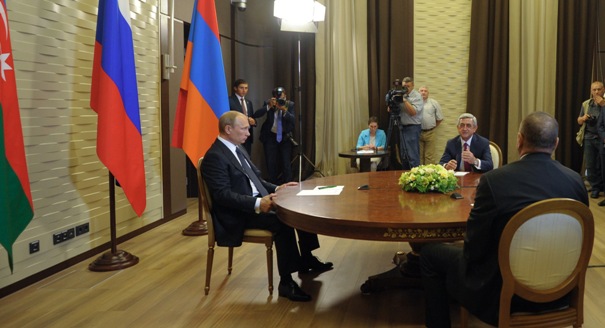
The Sochi meeting between Russia’s, Armenia’s, and Azerbaijan’s presidents is but one episode in the series of Russia’s protracted peacemaking efforts. Rather, the Armenia-Azerbaijan conflict serves as a great pretext for Russia’s presence in the South Caucasus.
It is unlikely that the August 10 Sochi meeting between Russia’s, Armenia’s, and Azerbaijan’s presidents will become a turning point in the Nagorno-Karabakh conflict. This is but one episode in the series of Russia’s protracted peacemaking efforts. Rather, the Armenia-Azerbaijan conflict serves as a great pretext for Russia’s presence in the South Caucasus. As long as the conflict continues, and no one knows how long it will last, Russia will maintain its presence in the region. If the conflict is somehow miraculously resolved, Moscow’s sway over both Azerbaijan and Armenia will diminish.
However, in Nagorno-Karabakh, we are dealing with a perennial conflict, which will remain fundamentally unchanged unless some global political upheavals are to occur.
So how is this trilateral summit different from other meetings of similar format?
Second, the success of Russia’s peacemaking efforts would be quite useful to Moscow at this time. The Ukrainian crisis devalues Russia’s peacemaking efforts; fewer and fewer people still believe it is willing and able to resolve conflicts in the post-Soviet space. Interestingly enough, the smiling Armenian President Serzh Sargsyan asked Putin to keep him informed of the steps Russia takes in Ukraine, promising to do the same vis-à-vis the events in the Caucasus region.
In other words, if Russia is able to succeed in its peacemaking efforts now, it might somewhat restore its dented international reputation.
Third, Russia is seeking to strengthen its position in the post-Soviet space more than ever before. In this context, it is interested in maintaining good working relations with both Armenia and Azerbaijan. It is especially true in light of the fact that Armenia is Russia’s strategic partner; it is a member of the Collective Security Treaty Organization and also intends to join the Customs Union and possibly the Eurasian Union. For its part, Azerbaijan, which has always considered Russia one of its major international partners, will have to overcome the temptation to supply Europe with gas under the so-called Southern Gas Corridor initiative, thus taking Russia out of the energy equation. So it is getting increasingly more difficult for Russia to preserve balance in its relations with both countries.
Fourth, it is possible that Russia may take some unconventional steps to validate its status of a peacemaker. For instance, it may offer to send its peacekeepers into the region (such rumors had been circulating before the start of the summit). Such an event seems unlikely, but if it indeed takes place, it may create a precedent for more Russian peacekeeping engagements in some other regions, such as the southeast of Ukraine.
In any event, the August trilateral summit goes beyond the actual Nagorno-Karabakh conflict, while the conflict itself remains unresolved.
Former Scholar in Residence, Religion, Society, and Security Program
Malashenko is a former chair of the Carnegie Moscow Center’s Religion, Society, and Security Program.
Recent Work
Alexey Malashenko
Alexey Malashenko
Carnegie does not take institutional positions on public policy issues; the views represented herein are those of the author(s) and do not necessarily reflect the views of Carnegie, its staff, or its trustees.

But their "principal to principal" model will only be as effective as the political strength of each leader back home.

Damien Ma

U.S. unpredictability has allowed China to capitalize on its positioning as the “responsible great power”. Paradoxically, the more China wins the perception game, the more likely expectations will rise for Beijing to deliver not just words but to demonstrate with its deeds.

Chong Ja Ian

Hanoi and Beijing have long treated each other as distant cousins rather than comrades in arms. That might be changing as both sides draw closer to hedge against uncertainty and America’s erratic behavior.

Nguyễn Khắc Giang

Across Asia, China is better positioned to withstand energy shocks from the fallout of the Iran war. Its abundant coal capacity can ensure stability in the near term. Yet at the same time, the country’s energy transition away from coal will make it even less vulnerable during the next shock.
Damien Ma

Malaysia’s chairmanship sought to fend off short-term challenges while laying the groundwork for minimizing ASEAN’s longer-term exposure to external stresses.

Elina Noor