

Commentary
Cornelius Adebahr
{
  "authors": [
    "Cornelius Adebahr"
  ],
  "type": "legacyinthemedia",
  "centerAffiliationAll": "dc",
  "centers": [
    "Carnegie Endowment for International Peace",
    "Carnegie Europe"
  ],
  "collections": [
    "Europe’s Eastern Neighborhood",
    "EU Integration and Enlargement"
  ],
  "englishNewsletterAll": "ctw",
  "nonEnglishNewsletterAll": "",
  "primaryCenter": "Carnegie Europe",
  "programAffiliation": "EP",
  "programs": [
    "Europe"
  ],
  "projects": [],
  "regions": [
    "Europe",
    "Eastern Europe",
    "Western Europe",
    "Germany",
    "Iran"
  ],
  "topics": [
    "Foreign Policy",
    "EU",
    "Political Reform"
  ]
}
Source: Getty
The least the EU can do is keep up the credibility of the promise of EU membership and reform its enlargement and neighborhood policies once a new Commission is in place later this year.
Source: Global Policy
World events – and history – seem to converge on the Western Balkans these days. The crisis in Ukraine highlights the EU’s failed approach to the neighbourhood, while reminding people both there and in the EU of how difficult Ukrainian membership would be to achieve. The countries that are (hoping to be) negotiating about further enlargement, in contrast, have faced a wave of populism, in both old and prospective EU member states. In the former, persisting dissatisfaction with the entry of countries like Romania and Bulgaria in 2007 makes it harder for national politicians to “sell” any further enlargement to their electorates. In the latter, citizens are frustrated with the slow speed of integration and have begun to question the EU’s sincerity to accept them as members one day. Finally, the 100th anniversary of the breakout of World War I this August has brought numerous references to the “powder keg” that the region once was – and, for some, still is today.
Today’s reality is – thankfully – much more profane, with talks centering on economic growth, establishing the rule of law, and fostering regional cooperation. In Dubrovnik in mid-July, foreign ministers, deputy ministers and other high-ranking officials from nearly 30 European countries – plus guests from the United States, Russia, China, Japan and New Zealand – met for the second edition of the Croatia Forum.Unlike is customary on such glamorous occasions, participants did not mince their words when it came to criticizing the “State of Play” of the integration of the Western Balkans into the EU. Stating that the EU’s enlargement process lacks dynamism was the more polite form of criticism, which extended to diagnosing a collective policy failure on the part of the national elites from the region. However, there is also an intrinsic difficulty to enlargement that even the most capable politicians could not do away with: the gap between a continuously integrating EU – which makes accession ever more demanding – and a region still mired in different stages of state-building.
So while some progress has been made since the most recent entry of Croatia into the EU last summer – Serbia has started accession negotiations, Albania has received candidate status, and Montenegro is advancing in its negotiations through the opening of new chapters of the acquis – a lot more needs to be done.
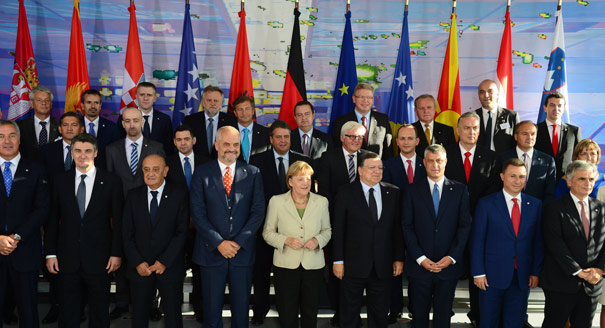
It is thus more than welcome that German Chancellor Angela Merkel made a personal effort to invite the leaders of all Western Balkans countries to a summit. The heads of government, foreign ministers, and economic ministers of eight governments – including those of Croatia and Slovenia, which are already EU members – plus EU leaders like Commission President Barroso and Enlargement Commissioner Füle all came to Berlin for one day for what was meant to not only be a symbolic meeting. Quite concretely, in addition to the leaders’ gathering, a business meeting chaired by Energy Commissioner Oettinger aimed to enhance economic and industrial cooperation in the region. This was more than necessary, given the region’s high unemployment rates as well as complete lack of an industrial base. Thus, investments in energy infrastructure are needed as much as an extension and upgrading of the existing transport infrastructure.
“Not forgetting the Western Balkans” is a start, yet it is not going to be enough if the EU wants these countries to one day be prosperous member states – not out of compassion but based on its own interests. True, Angela Merkel reiterated that the EU will stick to the “European perspective” it has promised those countries. However, placing all responsibility for achieving this on the countries themselves misses the broader picture of a largely disinterested EU that furthermore lacks the tools to break the gridlock holding back the societies of the region.
The least the EU can do is keep up the credibility of the membership promise and reform its enlargement and neighbourhood policies once a new Commission is in place later this year. As for the former, the continuation of this year’s summit in Vienna in 2015 is a good sign. For the latter policy areas, it will be crucial to define intermediate steps – as the visa facilitation regime did for the Western Balkans countries – that provide tangible rewards for concrete reform efforts.
This ‘piecemeal approach’ should be very much to the likings of Chancellor Merkel, who is known to detest grandiose speeches. That’s only one more reason why continued German leadership ought to be welcome in the Western Balkans.
Former Nonresident Fellow, Carnegie Europe
Cornelius Adebahr was a nonresident fellow at Carnegie Europe. His research focuses on foreign and security policy, in particular regarding Iran and the Persian Gulf, on European and transatlantic affairs, and on citizens’ engagement.
Recent Work
Cornelius Adebahr

Cornelius Adebahr, Barbara Mittelhammer
Carnegie does not take institutional positions on public policy issues; the views represented herein are those of the author(s) and do not necessarily reflect the views of Carnegie, its staff, or its trustees.

But their "principal to principal" model will only be as effective as the political strength of each leader back home.

Damien Ma

U.S. unpredictability has allowed China to capitalize on its positioning as the “responsible great power”. Paradoxically, the more China wins the perception game, the more likely expectations will rise for Beijing to deliver not just words but to demonstrate with its deeds.

Chong Ja Ian

Hanoi and Beijing have long treated each other as distant cousins rather than comrades in arms. That might be changing as both sides draw closer to hedge against uncertainty and America’s erratic behavior.

Nguyễn Khắc Giang

Across Asia, China is better positioned to withstand energy shocks from the fallout of the Iran war. Its abundant coal capacity can ensure stability in the near term. Yet at the same time, the country’s energy transition away from coal will make it even less vulnerable during the next shock.
Damien Ma

Malaysia’s chairmanship sought to fend off short-term challenges while laying the groundwork for minimizing ASEAN’s longer-term exposure to external stresses.

Elina Noor