

Commentary
Maha Yahya
{
  "authors": [
    "Maha Yahya"
  ],
  "type": "legacyinthemedia",
  "centerAffiliationAll": "dc",
  "centers": [
    "Carnegie Endowment for International Peace",
    "Malcolm H. Kerr Carnegie Middle East Center"
  ],
  "collections": [
    "Conflict and Refugees"
  ],
  "englishNewsletterAll": "menaTransitions",
  "nonEnglishNewsletterAll": "",
  "primaryCenter": "Malcolm H. Kerr Carnegie Middle East Center",
  "programAffiliation": "MEP",
  "programs": [
    "Middle East"
  ],
  "projects": [],
  "regions": [
    "Levant",
    "Maghreb",
    "Syria",
    "Iraq",
    "Middle East",
    "North Africa",
    "Afghanistan",
    "Eastern Europe"
  ],
  "topics": [
    "Political Reform",
    "Security",
    "Democracy",
    "Global Governance",
    "Foreign Policy"
  ]
}
Source: Getty
Despite its promise to leave no one behind, the new U.N. 2030 Sustainable Development Agenda is silent on the biggest crisis of the contemporary world: refugees.
Source: Huffington Post
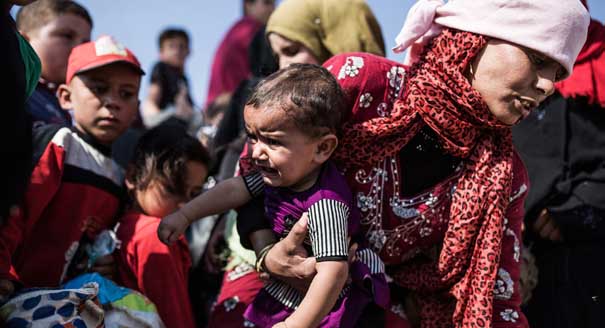
Despite its promise to leave no one behind, the U.N.'s new 2030 Sustainable Development Agenda is silent on the biggest crisis of our contemporary world: refugees. Progressively intractable conflicts are creating a spiraling global-refugee crisis that today includes close to 60 million individuals around the world. In 2014, an average of 42,500 people each day were forced to flee their homes due to ongoing war and violence—more than half of them children under 18. This global community of refugees could make the 24th most populous nation in the world.
To be truly transformative, the new agenda must address the plight of refugees and the internally displaced as a central feature for achieving peace and security. This requires a number of interconnected actions that link across various goals in the agenda, including those related to poverty, education, health and partnerships for development.A key achievement of the agenda, particularly through Goal 16 on Peace, Security, and Inclusivity, is its emphasis on the interdependence between conflict and development; that underdevelopment and inequality are drivers of conflict, while violence undermines development. This is clearest in Syria, where the massive damage to lives, livelihoods and the economic and physical infrastructure of the country means that 80 percent of the population now lives below the poverty line.
However, the goal's focus on governance structures and institution building makes the inclusion of millions of refugees and internally displaced individuals and communities neither obvious nor straightforward. For the countries of origin, the scale of this challenge is perhaps again clearest in Syria, where conflict has driven close to 12 million out of their homes and four million out of the country. Entire ethnic and religious communities are also fleeing lands they have lived on for centuries, in places such as Iraq, Afghanistan, and the Central African Republic. For the countries of refuge, particularly in Europe, confusion and a disjointed strategy reign supreme as leaders come under increased pressure from their own citizens to admit more refugees.
Holding the international community accountable for ensuring the delivery of needed support to sustain those fleeing the horrors of war is crucial. The funding shortfall for United Nations requirements for essential food, health, shelter and education services for refugees in the Middle East and Africa is not only appalling but is life threatening and sets the scene for future conflicts. To illustrate, the international community has pledged only $1.67 billion of the needed $4.53 billion needed for programs in Turkey, Jordan, Lebanon and Iraq. The rush to Europe witnessed in the past weeks is one result of this critical shortage in humanitarian support as conflicts intensify, winter looms and future prospects become even bleaker.
There is a need to combine humanitarian support with development initiatives. One critical area is the provision of educational services for the more than 28 million children who are out of school due to conflict, compounding their anguish and threatening their future. Initiatives, such as the non-formal education partnership between UNICEF and the Norwegian Refugee Council, are a good place to start, but much more needs to be done.
A sustainable end to conflict must address the root causes of violence, including political and socio-economic exclusion and inequities. It also necessitates respect for the right to self-determination, and an end to occupation. This is essential if countries are to escape a conflict trap of recurring episodes of violence that occurs when key grievances remain unaddressed and justice is not fulfilled. Lessons from Cambodia and Northern Ireland peace processes are instructive.
At the level of host countries, key measures for the integration of refugees are essential to mitigate future discord. This would include targets for economic as well as social and political integration. Sweden—which has taken more refugees per capita than any other European country, including more than 30,000 Syrians in 2014—perhaps offers the best example for capitalizing on the raw new talent that arrives with them. It is investing in the employability of every person through an integration program for refugees run by the Swedish public-employment service. This program assesses the skills of refugees and liaises with the private sector to identify appropriate job openings as the refugees learn Swedish, thus helping families adjust to their new surroundings and in time becoming an integral part of Swedish society. It also decreases the burden of support on the government itself and allows it to address its own labor shortages resulting from an aging population.
Refugees should not be viewed as a burden. Given the right access to education and employment, they actively contribute to their host communities. Let us remember that some of the leading innovators of our times were once refugees, including Apple Founder Steve Jobs; psychoanalyst Sigmund Freud; artists Mark Chagall, and Mona Hatoum; U.S Secretary of State Henry Kissinger; and novelist Isabelle Allende, among many others. Achieving the future we want and leaving no one behind means creating the conditions that can allow ordinary people to thrive and a multitude of new pioneers to emerge. The costs of failing to do so are evident in the world we live in today.
This post is part of a series produced by The Huffington Post, "What's Working: Sustainable Development Goals," in conjunction with the United Nations' Sustainable Development Goals (SDGs). The proposed set of milestones will be the subject of discussion at the UN General Assembly meeting on Sept. 25-27, 2015 in New York. The goals, which will replace the U.N.'s Millennium Development Goals (2000-2015), cover 17 key areas of development—including poverty, hunger, health, education, and gender equality, among many others. As part of The Huffington Post's commitment to solutions-oriented journalism, this What's Working SDG blog series will focus on one goal every weekday in September. This post addresses Goal 16.
This article was originally published by the Huffington Post.

Director, Malcolm H. Kerr Carnegie Middle East Center
Maha Yahya is director of the Malcolm H. Kerr Carnegie Middle East Center, where her research focuses on citizenship, pluralism, and social justice in the aftermath of the Arab uprisings.
Recent Work
Maha Yahya
Maha Yahya
Carnegie does not take institutional positions on public policy issues; the views represented herein are those of the author(s) and do not necessarily reflect the views of Carnegie, its staff, or its trustees.

But their "principal to principal" model will only be as effective as the political strength of each leader back home.

Damien Ma

U.S. unpredictability has allowed China to capitalize on its positioning as the “responsible great power”. Paradoxically, the more China wins the perception game, the more likely expectations will rise for Beijing to deliver not just words but to demonstrate with its deeds.

Chong Ja Ian

Hanoi and Beijing have long treated each other as distant cousins rather than comrades in arms. That might be changing as both sides draw closer to hedge against uncertainty and America’s erratic behavior.

Nguyễn Khắc Giang

Across Asia, China is better positioned to withstand energy shocks from the fallout of the Iran war. Its abundant coal capacity can ensure stability in the near term. Yet at the same time, the country’s energy transition away from coal will make it even less vulnerable during the next shock.
Damien Ma

Malaysia’s chairmanship sought to fend off short-term challenges while laying the groundwork for minimizing ASEAN’s longer-term exposure to external stresses.

Elina Noor