

Commentary
Dmitri Trenin
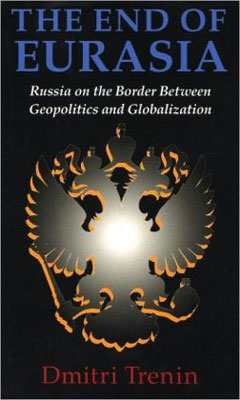
Trenin takes a look at the historical patterns of Russian territorial state formation, seeks to define the challenges and opportunities that Russia faces along its geopolitical fronts, and discusses various options for "fitting" Russia into the wider world.
Source: Washington

About the Author
Dmitri Trenin is deputy director of the Carnegie Moscow Center, where he specializes in foreign and security policy. He retired from the Russian Army in 1993 after a military career that included participation in the strategic arms control negotiations in Geneva. He is coeditor of Ambivalent Neighbors: The EU, NATO and the Price of Membership and coauthor of the forthcoming book Russia's Restless Frontier: The Chechnya Factor in Post-Soviet Russia (March 2004).
"This work is both the best and the most thought-provoking book on Russian foreign policy around, written by a Russian who is ahead of his time and the vast majority of his countrymen."
—Foreign Affairs
"Trenin presents a breath of fresh air with uncommon authenticity by turning the centuries-old Russian obsession with territorial expansion upside down...Well-written and recommended for upper-division undergraduates and graduate students."
—CHOICE
"An extraordinary and thought-provoking book on Russia's place in the world."
—The Japan Times
"This ambitious undertaking by a well-known author is a major contribution to both the literature in Russian area studies and theoretical research focusing on the development of political identity....The book successfully legitimates the study of geopolitics to answer important questions concerning shifts in national identity."
—International Politics
"A fascinating and pragmatic look at what potentially lies beyond the horizon for Russia...a must read for anyone trying to understand today's Russia."
—The Fletcher Forum of World Affairs
"A sober and incisive analysis..."
—Zbigniew Brzezinski
"Dmitri Trenin demolishes the windy concept of 'EuroAsia' and meticulously analyses Russia's place in the modern world. His coolly rational view is coming to be more widely shared in Russia, including, it seems by its current president. That is good news for the rest of us."
—Rodric Braithwaite, former British Ambassador to the USSR and to Russia
Former Director, Carnegie Moscow Center
Trenin was director of the Carnegie Moscow Center from 2008 to early 2022.
Recent Work
Dmitri Trenin
Dmitri Trenin
Carnegie does not take institutional positions on public policy issues; the views represented herein are those of the author(s) and do not necessarily reflect the views of Carnegie, its staff, or its trustees.

China’s banking crisis in the 2000s was resolved by transferring the costs to households through financial repression—a decision that recapitalized the banks while exacerbating the structural imbalances that continue to shape the Chinese economy today.

Michael Pettis

But their "principal to principal" model will only be as effective as the political strength of each leader back home.

Damien Ma

U.S. unpredictability has allowed China to capitalize on its positioning as the “responsible great power”. Paradoxically, the more China wins the perception game, the more likely expectations will rise for Beijing to deliver not just words but to demonstrate with its deeds.

Chong Ja Ian

Hanoi and Beijing have long treated each other as distant cousins rather than comrades in arms. That might be changing as both sides draw closer to hedge against uncertainty and America’s erratic behavior.

Nguyễn Khắc Giang

Across Asia, China is better positioned to withstand energy shocks from the fallout of the Iran war. Its abundant coal capacity can ensure stability in the near term. Yet at the same time, the country’s energy transition away from coal will make it even less vulnerable during the next shock.
Damien Ma