

Commentary
Alexey Malashenko
Source: Getty
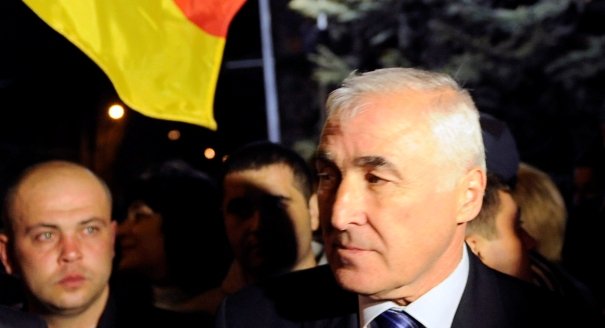
The voting results of the South Ossetian presidential election reflect the maturity of society in this republic.
The South Ossetian presidential election runoff on April 8 brought no surprises. As the experts predicted, Leonid Tibilov, former head of the republic’s KGB security service, won the race.
But attention is still focused on events in South Ossetia even after the election.
The first reason for this is that Tibilov won more than 53 percent of the vote, according to preliminary results, while his rival, David Sanakoyev, got almost 43 percent. The race between them was quite close and voters did not form the “monolithic” bloc they normally do in the Russian North Caucasus republics. This shows that people in this tiny quasi-state want to and can express their own opinions. The voting results do not indicate a split in society, but rather reflect the maturity of a society in which people have a sense of civic awareness.Second, in this situation, the Kremlin refrained from “hinting” to South Ossetia’s voters who they should vote for, as was the case in the November 2011 presidential election (the results of which were invalidated). Moscow thus showed that it is capable of recognizing its mistakes. It will now have to think about what future line to take in the republic (although it should be noted that none of the candidates in the election questioned South Ossetia’s unequivocally pro-Russian orientation).
Third, Tibilov will clearly have to form a coalition or national unity government, including with his opponents. One of those who will be offered a place in the new government will be the charismatic Alla Dzhioyeva, who won the November election but was prevented from taking part in the latest election. South Ossetia’s political landscape would be incomplete without her.
And finally, Tibilov will have to tackle the “Augean Stables” of problems inherited from previous South Ossetian leader Eduard Kokoity. Will he be up to the Herculean task? This is what the voters hope for—both those who gave him their support and those who voted for Sanakoyev. On the one hand, this work can become a cause for bringing the society together. But on the other hand, finding and punishing those guilty of embezzling money that was supposed to be spent on rebuilding the republic after the 2008 war could inflame the domestic situation.
No matter what one’s view is of South Ossetia, which remains unrecognized by most countries, one thing is clear: it suddenly appears more democratic than any of its neighbors to the north and south, and its people have received (or more precisely, have won) the right to express their will freely. The question now is how South Ossetia’s people will use this right.
Former Scholar in Residence, Religion, Society, and Security Program
Malashenko is a former chair of the Carnegie Moscow Center’s Religion, Society, and Security Program.
Recent Work
Alexey Malashenko
Alexey Malashenko
Carnegie does not take institutional positions on public policy issues; the views represented herein are those of the author(s) and do not necessarily reflect the views of Carnegie, its staff, or its trustees.

But their "principal to principal" model will only be as effective as the political strength of each leader back home.

Damien Ma

U.S. unpredictability has allowed China to capitalize on its positioning as the “responsible great power”. Paradoxically, the more China wins the perception game, the more likely expectations will rise for Beijing to deliver not just words but to demonstrate with its deeds.

Chong Ja Ian

Hanoi and Beijing have long treated each other as distant cousins rather than comrades in arms. That might be changing as both sides draw closer to hedge against uncertainty and America’s erratic behavior.

Nguyễn Khắc Giang

Across Asia, China is better positioned to withstand energy shocks from the fallout of the Iran war. Its abundant coal capacity can ensure stability in the near term. Yet at the same time, the country’s energy transition away from coal will make it even less vulnerable during the next shock.
Damien Ma

In the latest Five-Year Plan, the Chinese president cements the shift to an innovation-driven economy over a consumption-driven one.
Damien Ma