Afghanistan’s 2004 constitution created a framework for national progress, especially by recognizing women’s rights, but it repeatedly failed to resolve key disputes about state power. The coinciding of Afghanistan’s latest elections and renewed peace talks with the Taliban may now create a new path forward.
Fresh off concluding an agreement between the United States and the Taliban in late February 2020, U.S. Special Representative for Afghanistan Reconciliation Zalmay Khalilzad flew to Kabul. Once there, he needed not only to sell the government of Afghanistan on the peace deal but also to try to mediate a lingering dispute over the country’s September 2019 presidential election.
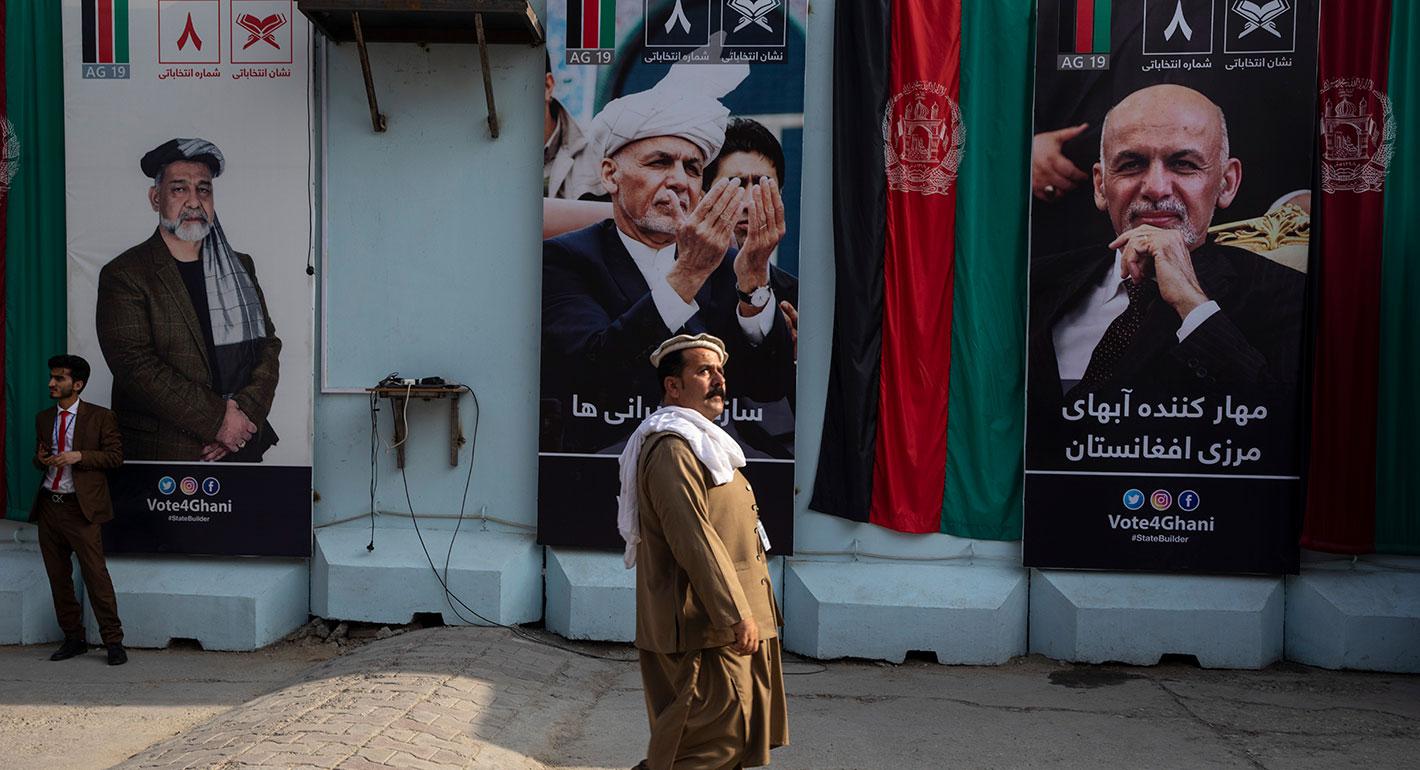
The Afghan electoral commission announced on February 18 that President Ashraf Ghani won 50.6 percent of the vote—pushing Ghani just above the 50 percent threshold for avoiding a second round runoff. His erstwhile partner, former chief executive of Afghanistan’s national unity government, Abdullah Abdullah, won 39.5 percent. Abdullah immediately challenged the result, further undermining the credibility of an election marred by low turnout and a contentious, six-month-long ballot count.
Yet Khalilzad was on well-trod ground: Every Afghan presidential election has been brokered or mediated by U.S. diplomats, though Washington seems to ride in later and later each time.
A Problem With Constitutional Roots
Afghanistan depends on U.S. support to conclude its elections because its constitution is remarkably ill-suited to the realities of its politics. It has a highly unitary state with strong presidential powers. The Afghan parliament is weak and not seen as especially legitimate due to a majoritarian system of representation that leads to many wasted votes and quixotic outcomes. As a result, the winner of presidential elections really does take all.
In a highly fractured political environment with strong local actors exercising control or influence over military and police forces, this system becomes dysfunctional. Because the formal institutions of the state do not provide tools to create constitutional versions of power sharing that reflect national realities, Kabul has come to depend on Washington as an external broker to negotiate extraconstitutional solutions.
The Cycle of U.S. Interventions
In 2004, then Afghan president Hamid Karzai claimed victory over his closest rival by nearly 40 percentage points—a result largely preordained by his selection to lead an interim administration in 2001 and his confirmation as transitional president in 2002, after the United States pressured his competitors to leave the race.
Karzai’s reelection in 2009 was more complicated. Although then U.S. Special Representative for Afghanistan and Pakistan Richard Holbrooke made clear his dissatisfaction with Karzai, the United States did not become deeply involved until after the first round of the contest, which was riddled with fraud. John Kerry, then chairman of the Senate Foreign Relations Committee, jumped in to persuade Karzai to accept a second round after he appeared to fall just short of the 50 percent threshold, though runner-up Abdullah eventually declined.
In 2014, the United States stayed on the sidelines until after a second-round runoff election. Abdullah had a lead in the first round, but Ghani won the second contest after minor candidates rallied to him. There was massive fraud in both rounds, and the state seemed to be teetering on the brink of a coup or another violent confrontation. Kerry, by then serving as the secretary of state, personally brokered both a system to assess fraud and a unity government.
A Way Forward?
In 2020, the United States is again seeking to help Afghanistan establish an inclusive government, but it has engaged so late in the process that Ghani and Abdullah have already hosted dueling inaugurations. Khalilzad appears to have used this challenging political situation to win concessions from Ghani to keep the Taliban peace process moving forward, but the repeated failure of national elections to produce workable results has deeper implications for any peace negotiations. Divisions in Kabul threaten to undermine the positions of the Afghan government and legitimate opposition groups in confronting the Taliban.
The shortcomings of Afghanistan’s constitutional system create both complications and opportunities for negotiators. Human rights activists and other modernizers want the government and the international community to insist that the rights recognized by the constitution be preserved, but the Taliban demands a new constitution and has achieved enough military prowess to enforce this demand. Even if that were not true, a political system that cannot manage disputes without the Taliban cannot possibly manage disputes once its leaders are included. Sticking to the current constitution would almost certainly lead to a failed government.
Preserving the constitution is thus an unrealistic goal for Afghan negotiators. The difficult but more realistic trick would be to simultaneously preserve the constitution’s human rights protections, repair its institutional defects, and shift the country from a unitary, winner-take-all electoral system to one that accommodates Kabul’s power-sharing realities.