

Commentary
Judy Dempsey
{
  "authors": [
    "Judy Dempsey"
  ],
  "type": "commentary",
  "blog": "Strategic Europe",
  "centerAffiliationAll": "",
  "centers": [
    "Carnegie Endowment for International Peace",
    "Carnegie Europe"
  ],
  "collections": [],
  "englishNewsletterAll": "",
  "nonEnglishNewsletterAll": "",
  "primaryCenter": "Carnegie Europe",
  "programAffiliation": "",
  "programs": [],
  "projects": [],
  "regions": [
    "Europe"
  ],
  "topics": [
    "Climate Change"
  ]
}
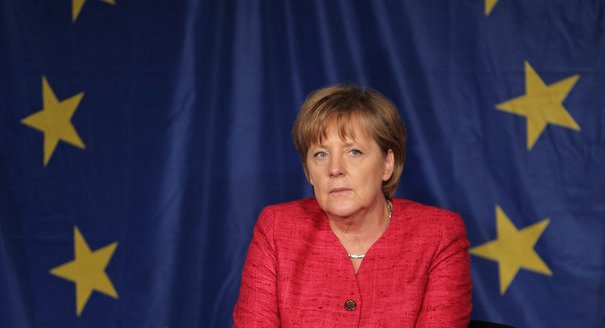
Source: Getty
Germans wants its finances brought under control, even if that means savings.
There’s nothing like a evening gown worn by a leading public figure to attract photographers. That was exactly the effect German Chancellor Angela Merkel’s dress had on the media last Wednesday.
As Merkel led the parade of distinguished guests to the opening of this year’s Bayreuth Festival, the cameras flashed at her metallic blue dress. But wait a minute. It wasn’t a new dress. Merkel had worn the same one four years ago.
You can guess the headlines.
“The cost-cutting chancellor recycles her dress,” said Bild, the conservative-leaning mass circulation daily newspaper.
The leftish Frankfurter Rundschau daily praised Merkel’s thriftiness. “It’s a time of belt-tightening for everyone,” it wrote.
And the weekly news magazine Der Spiegel, said Merkel was practicing what she preached during these times of economic crisis. “Frugality and down-to-earth-ness.”
But a closer look at the state of Germany’s finances reveals that it is not only at odds with Merkel’s dress attire. It is especially at odds with her constant badgering of Greeks and Spaniards and any other eurozone country embroiled in debt.
Merkel has repeatedly told these governments that they have to bring their budget deficits and public debt under control. This means reducing pensions, lengthening the working day, as well as slimming the public sector.
Merkel, once or twice, also said that Germany appreciated what these countries were going through. After all, she explained, Germany had also experience such pain in the past.
Germany’s finance minister, Wolfgang Schauble, has been very successful in cutting the budget deficit, but not through savings.
Thanks to record low levels of unemployment, income tax revenue has increased thus giving the finance ministry a windfall.
This has allowed Schauble to make headway in bringing the budget deficit down to 0.8 percent of gross domestic product.
Not bad, especially since that was achieved without hardly any real savings, reforms, or cuts.
As the Kiel Institute for the World Economy recently said: “The German state is not ambitious enough in its cost-saving endeavors. It is simply sitting back and enjoying soaring tax revenues.”
If you want to know how much more effort is really needed, look at Germany’s record public debt which soared in the wake of the 2008 to 2009 financial crisis when Berlin had to spend hundreds of billions to save banks and prop up the economy.
By the end of March of this year, the public debt grew to 2.09 trillion euro. That’s a rise of 42.3 billion euro over the previous year, according to figures recently released by the Bundesbank – Germany’s Central Bank.
What’s more, the ratio of debt to gross domestic product at the end of 2011 amounted to 81.2 percent. That, by the way, is much higher than Spain’s (68.5 percent). It is also well over the 60 percent level that is permitted by the EU’s stability rules, despite Berlin preaching to other EU countries to respect the bloc’s rules.
As a reminder of how vulnerable this high level of debt makes Germany to the whims of the financial markets, Moody’s, the rating agency, downgraded its outlook on Germany last week, sending shivers through the corridors of the finance ministry in Berlin.
Not surprisingly, opinion polls for the past few years have consistently shown that the public wants the government to reduce the budget deficit and rein in the public debt. It is willing to forgo tax cuts to achieve these goals.
Yet Merkel took a while to understand this shift in public opinion. When she was re-elected in 2009, one of the first things her government did was to cut the value added tax, or sales tax for the hotel industry.
Merkel agreed to this in order to placate coalition partners, the quarrel some Free Democrats who enjoy close ties to the hotel lobby. She then was surprised by the outcry over both the profligacy and the clientelism involved.
This episode could be a warning to Merkel as she prepares for next year’s federal elections.
Of course, the government will be tempted to spend more. I’m not so sure the public will buy into that. Germans, this time round, do not want their finances held hostage to their votes.

Nonresident Senior Fellow, Carnegie Europe
Dempsey is a nonresident senior fellow at Carnegie Europe
Recent Work
Judy Dempsey
Judy Dempsey
Carnegie does not take institutional positions on public policy issues; the views represented herein are those of the author(s) and do not necessarily reflect the views of Carnegie, its staff, or its trustees.
The war in Iran proves the United States is now a destabilizing actor for Europe and the Arab Gulf. From protect their economies and energy supplies to safeguarding their territorial integrity, both regions have much to gain from forming a new kind of partnership together.

Rym Momtaz
French President Emmanuel Macron has unveiled his country’s new nuclear doctrine. Are the changes he has made enough to reassure France’s European partners in the current geopolitical context?
Rym Momtaz, ed.
European reactions to the war in Iran have lost sight of wider political dynamics. The EU must position itself for the next phase of the crisis without giving up on its principles.

Richard Youngs
Europe isn’t as weak in the new geopolitics of power as many would believe. But to leverage its assets and claim a sphere of influence, Brussels must stop undercutting itself.

Dimitar Bechev
Europe’s reaction to the war in Iran has been disunited and meek, a far cry from its previously leading role in diplomacy with Tehran. To avoid being condemned to the sidelines while escalation continues, Brussels needs to stand up for international law.

Pierre Vimont