

{
  "authors": [
    "Ashley J. Tellis"
  ],
  "type": "event",
  "centerAffiliationAll": "",
  "centers": [
    "Carnegie Endowment for International Peace",
    "Carnegie Europe"
  ],
  "collections": [],
  "englishNewsletterAll": "",
  "nonEnglishNewsletterAll": "",
  "primaryCenter": "Carnegie Endowment for International Peace",
  "programAffiliation": "",
  "programs": [],
  "projects": [],
  "regions": [
    "South Asia",
    "India",
    "Afghanistan",
    "Pakistan",
    "Asia"
  ],
  "topics": [
    "Security",
    "Foreign Policy"
  ]
}
Carnegie Live... The Aftermath of the Mumbai Attacks
Fri, December 5th, 2008
Brussels
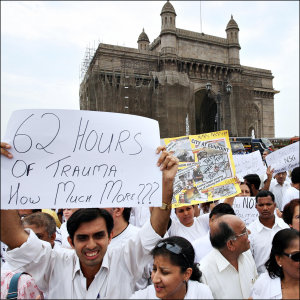
IMGXYZ1059IMGZYXThe terrorist attacks in Mumbai have led to heightened tensions in what was already a volatile region. Of particular concern is that the improving relationship between Pakistan and India has been brought to a halt with threats of military action coming from both sides.
Carnegie's Ashley J. Tellis briefed members of the European foreign policy community on avoiding a Pakistan-India war, the investigation into the attacks, Lashkar-e-Taiba (LeT), and the response of the international community.
- Tellis questioned the capacity of the Pakistani civilian government to conduct a thorough investigation into the attacks, explaining that the civilian government is relatively weak vis-à-vis the military and the intelligence agencies.
- India will need to review its law and order structures. At present, law and order is left almost entirely in the hands of the states, leading to ineffective counterterrorism strategies. It will also need to implement a better strategy for dealing with hostage situations through the creation of small tactical units.
- The LeT’s activities are not limited to the Indian subcontinent, and their vision is extensive. They have operations in the UK, Spain, Australia and the U.S., for instance. European intelligence agencies will need to closely watch LeT fundraising, sleeper cells, and recruitment activities.
Carnegie does not take institutional positions on public policy issues; the views represented herein are those of the author(s) and do not necessarily reflect the views of Carnegie, its staff, or its trustees.
Event Speaker
Former Senior Fellow
Ashley J. Tellis was a senior fellow at the Carnegie Endowment for International Peace.