

Commentary
Excitement is in the air following Aleksandar Vučić’s defeat in Serbia. To build a truly democratic state, the movement that unseated the former president must learn from the mistakes of the past.
Ivan Vejvoda
{
  "authors": [
    "Nathan J. Brown",
    "Amr Hamzawy"
  ],
  "type": "legacyinthemedia",
  "centerAffiliationAll": "dc",
  "centers": [
    "Carnegie Endowment for International Peace"
  ],
  "collections": [],
  "englishNewsletterAll": "menaTransitions",
  "nonEnglishNewsletterAll": "",
  "primaryCenter": "Carnegie Endowment for International Peace",
  "programAffiliation": "MEP",
  "programs": [
    "Middle East"
  ],
  "projects": [],
  "regions": [
    "Middle East",
    "Egypt"
  ],
  "topics": [
    "Political Reform",
    "Democracy"
  ]
}
Source: Getty
Source: The Daily Star

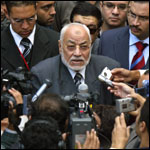
The Egyptian election results - where the Brotherhood won 76 seats in the People's Assembly, up from 17 previously - were startling. However, they should not deter the American government's newfound interest in Middle East democracy. The election results will not bring the Muslim Brotherhood to power, having only led to their forming a sizable opposition bloc. This outcome opens an opportunity for building government-opposition relations on a more democratic basis than has existed in Egypt for generations.
Egypt's Muslim Brotherhood, established 1928, is not Al-Qaeda. Those who view the movement as violent can support their claim with some justification, not so much by the Brotherhood's actions - it has remained largely peaceful for half a century - than by the fact that it has granted ideological cover to more violent groups, such as Islamic Jihad.
However, in recent years, Brotherhood leaders have also made a strategic decision favoring political participation and gradual democratic openings as the only viable ways to challenge the regime of President Hosni Mubarak. The movement's current platform retains what its own leaders admit is "an emotional slogan," namely: "Islam is the solution." However, its detailed program focuses almost exclusively on liberal political reform. Mohammad Habib, vice chairman of the Brotherhood, has identified the movement's priorities as abolition of restrictions imposed on establishing political parties, repeal of emergency laws, reinforcement of the power of Parliament and the judiciary against the executive, and the freeing of all political prisoners.
The Brotherhood does not come to its democratic program primarily through idealism. The Egyptian regime's most troubling authoritarian practices have been developed specifically for use against the Brotherhood and its supporters. And Brotherhood leaders currently feel their popular strength. Democratic reform is very much in the Brotherhood's interest.
Decades of limited political pluralism in Egypt have crippled secular opposition parties which, as the current elections proved, are marginal and decaying. By contrast, the Brotherhood has managed to develop networks of support and trust in the society by offering social and economic services. Lacking viable alternatives, many Egyptians are inclined to translate the Brotherhood's good credit into votes. Beyond its impressive organizational structures and vast financial resources, the movement has also cultivated an ethos of personal rectitude and community service among its cadres. Votes for the Brotherhood are not merely protests against the existing order, but also affirmations of support for an effective and non-corrupt alternative.
The Brotherhood's embrace of political reform has not led it to abandon approaches that disturb liberals. Its conception of the role of women, while it has progressed, remains rooted in a conservative understanding of religion. And the Brotherhood's position on Egypt's Christian Coptic minority remains ambivalent. There is legitimate reason to doubt whether the Brotherhood is truly committed to the modern principle of citizenship that it has begun to espouse. It may still lean on more exclusivist conceptions, in which Copts are merely a tolerated minority.
American concerns regarding the Brotherhood relate to foreign policy issues as well. Here the movement has tried to calm matters. Its leader, Mohammad Mehdi Akef, has indicated in recent press statements that the Brotherhood would respect all treaties signed by the Egyptian government, including the peace treaty with Israel. Yet the fact remains that the Brotherhood takes political positions and uses rhetoric that are unfriendly both to the United States and Israel.
But democratic transition will not occur by waiting for liberal democratic forces that precisely fit American policy positions. Democracy in the Arab world is far more likely to emerge from the daily tussles of a political process in which the current rulers and their opponents come to realize that they cannot vanquish each other. The strong showing of the Muslim Brotherhood in Egypt's parliamentary elections can thus contribute to democratization if it leads the regime to find ways to accommodate the movement's popularity and demands for political reform.
The Bush administration may come under pressure from Mubarak to regard the Brotherhood's gains as a security challenge rather than a political one. If the U.S. succumbs to this darker view, it may prompt a return to the stalemate of the 1990s, when regimes and Islamist movements battled each other in less polite locations than on the campaign trail.
Nathan Brown and Amr Hamzawy are senior associates in the Democracy and Rule of Law Project at the Carnegie Endowment for International Peace in Washington. They wrote this commentary for THE DAILY STAR.

Nonresident Senior Fellow, Middle East Program
Nathan J. Brown, a professor of political science and international affairs at George Washington University, is a distinguished scholar and author of nine books on Arab politics and governance, as well as editor of five books.

Director, Middle East Program
Amr Hamzawy is a senior fellow and the director of the Carnegie Middle East Program. His research and writings focus on Egypt’s and other middle powers’ involvement in regional security in the Middle East, particularly through collective diplomacy and multilateral conflict resolution
Carnegie does not take institutional positions on public policy issues; the views represented herein are those of the author(s) and do not necessarily reflect the views of Carnegie, its staff, or its trustees.
Excitement is in the air following Aleksandar Vučić’s defeat in Serbia. To build a truly democratic state, the movement that unseated the former president must learn from the mistakes of the past.
Ivan Vejvoda

A notable degree of participative democracy has firmly arrived in Europe. But to have more far-reaching impact, democratic deliberation needs to move into a radically new phase.

Richard Youngs

The domestic impacts of how long it is taking to end the war in Ukraine have pushed the French electorate to the political extremes and compromised the country’s diplomatic capacity.

Rym Momtaz

Before the next wave of EU enlargement takes place, the union needs to grapple with thorny questions of how power is distributed among its members.


Emil Sondaj Hansen, Ditte Brasso Sørensen

Radical-right parties are expected to do well in upcoming elections in four of the EU's biggest member states. If successful, they could prevent the union from addressing key challenges ahead.

Stefan Lehne