

Commentary
The new U.S.–Denmark–Greenland agreement will help Washington exert political, economic, and financial dominance under the guise of security. Yet, it acknowledged Copenhagen’s and Nuuk’s sovereignty on the island.
Marc Pierini
{
  "authors": [
    "Alexander Bessmertnykh",
    "James F. Collins",
    "Yuri Dubinin",
    "Arthur A. Hartman",
    "Victor Komplektov",
    "Vladimir Lukin",
    "Jack F. Matlock Jr.",
    "Thomas R. Pickering",
    "Yuli Vorontsov"
  ],
  "type": "legacyinthemedia",
  "centerAffiliationAll": "dc",
  "centers": [
    "Carnegie Endowment for International Peace"
  ],
  "collections": [],
  "englishNewsletterAll": "ctw",
  "nonEnglishNewsletterAll": "",
  "primaryCenter": "Carnegie Endowment for International Peace",
  "programAffiliation": "russia",
  "programs": [
    "Russia and Eurasia"
  ],
  "projects": [],
  "regions": [
    "North America",
    "United States",
    "Caucasus",
    "Russia"
  ],
  "topics": [
    "Foreign Policy"
  ]
}
Source: Getty
This year marks an important anniversary. In 1807, the Russian Empire and the young American Republic agreed to establish diplomatic relations. Soon after, Russia's first envoy, Alexander Dashkov, arrived in Washington, and John Quincy Adams traveled to St. Petersburg. Since this modest beginning, our relations, at their best and worst, have borne out de Tocqueville's prophecy that America and Russia are "marked out by the will of Heaven to sway the destinies of half the globe." Today, with the Cold War and immediate post-Soviet transition behind us, we face a new world in which an effective U.S.-Russian relationship is central to addressing many global challenges.
Source: International Herald Tribune

Russian and American ambassadors speak out.
This year marks an important anniversary. In 1807, the Russian Empire and the young American Republic agreed to establish diplomatic relations. Soon after, Russia's first envoy, Alexander Dashkov, arrived in Washington, and John Quincy Adams traveled to St. Petersburg.
Since this modest beginning, our relations, at their best and worst, have borne out de Tocqueville's prophecy that America and Russia are "marked out by the will of Heaven to sway the destinies of half the globe."
Today, with the Cold War and immediate post-Soviet transition behind us, we face a new world in which an effective U.S.-Russian relationship is central to addressing many global challenges.
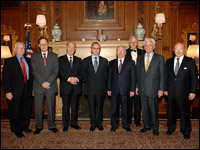
As American ambassadors to Moscow or Russian ambassadors to Washington, we are all direct descendants of those envoys who pioneered the bilateral conversation.
We are diplomats - not politicians - who represent a half-century of experience of "doing U.S.-Russian relations." We have come together on this diplomatic bicentennial at the Carnegie Endowment for International Peace in Washington to reflect on the prospects for U.S.-Russian relations.
Our careers have seen our countries face critical, at times existential, challenges. We have known the success of close cooperation when we defeated common foes and developed a safer world, but also the consequences of estrangement and rivalry.
Today, unprecedented globalization of communications, economic dynamism and the movement of people, goods and ideas have broken down traditional barriers and opened our nations to new and powerful influences for positive change. But change also brings with it new threats.
The threats posed by the proliferation of weapons of mass destruction, terrorism and organized crime, unprecedented stresses on our environment and energy security, and a host of unresolved and frozen regional conflicts are among the pressing issues that require joint attention. In these and many other areas, our two countries have the experience and responsibility to provide leadership.
Faced with so many important tasks, we cannot afford to let miscommunication or mistrust derail our relations. When we have pursued active dialog and creative diplomacy based on agreed principles, we have brought about positive change. How do we regain that relationship? What lessons have we learned?
First, America and Russia are large, complex nations with different histories, geography and cultures. It is normal and inevitable that we each see the world through the lens of our own national interests, compete in global economic and political affairs and have legitimate disagreements.
The task is to identify and advance shared interests even as we manage our differences and disagreements. As Ambassador Anatoly Dobrynin, who was instrumental in negotiating the Cuban missile crisis, wrote, "We should always be able to find a way to disagree without damaging a profoundly important strategic partnership."
Second, both countries have experienced profound change in the past quarter century. The Cold War's end and the dissolution of the Soviet Union into independent states brought a sea change across Europe and Eurasia, the consequences of which continue to reverberate. Russia has entered a difficult period of economic, social and political transformation as well as of reshaping its global and regional strategies. The United States has undergone the national shock of 9-11. The emergence of violent anti-U.S. extremism poses an imminent threat to Americans everywhere, challenging traditional U.S. policies, perceptions and priorities.
Third, U.S.-Russian relations work best when we avoid demonizing one another and hone in on common interests to develop shared solutions. For example, we have markedly improved our work together in combating terrorism. We must concentrate on opening new areas of cooperation in nuclear matters, including prevention of WMD proliferation.
Much remains to be done. There is growing concern that our successful arms control regime may disappear, with unacceptable consequences for the world. Present disagreements about missile defense in Europe, the shape of future security structures for Europe and how best to proceed in Kosovo have brought new tensions between us. Our diplomacy must find a way forward.
Fourth, as we begin our third diplomatic century, it is important to continue to rely on the power of diplomacy. Keeping our channels always open and busy spared us from nuclear annihilation in the 20th century and can help us surmount the threats that lie ahead. Today, in addition to regular diplomatic channels and contacts between leaders, we should explore further institutionalization of our dialog at the cabinet and sub-cabinet levels.
Finally, we need a wider conversation between our societies to strengthen the foundation of shared values. Encouraging the broadest possible open contacts among scientific, social, and religious organizations is equally important. To this end, our visa systems should facilitate exchange rather than hinder it.
Expanding our economic ties can also promote a more stable and predictable relationship. We must move beyond the WTO issue and remove politically motivated barriers that have held up U.S.-Russian commercial exchange so that Russia takes its place as a full member of the global trading community.
Our two countries have already proven themselves able to bridge wide political and cultural gaps. We can now work together in the broad context of democratic values and market economics. Today the U.S. and Russia need to build a well-defined new strategic framework for productive diplomacy to resolve old problems and meet new challenges. Our future work should be worthy of a third diplomatic century.
This article originally appeared in the International Herald Tribune online, September 24, 2007.
http://www.iht.com/articles/2007/09/24/news/edambass.php?page=1
Alexander Bessmertnykh
Nonresident Senior Fellow, Russia and Eurasia Program; Diplomat in Residence
Ambassador Collins was the U.S. ambassador to the Russian Federation from 1997 to 2001 and is an expert on the former Soviet Union, its successor states, and the Middle East.
Yuri Dubinin
Arthur A. Hartman
Victor Komplektov
Vladimir Lukin
Jack F. Matlock Jr.
Thomas R. Pickering
Yuli Vorontsov
Carnegie does not take institutional positions on public policy issues; the views represented herein are those of the author(s) and do not necessarily reflect the views of Carnegie, its staff, or its trustees.

The new U.S.–Denmark–Greenland agreement will help Washington exert political, economic, and financial dominance under the guise of security. Yet, it acknowledged Copenhagen’s and Nuuk’s sovereignty on the island.

Marc Pierini

A summer of escalation in the Black Sea has hurt Ukraine economically and is exacerbating world food security. A truce is needed—as is a broader reframing of Europe’s Ukraine strategy.

Thomas de Waal

Are Germany’s economic, industrial, and political struggles becoming a liability for the EU’s ability to rise to the geopolitical moment?

Rym Momtaz, ed.

European Commission President Ursula von der Leyen is about to give her annual address on the state of the EU. Here’s what she won’t—but should—say.
Rym Momtaz

Radical-right parties are expected to do well in upcoming elections in four of the EU's biggest member states. If successful, they could prevent the union from addressing key challenges ahead.

Stefan Lehne