• Research
  • Strategic Europe
  • About
  • Experts
Carnegie Europe logoCarnegie lettermark logo
EUUkraine
  • Donate
{
  "authors": [
    "Karim Sadjadpour"
  ],
  "type": "other",
  "centerAffiliationAll": "dc",
  "centers": [
    "Carnegie Endowment for International Peace"
  ],
  "collections": [],
  "englishNewsletterAll": "menaTransitions",
  "nonEnglishNewsletterAll": "",
  "primaryCenter": "Carnegie Endowment for International Peace",
  "programAffiliation": "MEP",
  "programs": [
    "Middle East"
  ],
  "projects": [],
  "regions": [
    "North America",
    "United States",
    "Middle East",
    "Iran"
  ],
  "topics": [
    "Security",
    "Military",
    "Foreign Policy",
    "Nuclear Policy"
  ]
}
Source: Getty

Other

Iran: Is Productive Engagement Possible?

Iran continues to be a critical national security challenge for the United States, despite decades of effort to change Tehran’s behavior by isolating the country politically and economically. The relevant question is not whether to talk to Iran but how. Engagement should focus on six critical issues: Iraq, Afghanistan, nuclear proliferation, the Arab–Israeli conflict, energy, and terrorism.

Link Copied
By Karim Sadjadpour
Published on Oct 16, 2008

Iran continues to be a critical national security challenge for the United States, despite decades of effort to change Tehran’s behavior by isolating the country politically and economically. A different approach is required. In a new policy brief, Karim Sadjadpour explains that the relevant question is not whether to talk to Iran but how to talk to Iran, and prioritizes U.S. engagement with Iran on six critical issues: Iraq, Afghanistan, nuclear proliferation, the Arab–Israeli conflict, energy, and terrorism.  

The next U.S. president should:
  • Focus initially on areas where the United States and Iran share common interests, such as Iraq and Afghanistan, rather than issues with little or no common interest, like the nuclear issue or the Israeli–Palestinian conflict.
     
  • Refrain from any grand overtures to Tehran which risk redeeming Iranian President Ahmadinejad’s policies and enhancing his bid for reelection in June of 2009. 
     
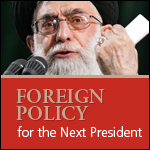
  • Deal with those who hold power in Iran, namely Supreme Leader Ayatollah Ali Khamenei.
     
  • Avoid rhetoric that threatens violence. This only empowers Tehran’s hard-liners and paints the United States as the aggressor.
     
  • Maintain a multilateral approach. Tehran is highly adept at exploiting rifts in the international community.
     
  • Resist attempts by spoilers within Iran to torpedo a diplomatic breakthrough. 
     
  • Pursue “secret” or “private” discussions—proven to have a greater success rate.
     
  • Support policies that facilitate, rather than impede, Iran’s modernization and reintegration in the global economy.
 Sadjadpour concludes with a note of caution:
 
“Around the same time the next U.S. president is inaugurated, the Iranian revolution will mark its thirtieth anniversary. Given three decades of compounded mistrust and ill will, the results of any process of engagement will not be quick; such antagonism will not melt away after one, two, or even many meetings. The initial pace will likely be painfully slow, as each side ascertains whether the other truly has good intentions. Furthermore, given the potentially enormous implications that a changed relationship with Washington would have for the Islamic Republic’s future, there are a variety of reasons why even a sincere, sustained American attempt at dialogue may not initially bear fruit.”

About the Author
Karim Sadjadpour
, a leading researcher on Iran, joined Carnegie as an associate after four years as the chief Iran analyst at the International Crisis Group based in Tehran and Washington, D.C. Sadjadpour has conducted dozens of interviews with senior Iranian officials, and hundreds with Iranian intellectuals, clerics, dissidents, paramilitaries, businessmen, students, activists, and youth, among others.

About the Author

Karim Sadjadpour

Senior Fellow, Middle East Program

Karim Sadjadpour is a senior fellow at the Carnegie Endowment for International Peace, where he focuses on Iran and U.S. foreign policy toward the Middle East.

    Recent Work

  • Q&A
    What’s Keeping the Iranian Regime in Power—for Now

      Aaron David Miller, Karim Sadjadpour, Robin Wright

  • Q&A
    How Washington and Tehran Are Assessing Their Next Steps

      Aaron David Miller, David Petraeus, Karim Sadjadpour

Karim Sadjadpour
Senior Fellow, Middle East Program
Karim Sadjadpour
SecurityMilitaryForeign PolicyNuclear PolicyNorth AmericaUnited StatesMiddle EastIran

Carnegie does not take institutional positions on public policy issues; the views represented herein are those of the author(s) and do not necessarily reflect the views of Carnegie, its staff, or its trustees.

More Work from Carnegie Europe

  • Commentary
    Strategic Europe
    Russia’s Imperial Retreat Is Europe’s Strategic Opportunity

    The war in Ukraine is costing Russia its leverage overseas. Across the South Caucasus and Middle East, this presents an opportunity for Europe to pick up the pieces and claim its own sphere of influence.

      William Dixon, Maksym Beznosiuk

  • Commentary
    Is the Radical-Right Threat Existential or Overstated?

    Amid increased polarization and the influence of disinformation, radical-right parties are once again gaining traction across Europe. With landmark elections on the horizon in several countries, are the EU’s geostrategic vision and fundamental values under existential threat?

      Catherine Fieschi, Cas Mudde

  • Commentary
    Strategic Europe
    Europe and the Arab Gulf Must Come Together

    The war in Iran proves the United States is now a destabilizing actor for Europe and the Arab Gulf. From protect their economies and energy supplies to safeguarding their territorial integrity, both regions have much to gain from forming a new kind of partnership together.

      • Rym Momtaz

      Rym Momtaz

  • Commentary
    Strategic Europe
    Taking the Pulse: Is France’s New Nuclear Doctrine Ambitious Enough?

    French President Emmanuel Macron has unveiled his country’s new nuclear doctrine. Are the changes he has made enough to reassure France’s European partners in the current geopolitical context?

      • Rym Momtaz

      Rym Momtaz, ed.

  • Commentary
    The Iran War’s Dangerous Fallout for Europe

    The drone strike on the British air base in Akrotiri brings Europe’s proximity to the conflict in Iran into sharp relief. In the fog of war, old tensions in the Eastern Mediterranean risk being reignited, and regional stakeholders must avoid escalation.

      Marc Pierini

Get more news and analysis from
Carnegie Europe
Carnegie Europe logo, white
Rue du Congrès, 151000 Brussels, Belgium
  • Research
  • Strategic Europe
  • About
  • Experts
  • Projects
  • Events
  • Contact
  • Careers
  • Privacy
  • For Media
  • Gender Equality Plan
Get more news and analysis from
Carnegie Europe
© 2026 Carnegie Endowment for International Peace. All rights reserved.