

Commentary
Nikolay Petrov
{
  "authors": [
    "Nikolay Petrov"
  ],
  "type": "legacyinthemedia",
  "centerAffiliationAll": "",
  "centers": [
    "Carnegie Endowment for International Peace",
    "Carnegie Russia Eurasia Center"
  ],
  "collections": [],
  "englishNewsletterAll": "",
  "nonEnglishNewsletterAll": "",
  "primaryCenter": "Carnegie Russia Eurasia Center",
  "programAffiliation": "",
  "programs": [],
  "projects": [],
  "regions": [
    "Caucasus",
    "Russia"
  ],
  "topics": [
    "Political Reform"
  ]
}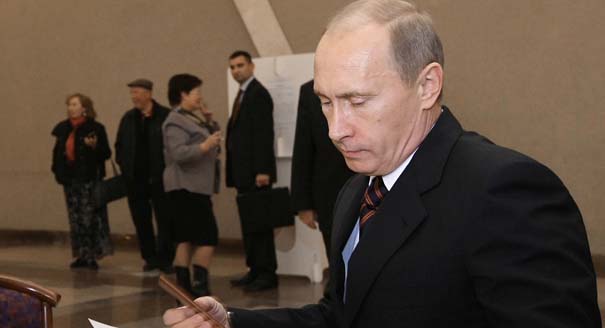
Source: Getty
The results of Russia's recent regional elections are of less importance than the fact that United Russia is gradually transforming from a monolithic bureaucracy under strict Kremlin control into something resembling a true political party.
Source: The Moscow Times

The party's losses in the eyes of the public are probably of less significance than its loss of status among the regional political elites. United Russia's greatest setbacks occurred not only in major cities with their large -- and less-controllable -- voter populations, but also among the Caucasus republics. United Russia on average lost about 10 percent of its usual voter base, but in Kabardino-Balkaria and Karachayevo-Cherkessia the losses stood at 25 percent. That signals the end of United Russia's monopoly among the administrative elite in the regions.
In rebuttal, party functionaries could stress that United Russia retained its strong standing in Tatarstan, with 80 percent of the vote as compared to 81 percent in 2007. But they understand perfectly well that those numbers cannot be attributed to the party's federal leadership.
The leaders of the three major rival parties -- the Communist Party, A Just Russia and the Liberal Democratic Party -- are also reporting success. The Communist Party received from 50 percent to 100 percent more votes across the board than it did in 2007, earning a presence in all nine regional parliaments and finishing a strong second after United Russia. One notable exception to this: The Patriots of Russia came out ahead of the Communists in Karachayevo-Cherkessia. The Patriots of Russia also had good results in Khakasia, but this party is no threat to the Communist Party as it participated in only three of the nine regional parliamentary elections.
A Just Russia has experienced noticeably better results this year and finished on par with the Communists in two or three regions. It even surpassed the Communists in the Kabardino-Balkaria and Arkhangelsk regions, but failed to gain parliamentary seats in Karachayevo-Cherkessia and Tatarstan. A Just Russia even lost ground in the Vladimir and Bryansk regions. The Liberal Democratic Party is celebrating that it gained seats in seven regional parliaments.
Rumors that the Kremlin is tired of the Liberal Democratic Party and plans to shove it aside have once again proven unfounded.
The picture turns out to be more interesting and varied on the municipal level. That is where candidates' personal influence plays an even greater role, and the state's rigid control of the political machine is less apparent. United Russia claimed victories in Novosibirsk, Chelyabinsk, Chita, Birobidzhan and Blagoveshchensk, where the incumbent mayors were re-elected by wide margins. In cities where a runoff election is required -- Smolensk, Murmansk, Petropavlovsk-Kamchatsky and Tomsk -- United Russia's incumbent mayors either already lost in the first round on Sunday or stand a good chance of losing once the opposition voters consolidate their support for a single candidate in the second round. In Tver, the Communist Party walked way with a clear victory, bringing in twice the number of votes as United Russia in the city's legislature. United Russia failed to achieve 40 percent representation in the city legislatures in Bryansk, Ulan-Ude and Tolyatti. In Tolyatti, second place went to the opposition movement December that includes representation from Yabloko and Right Cause.
Not only the participating parties but the entire electoral system passed the test of whether it could function under crisis conditions. Although the country is still very much struggling with overcoming the economic crisis, it has entered a new phase of political activity.
United Russia's weakness, which was clearly demonstrated during Sunday's elections, will only increase with time. Here the hard numbers from the election results are of less importance than the growing political rivalry within the party, disagreements between the party's regional and federal leadership and the conflicts between United Russia and local political elites that surfaced even during the last elections two years ago. United Russia is gradually transforming from a monolithic bureaucracy under strict Kremlin control into something resembling a true political party. In just a short time, United Russia might lose its standing as the dominant party.
The Kremlin faces another problem from the loyal "opposition parties" in the Duma. As they gain more voter support, their loyalty to the Kremlin will dissipate. On the other hand, the current mood of protest will probably not provide them with significant long-term support in a system dominated by United Russia and its spinoff parties in the Duma.
Real liberalization of the party and electoral systems is inevitable, and it must supplant the current, merely decorative system under President Dmitry Medvedev. If the Kremlin doesn't take concrete steps in that direction by the next elections, the growing pressure from dissatisfied voters with no place to vent their anger will simply blow the lid right off the kettle.
This comment first appeared in The Moscow Times
Former Scholar-in-Residence, Society and Regions Program, Moscow Center
Nikolay Petrov was the chair of the Carnegie Moscow Center’s Society and Regions Program. Until 2006, he also worked at the Institute of Geography at the Russian Academy of Sciences, where he started to work in 1982.
Recent Work
Nikolay Petrov
Nikolay Petrov
Carnegie does not take institutional positions on public policy issues; the views represented herein are those of the author(s) and do not necessarily reflect the views of Carnegie, its staff, or its trustees.

The EU’s responses to two recent incidents expose the gulf between European perceptions and capabilities. Unless the union can bridge that gap, it will never become a real geostrategic power.

Rym Momtaz

European states control several Overseas Countries and Territories around the world that carry strategic, economic, and environmental weight. As great powers challenge the rules-based order, defending them is a geopolitical imperative for Europe.

Marc Pierini

In supporting Europe’s far-right, MAGA and Russia both want the same thing: a weaker EU. Europe must defend itself without abandoning the openness these forces exploit.

Armida van Rij
As we close out another season of Strategic Europe, it is worth taking stock of the deep shifts underway.
Rym Momtaz
The hybrid warfare landscape is evolving rapidly, leaving policymakers without clear strategies. To better inform their work in addressing emerging challenges, governments must dig deeper into the underlying dynamics at play.

Raluca Csernatoni, Alicia Wanless