

Commentary
Russia is testing the waters of NATO’s mutual defense clause. What do strikes in Romanian territorial waters mean for the alliance’s posture toward Moscow?
Dimitar Bechev
{
  "authors": [
    "Nicu Popescu",
    "Tiago Antunes"
  ],
  "type": "commentary",
  "blog": "Strategic Europe",
  "centerAffiliationAll": "",
  "centers": [
    "Carnegie Endowment for International Peace",
    "Carnegie Europe"
  ],
  "englishNewsletterAll": "",
  "nonEnglishNewsletterAll": "",
  "primaryCenter": "Carnegie Europe",
  "programAffiliation": "",
  "regions": [
    "Europe",
    "Ukraine",
    "Russia",
    "United States"
  ],
  "topics": [
    "EU",
    "Foreign Policy"
  ]
}
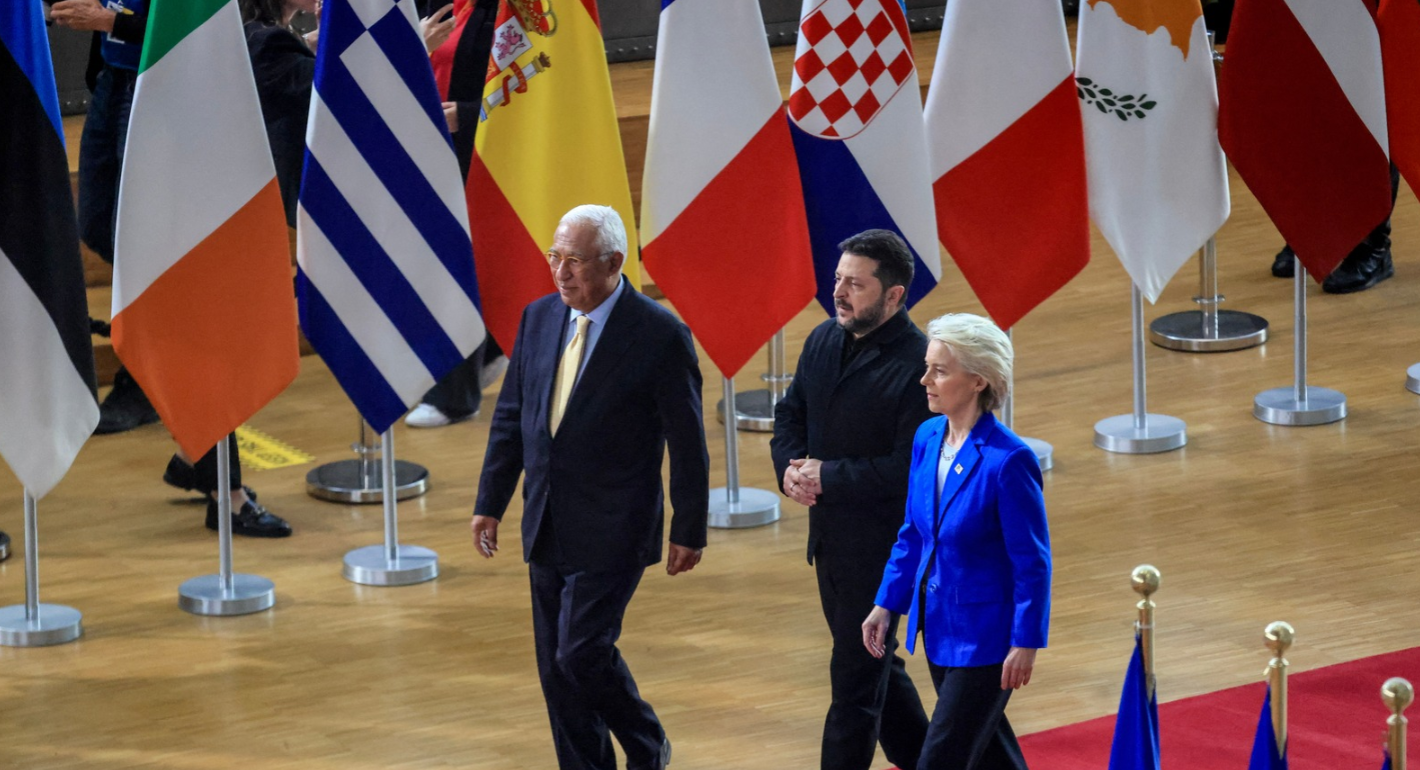
Source: Getty
The EU can impose sanctions but struggles to enforce them without the United States. With Washington increasingly disinterested in backing European interests, the bloc must now fend for itself.
It is time for Europeans to get more serious about enforcing their own sanctions regimes.
Despite an extensive raft of punitive measures adopted since Russia’s full-scale invasion of Ukraine in 2022, Russian cruise and ballistic missiles, drones, and armored vehicles are still using components made in Germany, Japan, the Netherlands, South Korea, Switzerland, the UK, and the United States.
By August 2026, Ukrainians had identified 5,816 such components in 202 Russian weapons systems that were shot down or landed unexploded in Ukraine. Some of those parts are quite new—produced in 2025 or even 2026—according to Ukrainian officials.
The EU does not have a central agency to enforce its sanctions. And it’s time it gets one.
For years or even decades, Europeans have mostly relied on the United States to do this work on any meaningful scale. Just as they relied on the American nuclear umbrella, Tomahawk cruise missiles, or F-35 fighter jets in the military sphere, so too they relied on the U.S. sanctions-enforcement arm—the Office of Foreign Assets Control (OFAC). This is a team of up to 250 officials tracing, chasing, and pressing countries to comply with U.S. sanctions, which often coincided with European ones.
However, political priorities in Washington and EU sanctions-enforcement regimes are increasingly divergent. Therefore, OFAC does much less of what Europeans need than it used to. There is not only a growing indifference to European priorities but also an increasing potential for the office to act against the continent’s interests. The sanctioning of a former European commissioner who championed the EU Digital Services Act, or of the International Criminal Court, might be indicative of a trend. There have also been recent threats over the EU’s possible spectrum-use restrictions for Starlink after the satellite internet service had its speed throttled in Ukraine. It would pose a problem for Europe’s sanctions to exist without that enforcement, or worse, if the United States and specifically OFAC were to act indifferent to or openly detrimental toward European interests.
In the EU, sanctions compliance is pursued at the national level. Even putting aside the fact that different governments have different appetites and capacities for sanctions enforcement, national authorities often also have insufficient human and technical means to pursue it on a major scale.
How do you fix that?
Europeans need their own version of OFAC: a strong, pan-European, state of the art, technically modern agency that is able to pursue much stronger enforcement.
One could imagine an EU-OFAC of sorts with executive powers, but chances are member states would not be willing to cede such powers to Brussels.
A fallback solution would be to create a sanctions-tracing clearing house, a European nonexecutive version of OFAC that collects intelligence, analyses it, and helps show national sanctions-enforcement authorities where to strike. It would be a system that chooses targets and helps member states find needles in the haystack, with advanced tech capabilities and dedicated coinvestigators. Such an institution would have an intra-EU focus but also the capacity to pursue sanctions diplomacy vis-à-vis other countries.
Within such a system, one can envisage joint investigative teams, where a mix of national and EU officials work together to pursue sanctions evaders. One can draw on the experience of the European Central Bank and national central banks, which have Joint Supervisory Teams that supervise banks on the assumption that the health of a systemic bank in an EU member state matters not just for the country in question but for the entire EU. What is true for banks is also true for sanctions. Failures in sanctions compliance in one EU country can lead to destruction in another.
A European OFAC would not necessarily be able to quickly plug sanctions leaks. But whether a leak is small or large is not just a symbolic matter. There is a big difference between Europe’s adversaries getting hundreds of chips or navigation systems from Europe and getting tens of thousands. Scale matters, and not policing sanctions circumvention properly translates materially into more capacity for Russia to attack, and potentially therefore to more destruction and death—not just in Ukraine but in EU member states.
Chasing compliance is often dismissed as playing whack-a-mole. That is true, but chasing the mole means it will have to consume energy running away, in this case working harder to avoid sanctions rather than investing in consolidation and upscaling. Europeans need their own capacity to disrupt the Russian military-industrial complex that threatens their continent in an increasingly brazen way. Given the increasing threat, the fight needs to be scaled up as well, through better sanctions enforcement sufficient to keep Europe safe and peaceful.
Playing whack-a-mole with sanctions avoiders is better than the fatalistic assumption that sanctions are leaky by definition. It’s similar to a water leak at home: If a complete replacement of the pipes is not possible in the immediate term, trying to limit the damage with towels, buckets, and silicone fillers is better than doing nothing.
Freezing accounts, identifying end beneficiaries, seizing yachts, chasing cryptocurrency exchanges, going after banks that fail to apply anti-money-laundering rules or that cash out cryptocurrency, using diplomacy to press some third countries to limit re-exports, and the judiciary to pursue individuals and companies who knowingly participated in circumvention all matter. Even if done imperfectly, at scale they can limit the damage.
Subscribe to Strategic Europe, delivered every Tuesday and Thursday!
Nicu Popescu
Co-Director of the European Security Program, European Council on Foreign Relations
Nicu Popescu is co-director of the European Security Program at the European Council on Foreign Relations and former deputy prime minister and minister of foreign affairs of Moldova.
Tiago Antunes
Associate Senior Fellow, European Council on Foreign Relations
Tiago Antunes is an associate senior fellow at the European Council on Foreign Relations and former secretary of state for European affairs in the Portuguese government.
Carnegie does not take institutional positions on public policy issues; the views represented herein are those of the author(s) and do not necessarily reflect the views of Carnegie, its staff, or its trustees.
Russia is testing the waters of NATO’s mutual defense clause. What do strikes in Romanian territorial waters mean for the alliance’s posture toward Moscow?

Dimitar Bechev
With its public finances in shambles, the far right polling at 35 percent ahead of the 2027 presidential election, and a growing protest movement, is France’s crisis a threat to the EU’s geopolitical awakening?

Rym Momtaz, ed.
Ahead of a tough winter for Ukraine, Donald Trump’s swing back toward Russia bodes ill. But instead of panicking, Kyiv’s European allies are focusing on action.
Rym Momtaz
While the EU and European governments are embracing the much-lauded middle-power moment, this entails three difficult conundrums.

Richard Youngs
Much has been said of the changes Brussels is trying to make to the EU enlargement process. Here’s why gradual integration might—or might not—be the answer.
Dimitar Bechev