

Commentary
Nikolay Petrov
{
  "authors": [
    "Nikolay Petrov"
  ],
  "type": "legacyinthemedia",
  "centerAffiliationAll": "",
  "centers": [
    "Carnegie Endowment for International Peace",
    "Carnegie Russia Eurasia Center"
  ],
  "collections": [],
  "englishNewsletterAll": "",
  "nonEnglishNewsletterAll": "",
  "primaryCenter": "Carnegie Russia Eurasia Center",
  "programAffiliation": "",
  "programs": [],
  "projects": [],
  "regions": [
    "Caucasus",
    "Russia"
  ],
  "topics": [
    "Political Reform"
  ]
}
Source: Getty
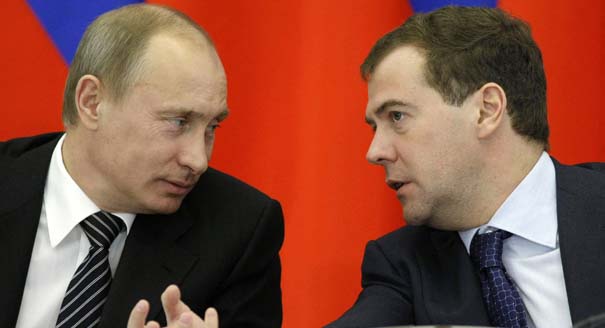
Dmitry Medvedev's recent surge in official activity is simply a PR ploy to shift focus away from Vladimir Putin as Russia's financial crisis deepens. It does not indicate any serious political or personal changes.
Source: The Moscow Times

Medvedev is "inflating" his political presence in the same way that gypsies would "inflate" a horse before putting it up for sale. It is obvious that the surge in activity is mostly PR and does not indicate any serious political or personal changes. For example, the announcement of a presidential staffing reserve of about 100 people does not mean that those are "Medvedev's people" or that Medvedev plans to suddenly replace officials installed by then-President Putin.
In addition, the real reason Medvedev replaced the governors in the Voronezh, Orlov and Pskov regions as well as the Nenets autonomous district is to better control the increase in the governors' independence.
The current round of appointments completely dispels the myth of the advent of younger and more energetic politicians, which many had hoped for when Medvedev announced the appointment of 33-year-old Nikita Belykh as the governor of Kirov. He was considered to be Medvedev's personal candidate. This is a typical Putin-style castling move in which an official from one agency is moved to a gubernatorial post. But in the regions during a period of crisis, where a leader's knowledge of the local situation often outweighs his image, changing the governor over a question of his style could only make the situation worse. It appears to be positively dangerous for the Kremlin, in the midst of an economic crisis, to remove governors it finds displeasing for one reason or another and replace them with people who have no experience in that region.
Recent surveys indicate that the few people who one year ago believed that Medvedev would be the country's actual -- and not merely nominal -- leader has now dropped by half. At the same time, the ratings for the Medvedev-Putin team remain high. That is the only basis for political stability. But if Putin and Medvedev do nothing to strengthen the country's political institutions, the entire system will effectively depend on keeping those ratings at a relatively high level. In that, not only the president and prime minister have a vested interest, but so does the entire political elite.
If you were to imagine that those ratings suddenly fell like the ruble, it would turn out that neither the State Duma nor the Federation Council as they now exist hold any real authority or influence and cannot provide the country with political stability. How can Putin hold onto his high ratings in the midst of a worsening economic crisis? It is possible that Medvedev's frenetic schedule in recent weeks is one attempt at resolving that problem. Putin has to be somehow saved from the blow, pulled to the side so as to remove any hint of his being responsible for the negative consequences of the crisis. The only way to do that is to put someone else's head on the chopping block. But now the country is faced with another problem: Who can rule the country besides Putin?
This comment first appeared in The Moscow Times
Former Scholar-in-Residence, Society and Regions Program, Moscow Center
Nikolay Petrov was the chair of the Carnegie Moscow Center’s Society and Regions Program. Until 2006, he also worked at the Institute of Geography at the Russian Academy of Sciences, where he started to work in 1982.
Recent Work
Nikolay Petrov
Nikolay Petrov
Carnegie does not take institutional positions on public policy issues; the views represented herein are those of the author(s) and do not necessarily reflect the views of Carnegie, its staff, or its trustees.

The EU can impose sanctions but struggles to enforce them without the United States. With Washington increasingly disinterested in backing European interests, the bloc must now fend for itself.


Nicu Popescu, Tiago Antunes

Russia is testing the waters of NATO’s mutual defense clause. What do strikes in Romanian territorial waters mean for the alliance’s posture toward Moscow?

Dimitar Bechev

Europe is facing rising populism internally as well as external pressures from Russia, China, Turkey, and the United States.
Dimitar Bechev

A notable degree of participative democracy has firmly arrived in Europe. But to have more far-reaching impact, democratic deliberation needs to move into a radically new phase.

Richard Youngs

Before the next wave of EU enlargement takes place, the union needs to grapple with thorny questions of how power is distributed among its members.


Emil Sondaj Hansen, Ditte Brasso Sørensen