

Commentary
Michael Pettis
{
  "authors": [
    "Michael Pettis"
  ],
  "type": "other",
  "centerAffiliationAll": "dc",
  "centers": [
    "Carnegie Endowment for International Peace",
    "Carnegie Russia Eurasia Center",
    "Carnegie China"
  ],
  "collections": [],
  "englishNewsletterAll": "asia",
  "nonEnglishNewsletterAll": "",
  "primaryCenter": "Carnegie China",
  "programAffiliation": "AP",
  "programs": [
    "Asia"
  ],
  "projects": [
    "Eurasia in Transition"
  ],
  "regions": [
    "United States",
    "China",
    "Western Europe",
    "North America",
    "East Asia"
  ],
  "topics": [
    "Economy",
    "Trade"
  ]
}
Source: Getty
Until the United States, China, and the EU reach consensus about the roots of the global economic crisis and coordinate recovery policy, the world economy is likely to get worse before it gets better.
By failing to recognize the global implications of domestic recovery efforts, U.S. policy makers are risking increased trade friction and a longer downturn. The United States should coordinate better with China and the EU to keep trade open while the global economy adjusts to significantly reduced U.S. demand.
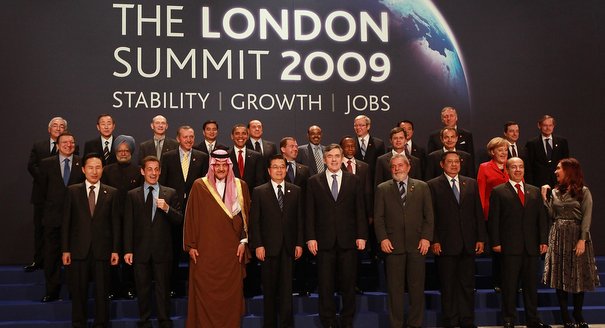
The April G20 meeting sidestepped the key issues dividing the United States, China, and the EU, who disagree fundamentally on the root causes of the crisis. Until the major powers reach consensus about the roots of the imbalance and coordinate policy to promote recovery, the world economy is likely to get worse before it gets better.
Key points for U.S. policy makers:
Key points for Chinese policy makers:
Pettis concludes:
“With such fundamental disagreement among China, Europe, and the United States on the causes of the crisis, and with conflicting domestic policy needs, it is not surprising that the outcome of the G20 meeting was little more than a repeat of the 1933 London Conference. It is hard to see how the major powers can agree on anything substantial, what with the United States looking to craft an agreement on coordinated fiscal expansion but focusing so intently on domestic issues that it ignores the global context; with Europe reluctant to spend and far more concerned about re-regulating the global financial framework; and with China struggling to adapt its development model to a new world in which economic growth is no longer driven by out-of-control U.S. consumption.”

Nonresident Senior Fellow, Carnegie China
Michael Pettis is a nonresident senior fellow at the Carnegie Endowment for International Peace. An expert on China’s economy, Pettis is professor of finance at Peking University’s Guanghua School of Management, where he specializes in Chinese financial markets.
Recent Work
Michael Pettis
Michael Pettis
Carnegie does not take institutional positions on public policy issues; the views represented herein are those of the author(s) and do not necessarily reflect the views of Carnegie, its staff, or its trustees.

Canadian Prime Minister Mark Carney has twice inspired praise for standing up to U.S. President Donald Trump: at the 2026 World Economic Forum in Davos and on Canada-U.S. trade negotiations. Is Carney showing a third way better than the EU has in dealing with the Trump administration?

Rym Momtaz, ed.

European states control several Overseas Countries and Territories around the world that carry strategic, economic, and environmental weight. As great powers challenge the rules-based order, defending them is a geopolitical imperative for Europe.

Marc Pierini

In supporting Europe’s far-right, MAGA and Russia both want the same thing: a weaker EU. Europe must defend itself without abandoning the openness these forces exploit.

Armida van Rij

As we close out another season of Strategic Europe, it is worth taking stock of the deep shifts underway.
Rym Momtaz

The hybrid warfare landscape is evolving rapidly, leaving policymakers without clear strategies. To better inform their work in addressing emerging challenges, governments must dig deeper into the underlying dynamics at play.


Raluca Csernatoni, Alicia Wanless