

Commentary
Nikolay Petrov
{
  "authors": [
    "Nikolay Petrov"
  ],
  "type": "legacyinthemedia",
  "centerAffiliationAll": "",
  "centers": [
    "Carnegie Endowment for International Peace",
    "Carnegie Russia Eurasia Center"
  ],
  "collections": [],
  "englishNewsletterAll": "",
  "nonEnglishNewsletterAll": "",
  "primaryCenter": "Carnegie Russia Eurasia Center",
  "programAffiliation": "",
  "programs": [],
  "projects": [],
  "regions": [
    "Caucasus",
    "Russia"
  ],
  "topics": [
    "Political Reform"
  ]
}
Source: Getty
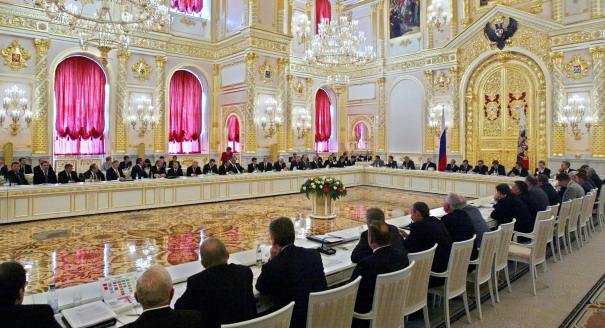
A new system has been implemented for naming the candidate for a gubernatorial post in Russia; the fate of 10 percent of the governors hangs in the balance.
Source: The Moscow Times

The new system introduced by Medvedev last year whereby the party holding the majority in the regional parliaments — that is, United Russia — names the candidate for the gubernatorial post has not been fully implemented in a single region, but a modified plan has already been activated. According to amendments introduced by the president and passed by the State Duma on a first reading, the majority party must present its list of candidates within 40 days, down from the previous limit of 90 days. Similarly, the president must review the list and make his choices within 10 days of receiving it, down from the previous 30 days.
The extended review period created confusion as a number of prominent regional politicians jockeyed for the top spot. This time, however, to avoid paralyzing regional governments while the Kremlin conducts its review, the names of all eight incumbent governors were included in the list of candidates. Some of them, like Sverdlovsk Governor Eduard Rossel, undertook an unprecedented campaign of public activity to demonstrate to the Kremlin their indispensability.
In the Volgograd region, deputies of the legislative assembly have begun preparing for the possibility of an outsider being appointed by initiating government reforms that would significantly strengthen parliamentary authority at the expense of gubernatorial powers.
What criteria will the Kremlin use to make its final choices? Political considerations alone are unlikely to dissuade the president from replacing governors. Judging from the results of the Oct. 11 elections, the Kremlin believes that the economic crisis has either passed or that the worst is already over. That puts many incumbent governors at risk of losing their jobs — especially the likes of Rossel, Volgograd Governor Nikolai Maksyuta and Astrakhan Governor Alexander Zhilkin. A number of other regional leaders, including Kurgan Governor Oleg Bogomolov, Altai Governor Alexander Berdnikov and Komi Governor Vladimir Torlopov, are also walking on thin ice.
No less important than the question of which governors are on their way out is who will be sent in to replace them. Lists of candidates include incumbent governors, two or three alternative candidates chosen from the ranks of regional politicians — typically the deputy governor or the speaker — or a Moscow official of deputy minister rank.
Most likely, however, the new governors will be appointed from outside the regions in which they are expected to serve. Today, the fate of 10 percent of the governors hangs in the balance. Medvedev has remained silent so far. But the deadlines are approaching, and by next week we should already hear his decision for at least the Sverdlovsk gubernatorial spot. It is even possible, though unlikely, that after mature reflection the president will reject the entire list of candidates and demand a new one — or put forward candidates of his own.
In any case, it appears that we are in store for some changes. The only problem is that while we will surely see a fresh slate of governors, the system for how they are appointed will remain the same.
Former Scholar-in-Residence, Society and Regions Program, Moscow Center
Nikolay Petrov was the chair of the Carnegie Moscow Center’s Society and Regions Program. Until 2006, he also worked at the Institute of Geography at the Russian Academy of Sciences, where he started to work in 1982.
Recent Work
Nikolay Petrov
Nikolay Petrov
Carnegie does not take institutional positions on public policy issues; the views represented herein are those of the author(s) and do not necessarily reflect the views of Carnegie, its staff, or its trustees.

The EU had to compromise to adopt a twenty-first sanctions package against Russia, exposing growing cracks in the union’s resolve. Is this latest, weaker round worth it to keep pressure on Moscow?

Rym Momtaz, ed.

Trump is distracted and Ukraine wants Europe to step up. The continent’s leaders must find their voice and assert it in talks with Russia.

Alissa de Carbonnel

Mounting economic strain and battlefield losses will not necessarily make the Kremlin less dangerous. They could instead push Moscow toward a more aggressive hybrid campaign designed to test NATO’s Eastern flank, exploit allied hesitation, and fracture European resolve.

Maksym Beznosiuk

As the EU confronts profound challenges, several leaders have called for fundamental reform to the union’s model—but only modest, superficial changes have resulted. What if Europe really could be reimagined from zero today: What should such a redesigned European order look like?

Richard Youngs, ed.
As Russia's war on Ukraine drags on, NATO is expanding its footprint in the Black Sea. Turkey, Romania, and Bulgaria are upgrading their fleets and deepening trilateral cooperation.

Dimitar Bechev