• Research
  • Strategic Europe
  • About
  • Experts
Carnegie Europe logoCarnegie lettermark logo
EUUkraine
  • Donate
{
  "authors": [
    "Amel Boubekeur"
  ],
  "type": "legacyinthemedia",
  "centerAffiliationAll": "dc",
  "centers": [
    "Carnegie Endowment for International Peace",
    "Malcolm H. Kerr Carnegie Middle East Center"
  ],
  "collections": [],
  "englishNewsletterAll": "menaTransitions",
  "nonEnglishNewsletterAll": "",
  "primaryCenter": "Malcolm H. Kerr Carnegie Middle East Center",
  "programAffiliation": "MEP",
  "programs": [
    "Middle East"
  ],
  "projects": [],
  "regions": [
    "North Africa",
    "Tunisia"
  ],
  "topics": [
    "Political Reform"
  ]
}
Source: Getty

In The Media
Malcolm H. Kerr Carnegie Middle East Center

The Islamist Threat In Tunisia Still Justifies the Stagnation of the Political Scene

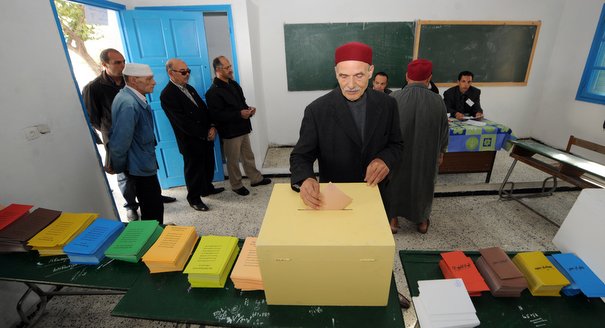
Tunisian President Benali has been in power for 22 years and he continues to justify stalling political reforms by pointing to the "Islamist threat." Today, there is certainly no chance to have an Islamist party in Tunisia but any democratic reconsideration of the regime is impossible as well.

Link Copied
By Amel Boubekeur
Published on Oct 21, 2009

Source: The Huffington Post

The Islamist Threat In Tunisia Still Justifies theTunisian President Benali will be, without a doubt, re-elected on 25 October for a fifth consecutive term. For 22 years, the consensus around Benali's control is mainly due to his manipulation of the Islamist threat. Unlike Morocco and Algeria, Tunisia has refused to legalize its Islamists as an official party. Mainly represented by the movement Annahda, Tunisian Islamists have been either imprisoned and tortured, or forced into exile. Despite the marginalization and the weakening of Annahda's popularity, the State maintains that the Islamist threat is still Tunisia's major problem. In doing so, it can justify its use of repressive methods and enlarge its control over the whole Tunisian political class and civil society.

Annahda, created in 1989 and led by Rachid Ghannouchi currently in exile in London, found itself shattered in the late 1990s and forced to rethink its oppositional strategy toward the State. Faced with this new "conciliation" framework, but also under the pressure of various international Human Rights organizations, the President Benali pardoned many prisoners and allowed the return of some exiled activists between 1999 and 2008. Now, even a small minority of former Annahda members have supported Benali's presidential candidacy. 

The majority though tried rather to reconcile with the secular opposition. In 2005,Islamists gathered for the first time alongside Communists and human rights activists within the "18 October Coalition for Rights and Freedoms" which called for more civil liberties and an ending to the torture.
 
However, Annahda's official political reintegration remains impossible as Benali still needs them to illustrate the Islamist threat. By dominating the political scene, the Benali / Annahda's conflict reduces the other opposition parties and civil society to that of walk-on roles. Having no other choice than being "anti" Islamist and by default "pro" Benali, this situation nips in the bud any common front to oppose the president's monopoly.
 
In April 2002, a terrorist attack, claimed by the Salafist Group for Preaching and Combat which became AlQaida in the Islamic Maghreb in 2007, targeted a synagogue in the resort area of Djerba. This event was an opportunity for Benali to link the Tunisian situation to the international war on terror. In December 2003, he proclaimed a new antiterrorism law which largely helped him to consolidate his control over Tunisia.
 
This law has indeed permitted the detention and torture of between 1000 and 2000 Tunisians on terrorism-related charges (figures vary between organizations as not all cases are reported). Men wearing a beard are harassed by police. Veiled women, already banned from having access to schools, hospitals and public institutions, are arrested in the street, forced to remove their headscarves and then taken to the police station. 
 
These measures mainly allow the State to put civil society under pressure and to spread fear beyond just the usual circles of Annahda followers. However, this enlarged anti-terrorist framework is also subsequently radicalizing a lot of young people who have never considered joining an Islamist movement before. The perfect example of this can be found in the violent clash that occurred in December 2006 between police and an amateur army of 30 young people who have been accused of belonging to Jihadi Salafism.
 
The Tunisian president has not chosen to address religious radicalism and terrorism through transparent solutions that are respectful of civil liberties. Maintaining the Islamist threat has allowed him to secure the support of its citizens and international partners. This strategy of using the Islamist threat as both Tunisia's major problem and the solution to the preservation of its own power may however reach its limits.
 
Today, there is certainly no chance to have an Islamist party in Tunisia but any democratic reconsideration of the regime is impossible as well. Toward civil society, the social responsibility of the State is declining as it is more and more obsessed with security policies. As a result, the classical way to ensure stability in Tunisia may be challenged by the emergence of a young generation who is rejecting both Annahda's failure to participate in politics and apathetic forms of State Islam unable to improve their living conditions.


About the Author

Amel Boubekeur

Former Resident Scholar, Middle East Center

Boubekeur was an associate scholar at the Carnegie Middle East Center. Her research focuses on Maghreb country politics, Euro–Arab relations, and Islam in Europe.

    Recent Work

  • Article
    The Tunisian Elections: International Community Must Insist on Moving Beyond Façade Democracy

      Amel Boubekeur

  • Article
    Morocco: The Emergence of a New Palace Party

      Amel Boubekeur

Amel Boubekeur
Former Resident Scholar, Middle East Center
Amel Boubekeur
Political ReformNorth AfricaTunisia

Carnegie does not take institutional positions on public policy issues; the views represented herein are those of the author(s) and do not necessarily reflect the views of Carnegie, its staff, or its trustees.

More Work from Carnegie Europe

  • Commentary
    Strategic Europe
    The EU Needs a Third Way in Iran

    European reactions to the war in Iran have lost sight of wider political dynamics. The EU must position itself for the next phase of the crisis without giving up on its principles.

      Richard Youngs

  • Commentary
    Strategic Europe
    Can Europe Still Matter in Syria?

    Europe’s interests in Syria extend beyond migration management, yet the EU trails behind other players in the country’s post-Assad reconstruction. To boost its influence in Damascus, the union must upgrade its commitment to ensuring regional stability.

      Bianka Speidl, Hanga Horváth-Sántha

  • Commentary
    Strategic Europe
    Europolis, Where Europe Ends

    A prophetic Romanian novel about a town at the mouth of the Danube carries a warning: Europe decays when it stops looking outward. In a world of increasing insularity, the EU should heed its warning.

      Thomas de Waal

  • Commentary
    Strategic Europe
    Taking the Pulse: What Issue Is Europe Ignoring at Its Peril in 2026?

    2026 has started in crisis, as the actions of unpredictable leaders shape an increasingly volatile global environment. To shift from crisis response to strategic foresight, what under-the-radar issues should the EU prepare for in the coming year?

      Thomas de Waal

  • Commentary
    Can Europe and Africa Mend Fences?

    Despite the strategic importance of relations between the EU and the African Union, deep divisions remain between the blocs. At their upcoming summit, both partners should strive to build a mutually beneficial cooperation.

      Marta Martinelli

Get more news and analysis from
Carnegie Europe
Carnegie Europe logo, white
Rue du Congrès, 151000 Brussels, Belgium
  • Research
  • Strategic Europe
  • About
  • Experts
  • Projects
  • Events
  • Contact
  • Careers
  • Privacy
  • For Media
  • Gender Equality Plan
Get more news and analysis from
Carnegie Europe
© 2026 Carnegie Endowment for International Peace. All rights reserved.