

Commentary
Maria Lipman
{
  "authors": [
    "Maria Lipman"
  ],
  "type": "legacyinthemedia",
  "centerAffiliationAll": "",
  "centers": [
    "Carnegie Endowment for International Peace",
    "Carnegie Russia Eurasia Center"
  ],
  "collections": [],
  "englishNewsletterAll": "",
  "nonEnglishNewsletterAll": "",
  "primaryCenter": "Carnegie Russia Eurasia Center",
  "programAffiliation": "",
  "programs": [],
  "projects": [],
  "regions": [
    "Caucasus",
    "Russia"
  ],
  "topics": [
    "Political Reform"
  ]
}
Source: Getty
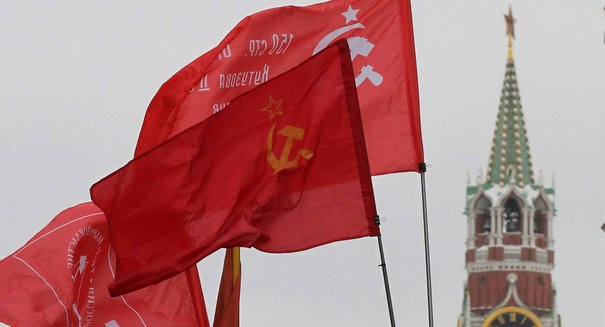
The Russian perception of Stalin and his crimes has more to do with the nature of Russian statehood than with the monstrous actions of the man himself.
Source: The Washington Post

Medvedev's address may have sounded radical, but many here are skeptical that the president's words will actually bring change. The number of alarming signals of Stalin's rehabilitation is growing. And in general over the year and a half of his presidency, Medvedev's often well-intended rhetoric has not been matched with policy.
But it would be wrong to dismiss the speech and conclude instead -- as observers at home and abroad sometimes do -- that Russia has made a definitive turn "back" toward the Soviet Union and an admiration of Stalin. In fact, perceptions of Stalin are conflicted, and this conflict reflects Russia's attempts -- very feeble, so far -- to reinvent itself as a modern nation.
On the one hand, there is evidence of a warming in attitudes toward Stalin. In one recent example a stanza from the old Soviet anthem was returned to the Kurskaya metro station in Moscow. Those lines "Stalin raised us, he inspired us to loyalty to the people, to the labor and heroic deeds" had been removed in the 1950s as part of Nikita Khrushchev's de-Stalinization campaign; they were brought back this fall when the station's original decor was restored. Another instance is the prosecution, on a far-fetched pretext of privacy violation, of a provincial historian conducting archival research of the fates of ethnic Germans deported and killed on Stalin's orders. In December, Stalin came in third in a TV station's poll of greatest Russian historical figures. Contest organizers are rumored to have tinkered with the results after discovering that the man who masterminded the extermination of millions of his compatriots actually finished first.
Yet the peak of Stalin's terror is also recognized for what it was. In 2007, 72 percent of respondents told the Levada polling agency that the repression of 1937-38 were "political crimes that can't be justified." The day of remembrance of political repression, officially introduced in 1991, is not marked by major national events, but on Thursday, just outside the infamous Lubyanka building, the KGB's headquarters and prison, the names of Stalin's victims were read for 12 straight hours by any who wanted to participate. Other commemorations were staged elsewhere in Russia.
Prime Minister Vladimir Putin recently met with the widow of Alexander Solzhenitsyn, and they discussed how best to teach his work "The Gulag Archipelago" in schools. Two years ago, Putin visited a site of mass executions in the 1930s. The Gulag volumes are available in bookstores, as are a broad range of works about the history of Communist terror and books that take a much more positive view of Stalin. Likewise on television, praise of Stalin and his henchmen appears side by side with series and programs based on works by Solzhenitsyn and other chroniclers of Stalin's repression.
The perception of Stalin and his crimes has much more to do with the nature of Russian statehood than with the monstrous actions of the man himself. Russians cling to the image of Stalin as the embodiment of the great state, and he is particularly inseparable from the triumph of the Soviet Union over Nazi Germany. The implication is that individuals may have been cowed, and that the ferocious state treated them mercilessly, but the state was the vehicle that inspired Russia's victory in World War II, its greatest achievement of the 20th century. Ruling elites today are no longer ferocious; rather, they are seen as greedy and self-serving, but the model of the omnipotent state and the impotent people is still generally accepted.
For the government, this acceptance of Stalin and the paternalistic state-society pattern may be handy as a way to consolidate power. But some in the decision-making circles do seem to realize that current social, political and economic models are unable to produce growth and development. From Putin and Medvedev down, modernization has become the mantra. But modernization is incompatible with a statehood based on the specter of Stalin and faith in the magic empowerment of the apathetic people by forces of the state. Unless Russia reinvents itself and takes real steps to encourage people's entrepreneurship and creativity, talk of modernization will remain hollow.
Medvedev's speech points in the right direction, but it must be accompanied by changes in policy to carry weight. Moreover, for change to succeed, the president will need to build a constituency that will trust him, share his objectives and work toward their implementation. As long as there is no such constituency in sight, Stalin's name engraved in marble in the Moscow metro will outweigh Medvedev's humane words.
Former Scholar in Residence, Society and Regions Program, Editor in Chief, Pro et Contra, Moscow Center
Lipman was the editor in chief of the Pro et Contra journal, published by the Carnegie Moscow Center. She was also the expert of the Carnegie Moscow Center’s Society and Regions Program.
Recent Work
Maria Lipman
Maria Lipman
Carnegie does not take institutional positions on public policy issues; the views represented herein are those of the author(s) and do not necessarily reflect the views of Carnegie, its staff, or its trustees.

European Commission President Ursula von der Leyen is about to give her annual address on the state of the EU. Here’s what she won’t—but should—say.

Rym Momtaz

The EU’s responses to two recent incidents expose the gulf between European perceptions and capabilities. Unless the union can bridge that gap, it will never become a real geostrategic power.
Rym Momtaz

European states control several Overseas Countries and Territories around the world that carry strategic, economic, and environmental weight. As great powers challenge the rules-based order, defending them is a geopolitical imperative for Europe.

Marc Pierini

In supporting Europe’s far-right, MAGA and Russia both want the same thing: a weaker EU. Europe must defend itself without abandoning the openness these forces exploit.

Armida van Rij

As we close out another season of Strategic Europe, it is worth taking stock of the deep shifts underway.
Rym Momtaz