

Commentary
Maria Lipman
{
  "authors": [
    "Maria Lipman"
  ],
  "type": "commentary",
  "centerAffiliationAll": "",
  "centers": [
    "Carnegie Endowment for International Peace",
    "Carnegie Russia Eurasia Center"
  ],
  "collections": [],
  "englishNewsletterAll": "",
  "nonEnglishNewsletterAll": "",
  "primaryCenter": "Carnegie Russia Eurasia Center",
  "programAffiliation": "",
  "programs": [],
  "projects": [],
  "regions": [
    "Russia",
    "Eastern Europe",
    "Ukraine"
  ],
  "topics": [
    "Political Reform",
    "Economy",
    "Foreign Policy"
  ]
}
Source: Getty
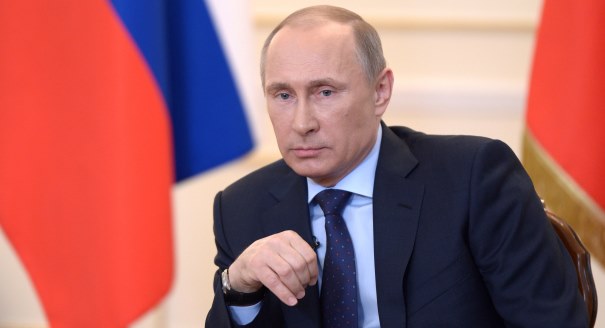
The seizure of Crimea is Putin’s personal conquest, as well as a dramatic reinforcement of his regime of personal power. For now Putin has succeeded in halting Russia’s social and economic modernization and has pushed Russia to an anti-modernization course.
In February President Vladimir Putin met with his Cabinet members and repeated what they “all agreed on”: the current economic model based on export of commodities, such as oil and gas, has exhausted itself.
“We were always hoping for continued increase in energy prices, and energy prices are at a good level, but we do not have the same kind of growth as in the past, and we could say that this source has now exhausted itself.” Putin also added that “we have spoken often about our reserves too.”
While loyal experts admit that the Russian economy has entered a period of economic stagnation, the more critical ones insist that recession is a more appropriate description. At the same meeting Putin also spoke about “the need to promote Russia’s economic interests abroad through our trade offices.” But this is hardly an option after the West has already imposed sanctions on Russia and tougher, economic sanctions are not unlikely.
Before Crimea was taken over Russian pollsters observed a sense of Putin fatigue among the Russian people: while his approval ratings decreased only slightly, fewer people were willing to see him at the helm beyond 2018, the end of his current, third term. Instead there was a distinct desire to see “somebody else” in the Kremlin. The economic slowdown (the growth was just over one percent in 2013) threatened to consolidate this trend. When living standards had been steadily growing, Putin’s approval was unaffected by the chronic public complaints—over greedy and lawless bureaucracy, pervasive corruption, lawlessness, social injustice, dysfunctional and abusive police (about two thirds of polled Russians routinely shared such grievances). But these problems could become a challenge to the Kremlin after its ability to buy support has declined.
The takeover of Crimea has dramatically changed the public sentiments in Russia. This month 60 percent said the country was headed in the right direction, while only 26 believed that Russia is on the wrong course. One year ago the right/wrong direction ratio was 40 to 44. The Putin fatigue is gone. Over the past year Putin’s approval rating has grown from 63 to 80 percent; 51 percent said they trusted him, up from 35 in March 2013. Such is the instant benefit of the takeover of Crimea.
The patriotic euphoria over the inclusion of Crimea in the Russian Federation is in large part a product of the aggressive propaganda campaign on the Russian national television networks. The adjoining of Crimea is broadly seen as a triumph of “historical justice” that, in the minds of most Russians, appears to be superior to the justice of legal norms and procedures. What is also important is that this triumph came at no cost whatsoever to the Russian people—it was swift and bloodless (thank God!) and the economic consequences, such as a record capital flight, reduced investments, continued slowdown etc. will only be felt in the future. The seizure of Crimea is Putin’s personal conquest, while the Russian people’s contribution has been reduced to their renewed pledge of allegiance to the national leader. This is a dramatic reinforcement of Russia’s traditional paternalistic pattern and Putin’s regime of personal power. For now Putin has succeeded in halting Russia’s social and economic modernization and has pushed Russia to an anti-modernization course.
Former Scholar in Residence, Society and Regions Program, Editor in Chief, Pro et Contra, Moscow Center
Lipman was the editor in chief of the Pro et Contra journal, published by the Carnegie Moscow Center. She was also the expert of the Carnegie Moscow Center’s Society and Regions Program.
Recent Work
Maria Lipman
Maria Lipman
Carnegie does not take institutional positions on public policy issues; the views represented herein are those of the author(s) and do not necessarily reflect the views of Carnegie, its staff, or its trustees.

Funding Ukraine remains a priority for European leaders. As Russia’s war of aggression heads into another winter, two feasible options to mobilize support for Kyiv should be fast-tracked.


Vladyslav Rashkovan, Gregory P. Wilson

While the EU and European governments are embracing the much-lauded middle-power moment, this entails three difficult conundrums.

Richard Youngs

Europe is facing rising populism internally as well as external pressures from Russia, China, Turkey, and the United States.

Dimitar Bechev

A notable degree of participative democracy has firmly arrived in Europe. But to have more far-reaching impact, democratic deliberation needs to move into a radically new phase.
Richard Youngs

Much has been said of the changes Brussels is trying to make to the EU enlargement process. Here’s why gradual integration might—or might not—be the answer.
Dimitar Bechev