

In The Media
Michele Dunne, Robert Kagan
{
  "authors": [
    "Robert Kagan"
  ],
  "type": "legacyinthemedia",
  "centerAffiliationAll": "",
  "centers": [
    "Carnegie Endowment for International Peace"
  ],
  "collections": [],
  "englishNewsletterAll": "",
  "nonEnglishNewsletterAll": "",
  "primaryCenter": "Carnegie Endowment for International Peace",
  "programAffiliation": "",
  "programs": [],
  "projects": [],
  "regions": [
    "North America",
    "United States"
  ],
  "topics": [
    "Foreign Policy"
  ]
}
Source: Getty
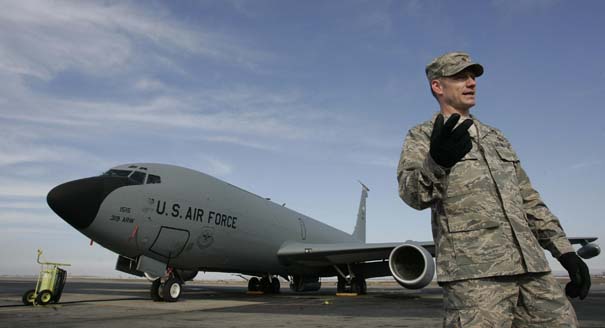
The United States remains the world’s only global military power, with forces deployed in every theater, and its citizens still view war as an unfortunate but unavoidable fact of international life.
Source: The Wall Street Journal

Americans, who went to war, officially or unofficially, at least 10 times under Presidents Ronald Reagan, George H.W. Bush, Bill Clinton and George W. Bush, show no sign of abandoning their substantial reliance on military power. Nor does the current president, for all the rhetoric of diplomacy.
In many circles it has for years been fashionable to argue that the U.S. has relied too heavily on the military and paid too little attention to diplomacy and the so-called underlying causes of terrorism or other forms of aggression.
The events of 2009 have revealed the limits of such facile observations. Even the present administration evidently believes, with good reason, that whatever the value of diplomacy and reform, they are no substitute for hard military power.
No End In Sight
Amid the hubbub over the failed Christmas terrorist attack, it might be easy to lose sight of a few facts about the past year.
For instance, Americans spent over $500 billion on the military, over $600 billion if the wars in Afghanistan and Iraq are included. As was true in the Bush and Clinton years, this is more than the rest of the world combined.
This large budget remains too small to meet America's many commitments around the world, which is an old problem that the previous administration also did too little to repair. But the Obama administration made no cuts in overall spending and is not likely to make any next year either. Nor was there public clamor for reduced defense spending in 2009, unlike during, say, the Reagan years, when cutting the defense budget was a major plank of the Democratic Party.
The U.S., of course, remained very much a nation at war in 2009, with no prospect that it will enjoy peace anytime soon. At year's end, over 100,000 U.S. troops were still serving in Iraq, and although that number is supposed to decline to roughly 50,000 by the summer of 2010, Mr. Obama so far has stood by his pledge not to make a hasty and irresponsible exit from Iraq.
At the same time, he doubled the number of U.S. troops in Afghanistan in 2009 and ordered a further increase in the coming year from nearly 70,000 to nearly 100,000 by summer.
Unnoticed by many people, as usual, was the fact that the U.S. in 2009 also remained the world's only global military power, with forces deployed in every theater: in addition to the troops in Iraq and Afghanistan, over 80,000 in Europe, more than 70,000 in East Asia and the Pacific, and roughly 12,000 in North Africa, the Near East, South Asia, sub- Saharan Africa and the Western Hemisphere. There was no call in 2009 for America to "come home" from any of these global deployments.
If anything, by year's end, it appeared that American military involvements were likely to broaden in the future, with military actions in Yemen and Somalia not inconceivable should local struggles against al Qaeda and its affiliates falter.
No Utopianism
In the activity formerly known as the war on terror, there was no evidence of slackening by the Obama administration in 2009, at least when it came to using military force to address the terrorist threat.
In Afghanistan, a central front in the battle against al Qaeda and its supporters, Mr. Obama substantially increased the military component of the struggle. In Pakistan, too, the Obama administration stepped up American military activity. As Bill Roggio reports in the Long War Journal, the Obama administration has sharply increased the number of drone attacks on targets in Pakistan, with 53 such attacks in 2009, compared with 36 in 2008.
Indeed, the Obama administration carried out more drone strikes in its first year than the Bush administration carried out in the previous five years combined, and these strikes produced a record number of enemy casualties. While the Obama administration may be more generous in providing legal defense to captured terrorists than the Bush administration, it has also made a greater effort to assassinate them, thus obviating the need for trial.
American attitudes toward the phenomenon of war remained sober in 2009. While at other times in American history—at the end of the 19th century, in the decade following World War I, and again after the end of the Cold War—leading thinkers promising a new era of peace gained a wide audience, today there is no hint of utopianism.
Mr. Obama's well-argued case for the continuing relevance of military power in an era when the prevalence of war shows no sign of diminishing—delivered to the Nobel Peace Prize committee, no less—was a sign of the great distance that still separates Americans and Europeans on the issue of war and peace. The year 2009 showed that the U.S., perhaps alone among the world's democracies, still sees war as an unfortunate but unavoidable fact of international life.

Former Senior Associate
Kagan, author of the recent book, The Return of History and the End of Dreams (Knopf 2008), writes a monthly column on world affairs for the Washington Post and is a contributing editor at both the Weekly Standard and the New Republic.
Recent Work

Michele Dunne, Robert Kagan
Robert Kagan, Michele Dunne
Carnegie does not take institutional positions on public policy issues; the views represented herein are those of the author(s) and do not necessarily reflect the views of Carnegie, its staff, or its trustees.

With its public finances in shambles, the far right polling at 35 percent ahead of the 2027 presidential election, and a growing protest movement, is France’s crisis a threat to the EU’s geopolitical awakening?

Rym Momtaz, ed.

Ahead of a tough winter for Ukraine, Donald Trump’s swing back toward Russia bodes ill. But instead of panicking, Kyiv’s European allies are focusing on action.
Rym Momtaz

Funding Ukraine remains a priority for European leaders. As Russia’s war of aggression heads into another winter, two feasible options to mobilize support for Kyiv should be fast-tracked.


Vladyslav Rashkovan, Gregory P. Wilson

While the EU and European governments are embracing the much-lauded middle-power moment, this entails three difficult conundrums.

Richard Youngs

Europe is facing rising populism internally as well as external pressures from Russia, China, Turkey, and the United States.

Dimitar Bechev