

Paper
Douglas H. Paal
{
  "authors": [
    "Douglas H. Paal"
  ],
  "type": "legacyinthemedia",
  "centerAffiliationAll": "dc",
  "centers": [
    "Carnegie Endowment for International Peace",
    "Carnegie China"
  ],
  "collections": [],
  "englishNewsletterAll": "asia",
  "nonEnglishNewsletterAll": "",
  "primaryCenter": "Carnegie China",
  "programAffiliation": "AP",
  "programs": [
    "Asia"
  ],
  "projects": [],
  "regions": [
    "South Asia",
    "India",
    "East Asia",
    "China"
  ],
  "topics": [
    "Political Reform",
    "Security",
    "Military",
    "Domestic Politics"
  ]
}
Source: Getty
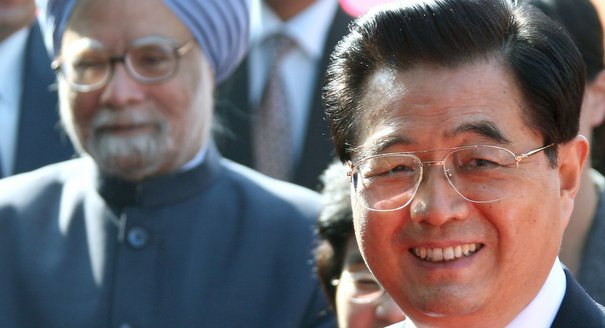
While India has recently adopted a more conciliatory attitude in trying to resolve its long-standing border disputes with China, it remains to be seen whether this diplomatic cooperation will continue.
Source: World Politics Review

WPR: What are the core unresolved issues regarding the India-China border?
Douglas Paal: The principal disputes are over territory. The Sino-Indian territorial dispute is one of China's few remaining border disputes after a decade of resolving tough disputes with 11 other important neighbors. At the western end of the Sino-Indian border lies Aksai-Chin, which China conquered in the 1962 border war with India. This high, flat plateau embraces the only road connection between Tibet and far-western Xinjiang near the border, and is viewed by China as a strategic requirement. In the east, the dispute is over Arunachal Pradesh, controlled by India. Observers have long expected that a swap of these two territories would end their dispute and allow the border to be settled. But the political atmosphere has not been right at the same time in both capitals to do so since the 1962 war.
WPR: What explains the heightened Chinese activity there (i.e., provocative intrusions and military infrastructure development) over the past year, and what considerations are guiding the Indian response (i.e., restraint on the intrusions while hardening its side of the border)?
Paal: The question assumes that there have been higher incidents of Chinese provocation, as alleged commonly in India's media. Chinese and foreign observers who have visited the Indian border area from China, however, have not supported these allegations. It would be interesting to know the truth.
WPR: What impact has this had on bilateral relations, and are there any mechanisms in place to prevent it from becoming a flashpoint?
Paal: Interestingly, India has shown creative diplomacy in recent months, seeking to defuse the rising tensions. Delhi sent a new ambassador to Beijing -- an expert on relations with the United States, S. Jaishankar -- to find some means of resolving Sino-Indian disputes. An early fruit of his efforts is an agreement for the first joint exercise between the two countries' militaries since 1962. It remains to be seen whether this will develop into a pattern of diplomatic cooperation that institutionalizes itself.

Distinguished Fellow, Asia Program
Paal previously served as vice chairman of JPMorgan Chase International and as unofficial U.S. representative to Taiwan as director of the American Institute in Taiwan.
Recent Work
Douglas H. Paal


Douglas H. Paal, Tong Zhao, Chen Qi, …
Carnegie does not take institutional positions on public policy issues; the views represented herein are those of the author(s) and do not necessarily reflect the views of Carnegie, its staff, or its trustees.

European states control several Overseas Countries and Territories around the world that carry strategic, economic, and environmental weight. As great powers challenge the rules-based order, defending them is a geopolitical imperative for Europe.

Marc Pierini

In supporting Europe’s far-right, MAGA and Russia both want the same thing: a weaker EU. Europe must defend itself without abandoning the openness these forces exploit.

Armida van Rij

The hybrid warfare landscape is evolving rapidly, leaving policymakers without clear strategies. To better inform their work in addressing emerging challenges, governments must dig deeper into the underlying dynamics at play.


Raluca Csernatoni, Alicia Wanless

Mounting economic strain and battlefield losses will not necessarily make the Kremlin less dangerous. They could instead push Moscow toward a more aggressive hybrid campaign designed to test NATO’s Eastern flank, exploit allied hesitation, and fracture European resolve.

Maksym Beznosiuk

Over the past ten years, NATO has held almost as many summits as it did during the entirety of the Cold War. Are they still useful, or is it time to stop holding annual meetings?

Rym Momtaz, ed.