

Commentary
Dmitri Trenin
{
  "authors": [
    "Dmitri Trenin"
  ],
  "type": "legacyinthemedia",
  "centerAffiliationAll": "",
  "centers": [
    "Carnegie Endowment for International Peace",
    "Carnegie Russia Eurasia Center"
  ],
  "collections": [],
  "englishNewsletterAll": "",
  "nonEnglishNewsletterAll": "",
  "primaryCenter": "Carnegie Russia Eurasia Center",
  "programAffiliation": "",
  "programs": [],
  "projects": [
    "U.S.-Russia Bilateral Presidential Commission"
  ],
  "regions": [
    "Caucasus",
    "Russia"
  ],
  "topics": [
    "Foreign Policy"
  ]
}
Source: Getty
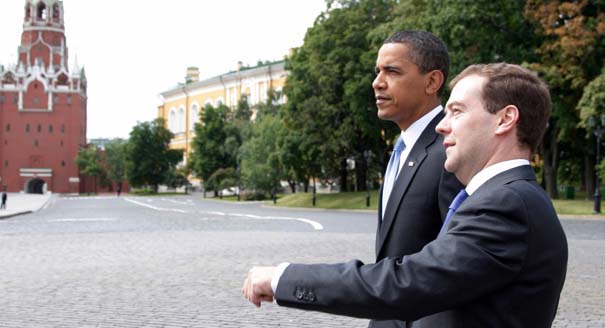
The Kremlin’s new foreign policy agenda reflects Russia’s increasing need to channel resources towards modernization, a project which requires improved relations with the West.
Source: The Moscow Times

In this case, what you see is what you get. Russia’s tone, especially toward the United States, began to change last year, but the Kremlin’s support for a fourth version of United Nations Security Council sanctions on Iran demonstrates that, today, there is real substance. Moreover, surrendering territorial claims in the Arctic — the stakes in the dispute with Norway — is no small matter.
Putin’s joint visit to Katyn with Polish Prime Minister Donald Tusk in April was, of course, symbolic. But serious conversations between the two men started in September, during Putin’s visit to Gdansk to mark the 70th anniversary of the beginning of World War II. The kneeling act was also followed, just three days later, by Russian officials going out of their way to help investigate the air crash in Russia that killed Polish President Lech Kaczynski and scores of Polish dignitaries, and to pay respects to the victims.
An apparently genuine internal Foreign Ministry document, which was published in Russian Newsweek on May 10, made it clear that the Kremlin now prioritizes relations with the United States and Europe. All of this is a far cry from the 2007 Victory Day parade on Red Square, when then-President Putin compared President George W. Bush’s policies to those of the Third Reich; or when Russia resumed strategic bomber air patrols in 2007 along the Norwegian coast and into the North Atlantic and the Caribbean; or President Dmitry Medvedev’s address to the nation on Nov. 5, 2008 — the day after Barack Obama was elected U.S. president — when Medvedev threatened to deploy Iskander short-range missiles in Kaliningrad.
Four factors have contributed most to this positive reversal: the Georgia war of 2008, the global economic crisis, the Obama factor and China’s relentless rise.
The Georgia war demonstrated how quickly relations with the United States could deteriorate, almost to the point of reviving the Cold War, leaving Russia isolated and in a generally weak position. The economic crisis destroyed illusions of sustained energy-fueled growth and the hubris that went with it.
Moreover, the Obama administration, by having reset U.S. foreign policy, removed the principal irritants in Russian-Western relations — the prospect of NATO enlargement to Ukraine and Georgia, close relations with Georgian President Mikheil Saakashvili and plans for deploying elements of a strategic missile defense system in Central Europe. Obama also showed genuine respect and openness to Russia.
Finally, as China has become more confident and assertive, its shadow over Russia has grown longer and thicker.
Faced with this situation, the Russian leadership sees both new dangers and new opportunities, which are often intimately interlinked. The country’s backwardness vis-a-vis not only the West, but also some of the emerging powers drives home the need to modernize Russia’s technological base. But where is the money for that?
Russia’s worsening credit rating and the tougher borrowing terms in the international market are forcing Russia to compete harder for capital. Obama’s openness and pragmatism have turned the United States into a partner, but it is uncertain how long he will stay in the White House and how strong he will be in the future. China is both a market and a partner, but this partnership looks increasingly tilted in China’s favor.
So Russia needed to adjust its foreign policy. Passionate defense of Russia’s diminished status makes less sense than practical efforts to stop the country’s decline and enhance its real power. Multipolarity exists, but Russia is not much of a pole. Summits of the BRIC leaders are still held, but the real focus of Russia’s policy is the member countries of the Organization for Economic Cooperation and Development, which have technology and money. Russian foreign policy’s new central task is to channel those resources to the country’s modernization drive, which requires improved relations with the United States, in particular, and the West as a whole.
Still, there are important caveats. The Russian government’s concept of modernization is too narrow to succeed. Unless the basic conditions for doing business in Russia improve substantially and until the government starts to modernize itself, technology transfers will have little effect.
Putin himself has furnished proof of that. Speaking recently at the Russian Academy of Sciences, he said the Soviet economy was structurally incapable of using most of the technological secrets acquired through KGB-style industrial espionage. Without an independent judiciary, secure property rights and a check on corruption, Putin’s modernization will mimic Brezhnev’s. The danger is not of the Kremlin losing interest in technology transfers from the West, but rather its inability to create the right legal, business and political environment to capitalize on them.
The West has broadly welcomed Russia’s new line. Obama has sent a nuclear energy cooperation agreement with Russia to Congress, while the European Union has offered a “partnership for modernization.” Both want Russia to complete its accession to the World Trade Organization.
This is crucial. There can be no better foundation for modernization than WTO membership. When this is achieved, the next steps are a permanent normal trade status for Russia in the United States and practical moves toward a pan-European free-trade area between the EU, Russia, Ukraine and other countries. Europe’s potentially most effective instrument to help Russian modernization is gradual abolition of the visa regime with Russia.
The time to act is now. Within a few years, when it becomes clear to the Russian leadership that modernization conceived as technological innovation is too narrow to succeed, important choices will have to be made. Either the scope of modernization will be broadened, or modernization will be aborted in favor of regime preservation. Forward-looking elements in Russia will require compelling arguments if their case is to prevail.
Former Director, Carnegie Moscow Center
Trenin was director of the Carnegie Moscow Center from 2008 to early 2022.
Recent Work
Dmitri Trenin
Dmitri Trenin
Carnegie does not take institutional positions on public policy issues; the views represented herein are those of the author(s) and do not necessarily reflect the views of Carnegie, its staff, or its trustees.

The aftermath of the Ceuta crisis shows Europe has drawn the wrong lessons. Rather than doubling down on failed migration policies, the EU needs to address the underlying roots of such episodes.

Richard Youngs

Canadian Prime Minister Mark Carney has twice inspired praise for standing up to U.S. President Donald Trump: at the 2026 World Economic Forum in Davos and on Canada-U.S. trade negotiations. Is Carney showing a third way better than the EU has in dealing with the Trump administration?

Rym Momtaz, ed.

The EU’s responses to two recent incidents expose the gulf between European perceptions and capabilities. Unless the union can bridge that gap, it will never become a real geostrategic power.
Rym Momtaz

European states control several Overseas Countries and Territories around the world that carry strategic, economic, and environmental weight. As great powers challenge the rules-based order, defending them is a geopolitical imperative for Europe.

Marc Pierini

In supporting Europe’s far-right, MAGA and Russia both want the same thing: a weaker EU. Europe must defend itself without abandoning the openness these forces exploit.

Armida van Rij