

Q&A
Suzanne Maloney, Aaron David Miller, Karim Sadjadpour
{
  "authors": [
    "Karim Sadjadpour"
  ],
  "type": "legacyinthemedia",
  "centerAffiliationAll": "dc",
  "centers": [
    "Carnegie Endowment for International Peace",
    "Carnegie Europe",
    "Malcolm H. Kerr Carnegie Middle East Center"
  ],
  "collections": [],
  "englishNewsletterAll": "menaTransitions",
  "nonEnglishNewsletterAll": "",
  "primaryCenter": "Carnegie Endowment for International Peace",
  "programAffiliation": "MEP",
  "programs": [
    "Middle East"
  ],
  "projects": [],
  "regions": [
    "Middle East",
    "Iran",
    "Gulf"
  ],
  "topics": [
    "Political Reform",
    "Foreign Policy"
  ]
}
Source: Getty
The confidential documents released by WikiLeaks reveal that Arab officials distrust the government in Tehran, which effectively uses soft power and political influence to maintain a significant role on the regional and global stage.
Source: The Financial Times

So far, the Obama administration has admirably eschewed their advice. Instead it has used a recent $60bn arms deal with Saudi Arabia, along with further multi-billion-dollar deals with the United Arab Emirates, Oman and Kuwait, to develop a strategy of military containment.
Yet such an approach ignores the fact that Iran’s strength lies primarily in its political influence, not its military prowess. Tehran’s military budget is less than a quarter of regional rival Saudi Arabia’s. But its soft power, along with it support for militias, can undermine governments with vastly superior armies, as has been evidenced by the US in Iraq.
The WikiLeaks revelations make clear that Arab officials believe Iran to be inherently dishonest and dangerous. The feeling is probably mutual. But they hide perhaps a more interesting issue, namely what type of Iranian government would actually best serve Gulf Arab interests.
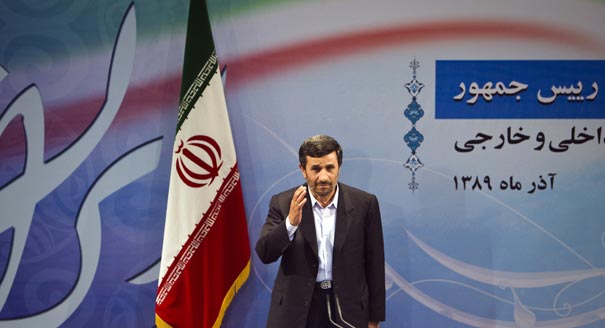
President Mahmoud Ahmadi-Nejad and the Islamic Republic may be loathed, but equally the advent of a more progressive, democratic Iran would enable Tehran to emerge from its largely self-inflicted isolation and begin to realise its enormous potential. In the zero-sum game of Middle Eastern politics, a democratic Iran would pose huge challenges to Persian Gulf sheikhdoms.
Today Iran is not, of course, a global superpower by any metric. Its economy suffers from endemic mismanagement; its military budget is less than 2 per cent that of the US. Apart from North Korea, Venezuela and Syria, it has few reliable strategic allies.
Indeed, while its international profile has been rising, however, Iran’s internal decay has seemingly been accelerating. The palpable disaffection of its youth clearly came to a head after the contested 2009 presidential elections. Further deep internal fissures have forced the regime to rely on coercion and intimidation in order to maintain power.
Nonetheless, without Iran’s co-operation it is going to be difficult to bring long-term stability to Iraq, Afghanistan, the Levant or the Holy Land. At the same time, a peaceful and prosperous region seems inimical to the interests of the current Islamic Republic.
Anxious Gulf Arab countries, therefore, have little to fear: the US and Iran will not be friends anytime soon. As one Iranian diplomat once told me, “Iran derives its popularity in the region and the Muslim world based on our defiance towards the US and Israel.”
A US general once said that Iran only offers to help resolve problems that it itself helps to create. But he might also have reflected that it is at times of crisis and carnage in the region, and especially those linked to either the US or Israel, when Iran’s soft power and ideology gains most purchase.

Senior Fellow, Middle East Program
Karim Sadjadpour is a senior fellow at the Carnegie Endowment for International Peace, where he focuses on Iran and U.S. foreign policy toward the Middle East.
Recent Work


Suzanne Maloney, Aaron David Miller, Karim Sadjadpour

Aaron David Miller, Karim Sadjadpour, Robin Wright
Carnegie does not take institutional positions on public policy issues; the views represented herein are those of the author(s) and do not necessarily reflect the views of Carnegie, its staff, or its trustees.

Russia is testing the waters of NATO’s mutual defense clause. What do strikes in Romanian territorial waters mean for the alliance’s posture toward Moscow?

Dimitar Bechev

With its public finances in shambles, the far right polling at 35 percent ahead of the 2027 presidential election, and a growing protest movement, is France’s crisis a threat to the EU’s geopolitical awakening?

Rym Momtaz, ed.

Ahead of a tough winter for Ukraine, Donald Trump’s swing back toward Russia bodes ill. But instead of panicking, Kyiv’s European allies are focusing on action.
Rym Momtaz

Funding Ukraine remains a priority for European leaders. As Russia’s war of aggression heads into another winter, two feasible options to mobilize support for Kyiv should be fast-tracked.


Vladyslav Rashkovan, Gregory P. Wilson

While the EU and European governments are embracing the much-lauded middle-power moment, this entails three difficult conundrums.

Richard Youngs