

Commentary
Thomas de Waal
{
  "authors": [
    "Thomas de Waal"
  ],
  "type": "legacyinthemedia",
  "centerAffiliationAll": "dc",
  "centers": [
    "Carnegie Endowment for International Peace",
    "Carnegie Europe",
    "Carnegie Russia Eurasia Center"
  ],
  "collections": [],
  "englishNewsletterAll": "ctw",
  "nonEnglishNewsletterAll": "",
  "primaryCenter": "Carnegie Europe",
  "programAffiliation": "russia",
  "programs": [
    "Russia and Eurasia"
  ],
  "projects": [],
  "regions": [
    "Caucasus",
    "Russia",
    "Armenia",
    "Georgia"
  ],
  "topics": [
    "Political Reform",
    "Domestic Politics"
  ]
}
Source: Getty
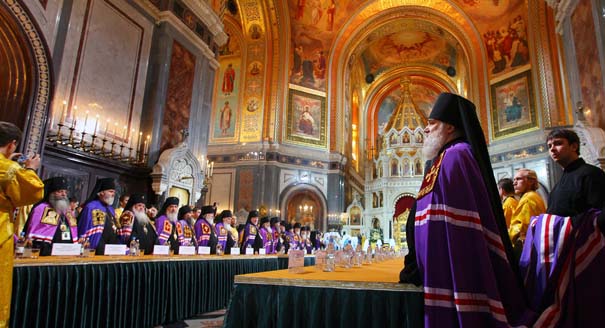
In post-Soviet countries, the leaders of national churches are increasingly exercising considerable influence on their populations and pursuing their own social and political agendas.
Source: National Interest

The phenomenon is strongest in Armenia, Georgia and Russia. The Armenian catholicos, Karekin II is not just the leader of the Armenian Gregorian Church but of Armenians worldwide. But he exercises the enormous influence he has fairly quietly. Ilia II of Georgia (who has been patriarch of Georgia since 1977) and the patriarch of Moscow, Kirill I, are more visible and both are shrewd political figures.
You could say that these two patriarchs are possibly the only untouchable figures in their two countries. In an opinion poll for NDI last April Patriarch Ilia II won an astonishing 90 percent approval rating, easily making him the most popular figure in Georgia—and comfortably outstripping President Mikheil Saakashvili who earned a positive rating of 58 percent.
Last year the Patriarch of Moscow, Kirill I, was in seventh place in Nezavisimaya Gazeta’s traditional list, compiled by experts, of Russia’s one hundred leading political figures—no mean feat for a nonpolitician. Ahead of him were only Vladimir Putin and Dmitry Medvedev and their closest allies. Behind him in the list were Russia’s defense and foreign ministers and Alexei Miller, head of Gazprom.
These men cannot be cut down to size. Surveys suggest that religious belief in Russia is getting stronger, not weaker. According to the Levada Center, two-thirds of the population now identify themselves as Russian Orthodox believers, up from less than half in the mid-nineties. The political leaders need to be associated with the powerful symbol that this represents, so, rejecting their Komsomol youth, they show up to religious services and share national platforms with the patriarch. By temperament and outlook, Georgian president Mikheil Saakashvili is far from being a pious Orthodox believer, but he recently paid public homage to the patriarch and before that consented to have his son christened.
The patriarchs use this affirmation to pursue their own agendas. To the credit of both Ilia and Kirill, one way they have done this is to insist on good relations with each other. They have opted out of the extreme narratives that took hold of both Russia and Georgia during the August war of 2008. Patriarch Ilia helped secure the return of dead bodies and personally spoke up for two Georgian musicians who had been vilified for holding concerts in Russia. Kirill instructed the Russian Orthodox Church to take a nonconfrontational line on the status disputes over Abkhazia and South Ossetia. Last month he declared, "Our brotherly churches, which are so close to each other geographically and cordially, should be two locomotives pulling our interstate relations out of the difficult situation they are now in."
Although he wouldn’t see it that way the Moscow patriarch is probably the most effective instrument of Russian soft power in the “near abroad.” He made several visits to Ukraine last year and was the only Orthodox Patriarch to be invited to the presidential inauguration ceremony of Viktor Yanukovich.
More controversially, the respect given to the Orthodox churches gives them space to advance their own conservative social agendas. Sometimes they end up just tilting at windmills, as when Archpriest Vsevolod Chaplin called last week for Russian women to stop wearing skimpy dresses—he called it “striptease”—and proposed a "national dress code". Good luck to him. But the churches are more effective on shaping a social consensus that is hostile to homosexuality and other liberal trends.
In Georgia the church message is even stronger. Ilia II urged Georgian parents to have a third child, promising to be that child’s godparent if they did. The birth rate shot up as a result. Then he condemned the spread of the observation of Halloween. Last year, he urged young Georgians not to yield to the temptation of living abroad and to resist the “danger” of globalization. “This is the time when a man should not abandon his treasure and go abroad. Any treasure must be taken care of! What is our treasure? The whole of Georgia—its temples, its values and traditions, its nation; this is our treasure house.”
The patriarch has also dipped his toe into politics, criticizing for example Georgia’s controversial education minister, Dmitry Shashkin. In Russia it is unthinkable that the patriarch, for all his power, would confront the governing elite on a key political issue. In Georgia that is now a possibility and President Saakashvili now finds he has one potential critic who is above criticism.

Senior Fellow, Carnegie Europe
Thomas de Waal is a senior fellow at Carnegie Europe, specializing in Eastern Europe and the Caucasus.
Recent Work
Thomas de Waal
Thomas de Waal
Carnegie does not take institutional positions on public policy issues; the views represented herein are those of the author(s) and do not necessarily reflect the views of Carnegie, its staff, or its trustees.

Before the next wave of EU enlargement takes place, the union needs to grapple with thorny questions of how power is distributed among its members.


Emil Sondaj Hansen, Ditte Brasso Sørensen

A summer of escalation in the Black Sea has hurt Ukraine economically and is exacerbating world food security. A truce is needed—as is a broader reframing of Europe’s Ukraine strategy.
Thomas de Waal

European Commission President Ursula von der Leyen is about to give her annual address on the state of the EU. Here’s what she won’t—but should—say.

Rym Momtaz

The EU’s responses to two recent incidents expose the gulf between European perceptions and capabilities. Unless the union can bridge that gap, it will never become a real geostrategic power.
Rym Momtaz

European states control several Overseas Countries and Territories around the world that carry strategic, economic, and environmental weight. As great powers challenge the rules-based order, defending them is a geopolitical imperative for Europe.

Marc Pierini