

Commentary
Thomas de Waal
{
  "authors": [
    "Thomas de Waal"
  ],
  "type": "legacyinthemedia",
  "centerAffiliationAll": "dc",
  "centers": [
    "Carnegie Endowment for International Peace",
    "Carnegie Europe",
    "Carnegie Russia Eurasia Center"
  ],
  "collections": [],
  "englishNewsletterAll": "ctw",
  "nonEnglishNewsletterAll": "",
  "primaryCenter": "Carnegie Europe",
  "programAffiliation": "russia",
  "programs": [
    "Russia and Eurasia"
  ],
  "projects": [],
  "regions": [
    "Caucasus",
    "Russia"
  ],
  "topics": [
    "Political Reform",
    "Domestic Politics"
  ]
}
Source: Getty
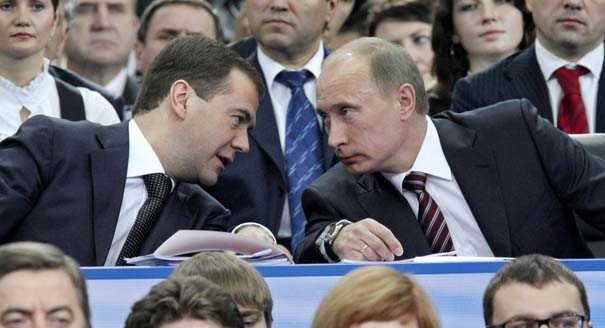
As Russia’s 2012 presidential elections draw near, the tandem government between President Dmitry Medvedev and Prime Minister Vladimir Putin faces increasing strain.
Source: The National Interest

Let me clarify this by saying that if this happens it will not be because Prime Minister Vladimir Putin and President Dmitry Medvedev want it that way. The two men still obviously need one another. The younger and weaker Medvedev needs Putin in order to function as Russian president. Putin needs Medvedev as the respectable face for Russia abroad, not least with Washington, and a voice of hope for the intelligentsia at home. But circumstances are pulling them further apart.
I do not claim detailed expertise on the ins and outs of the Medvedev-Putin relationship, but having watched several Moscow power plays work themselves through in the past I see two eternal verities of Russian politics revealing themselves, as the March 2012 presidential election approaches.
The first is that Russian leaders are not fully autonomous actors, but the patrons of big client networks. If Medvedev or Putin has occasional thoughts of retiring to spend more time at the dacha, that is anathema to their closest aides, who will lose far more than their bosses, both materially and politically, by being ejected from the seat of power. So although Medvedev and Putin use every opportunity to declare steadfast loyalty to one another, their apparatchiks are already engaged in covert warfare. Already loyalists from each camp have begun to send out their signals that their man would like to run for president in 2012.
Russia is not a democracy but it is not the Soviet Union: there is enough of a public political sphere for citizens to be able to judge the actions of their leaders. In December, both men submitted themselves to lengthy television interviews with live questions from viewers. It was a chance for Medvedev to engage in a discreet beauty contest with Putin.
Some of the differences in emphasis were striking. Putin gave viewers a stream of economic data. He talked about order, the importance of a strong state and Russia’s big upcoming sporting events. With customary sarcasm, he said of opposition politician Boris Nemtsov and his allies, “They were dragged away from the feeding trough, they ran out of cash and they want to come back and fill their pockets again.” As for Mikhail Khodorkovsky, who was still awaiting a verdict in his new trial, Putin compared him to Bernard Madoff and said, “We need to proceed from the fact that the crimes of Mr Khodorkovsky have been proved in court.”
Medvedev was less pithy, more thoughtful, more lawyerly. He repeated his two buzzwords, modernizatsia and innovatsia, which do not appear to be part of Putin’s vocabulary. On the Khodorkovsky case, there was an implied rebuke for Putin, when he said, “Neither the president not any other official in state service has the right to state his position on this case or any other case until the verdict is given.” Of Nemtsov and others, he said, “They are well-known politicians. People have different attitudes towards them. They have, so to say, their own electorate. But they are also public figures.”
In a system where there is no viable opposition or probing media, it’s likely that these differences of priority between the only two politicians with a national profile will become the nearest thing Russia has to a presidential policy debate. Medvedev and Putin will, perhaps unwittingly, become the two poles of reform versus consolidation around which Russians will cluster.
In quieter times this would be quite manageable, akin to the different points of view within Brezhnev’s Politburo. But distance between the two men is bound to widen because of a second Russian political verity, which is that Russian “stability” is always much less stable than it looks. Putin’s decade-old pact with the electorate is slowly wearing thin. Ordinary Russians are venting rage on a number of issues, ranging from the Khimki forest highway, police corruption and the mayhem on the roads. In the last month alone there have been two crises, over anti-Caucasian riots and airport shutdowns. The economy is faltering and continues to be much too dependent on oil and gas revenues—a point Medvedev himself frequently makes. In 2011, the more open Medvedev is bound to be a lightning rod for grievances on all these issues and to be cast by many—and against his will—as the leader of the opposition to the status quo.
All of this will put pressure on Putin as he makes the lonely decision on how to manage the 2012 transition and what to do with his old friend. He has the power to do what he wants with the tandem, but he no longer has the unrivaled authority he used to.

Senior Fellow, Carnegie Europe
Thomas de Waal is a senior fellow at Carnegie Europe, specializing in Eastern Europe and the Caucasus.
Recent Work
Thomas de Waal
Thomas de Waal
Carnegie does not take institutional positions on public policy issues; the views represented herein are those of the author(s) and do not necessarily reflect the views of Carnegie, its staff, or its trustees.

Before the next wave of EU enlargement takes place, the union needs to grapple with thorny questions of how power is distributed among its members.


Emil Sondaj Hansen, Ditte Brasso Sørensen

A summer of escalation in the Black Sea has hurt Ukraine economically and is exacerbating world food security. A truce is needed—as is a broader reframing of Europe’s Ukraine strategy.
Thomas de Waal

European Commission President Ursula von der Leyen is about to give her annual address on the state of the EU. Here’s what she won’t—but should—say.

Rym Momtaz

The EU’s responses to two recent incidents expose the gulf between European perceptions and capabilities. Unless the union can bridge that gap, it will never become a real geostrategic power.
Rym Momtaz

European states control several Overseas Countries and Territories around the world that carry strategic, economic, and environmental weight. As great powers challenge the rules-based order, defending them is a geopolitical imperative for Europe.

Marc Pierini