

Commentary
Olga Shumylo-Tapiola
{
  "authors": [
    "Olga Shumylo-Tapiola"
  ],
  "type": "legacyinthemedia",
  "centerAffiliationAll": "",
  "centers": [
    "Carnegie Endowment for International Peace",
    "Carnegie Europe",
    "Carnegie Russia Eurasia Center"
  ],
  "collections": [
    "Europe’s Eastern Neighborhood"
  ],
  "englishNewsletterAll": "",
  "nonEnglishNewsletterAll": "",
  "primaryCenter": "Carnegie Europe",
  "programAffiliation": "",
  "programs": [],
  "projects": [],
  "regions": [
    "Europe",
    "Eastern Europe"
  ],
  "topics": []
}
Source: Getty
With emerging powers such as China, India, and Brazil capturing the limelight at this year’s World Economic Forum in Davos, Ukraine seemed to have little to share with the world and even less to learn from it.
Source: Kyiv Post

As a Ukrainian and a woman I could not help being affected by the president’s statements. Yet, this was a harmless and ill-conceived comment, typical of Ukrainian (and many other post-Soviet) men of a particular generation and class. While much time was dedicated to this incident, shamefully less was dedicated to analyzing the president’s limited vision for this year’s World Economic Forum, and the accordingly modest results he drew from it.
For Ukraine, this year’s World Economic Forum was relatively unimportant. With emerging powers such as China, India and Brazil capturing the limelight, participants gathered in Davos to discuss how to move to adopting more strategic and long-term “shared norms for a new reality.” Yet Kyiv had little to share with the world and even less to learn from it.
In contrast to 2005, when President Viktor Yushchenko brought tears to many eyes when addressing a large audience on democracy in Ukraine, or to 2010, when the country’s presidential hopefuls shared their vision for the future with an expectant audience, this year’s forum had neither tears nor expectations for Ukraine.
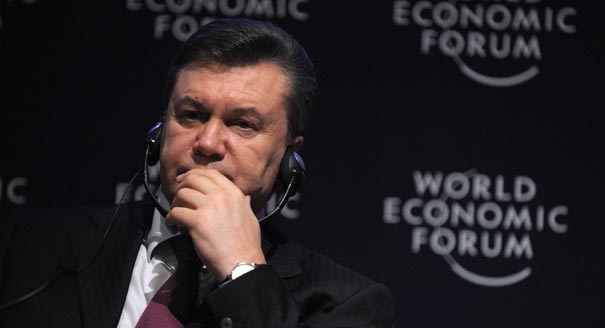
For Yanukovych, the forum was essentially another photo opportunity. His goals were rather modest and the agenda underwhelming. He participated in only one formal event, the panel on Europe’s energy policy, where he made surprisingly negative comments on Russia. In private meetings, his two priorities were energy and Chornobyl.
On the energy front, Yanukovych was clearly looking for two things – diversification of Ukraine’s energy resources and a halt to the South Stream pipeline project, which would allow Russia to bypass Ukraine in transiting gas to Western Europe. While diversification is becoming an attainable goal, with two memorandums signed with Azerbaijan in Davos, it is highly unlikely that Russia will give up its plans on alternative transit routes. However, the president will keep pushing these two goals, even at the expense of annoying Moscow.
The president’s meeting with Shell chief executive officer Peter Voser is another encouraging signal for Kyiv’s hopes for diversification, as the company is interested in exploring Ukraine’s shale gas resources. Yet it is premature to think that this deal is sealed (as some Ukrainian analysts suggest). Ukraine doesn’t have a good track record with investors, and Shell in particular will be wary of that. The 25th anniversary of the Chornobyl disaster this April is rapidly approaching, yet meetings with United Nations Secretary General Ban Ki-moon and European Bank for Reconstruction and Development President Thomas Mirow led to few concrete results. Although, at the very least, the EBRD has confirmed participation in the anniversary’s conference. Still, the president did not succeed in attracting additional funds for the new phase of Chornobyl’s transformation. A gap of 740 million euros remains and it is unlikely that the West or international organizations will be willing to fill in the gap.
Yanukovych had a chance to talk about the future during the Ukrainian lunch organized by Victor Pinchuk. The president launched the presentation on Euro 2012.
He spoke about investment opportunities in Ukraine, focusing on the country’s political stability, economic growth and reforms. Many of the lunch’s guests were apparently unmoved by the president’s performance. However, given the country’s steady decline in all international ratings, including the World Economic Forum’s Global Competitiveness Report, it would have been difficult for even the most skilled speaker to win over the audience.
By identifying three areas – metallurgy, agriculture and innovation – as being key to Ukraine’s recovery, Yanukovych was again sending mixed messages. It has been consistently demonstrated that there is little room for innovation if Ukrainian metallurgy or agriculture is involved. The reference to agriculture was directed at those who still hope that Ukraine can become the breadbasket of Europe. In reality, recent decisions on grain and land have dimmed those hopes.
The message from this event was resoundingly clear: Ukraine is no longer an attractive location for Western investors. Neither, moreover, did the country manage to attract investment from the big players further east, such as India and China. Russian investors remain the only ones undeterred by Ukraine’s bureaucracy and problems with the rule of law.
Ultimately, the president’s participation in the forum was neither a failure nor a success. He set limited goals and achieved them relatively easily. However, he will need to significantly improve Ukraine’s international standing if he wants the country to become a destination for foreign investment, or to join the G20 within the next 10 years (as he claimed last summer).
He will also have to consider adopting a more active and effective approach to Davos, focusing on innovation-driven growth, re-thinking the exploitation of natural resources, the fight against corruption, and the education of tomorrow’s leaders. Some may say that Yanukovych will not be able to cover all these topics alone. However, the solution is simple – bring fewer bodyguards and more analysts and businessmen to Davos.

Former Nonresident Associate, Carnegie Europe
Shumylo-Tapiola is a nonresident associate at Carnegie Europe in Brussels, where her research focuses on Eastern Europe and Eurasia.
Recent Work
Olga Shumylo-Tapiola
Olga Shumylo-Tapiola
Carnegie does not take institutional positions on public policy issues; the views represented herein are those of the author(s) and do not necessarily reflect the views of Carnegie, its staff, or its trustees.

The EU can impose sanctions but struggles to enforce them without the United States. With Washington increasingly disinterested in backing European interests, the bloc must now fend for itself.


Nicu Popescu, Tiago Antunes

Russia is testing the waters of NATO’s mutual defense clause. What do strikes in Romanian territorial waters mean for the alliance’s posture toward Moscow?

Dimitar Bechev

With its public finances in shambles, the far right polling at 35 percent ahead of the 2027 presidential election, and a growing protest movement, is France’s crisis a threat to the EU’s geopolitical awakening?

Rym Momtaz, ed.

Ahead of a tough winter for Ukraine, Donald Trump’s swing back toward Russia bodes ill. But instead of panicking, Kyiv’s European allies are focusing on action.
Rym Momtaz

Funding Ukraine remains a priority for European leaders. As Russia’s war of aggression heads into another winter, two feasible options to mobilize support for Kyiv should be fast-tracked.


Vladyslav Rashkovan, Gregory P. Wilson