

In The Media
Minxin Pei
{
  "authors": [
    "Minxin Pei"
  ],
  "type": "legacyinthemedia",
  "centerAffiliationAll": "dc",
  "centers": [
    "Carnegie Endowment for International Peace"
  ],
  "collections": [],
  "englishNewsletterAll": "asia",
  "nonEnglishNewsletterAll": "",
  "primaryCenter": "Carnegie Endowment for International Peace",
  "programAffiliation": "AP",
  "programs": [
    "Asia"
  ],
  "projects": [],
  "regions": [
    "East Asia",
    "China"
  ],
  "topics": [
    "Political Reform",
    "Democracy"
  ]
}
Source: Getty
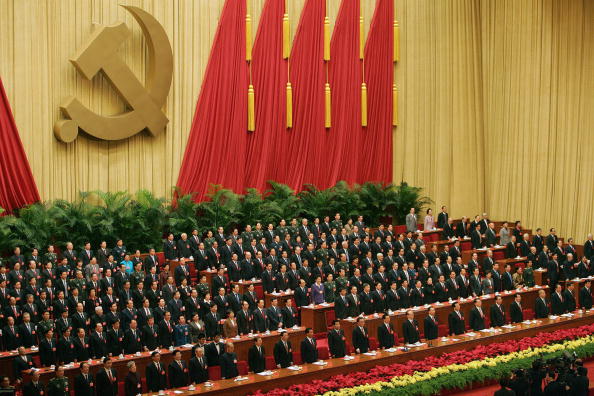
The Chinese Communist Party's rule is likely to become increasingly unsustainable as economic growth slows and a growing middle class protests against the party's single-minded focus on maintaining power.
Source: International Herald Tribune

Yet however insignificant it may have seemed back then, there was no question about its ideology, identity and mission. Inspired by utopian Marxism, the party represented China’s idealist leftists, nationalists and the downtrodden. Its mission was to end social injustice and Western colonialism.
Today the party is a political behemoth, with 80 million members and control of the world’s second-largest economy. At home its grip on power faces no organized challenge; abroad its leaders are accorded a respect Mao and Zhou Enlai could not have dreamed of.
Indeed, we should give the party its due for having abandoned the Maoist madness of its first three decades in power — the mass terror, famine, brutal political campaigns and vicious power struggles — and for radically improving the material lives of China’s 1.3 billion people.
Yet if asked, “What does the Communist Party stand for,” few Chinese leaders today could give a coherent or honest answer.
This much we know: It no longer stands for a utopian ideology. If there is one ideology that the party represents, it is the ideology of power. The sole justification for the party’s rule is the imperative to stay in power.
Nor does the party stand for China’s masses. Despite efforts to broaden its social base and make it more connected with China’s dynamic and diverse society, the party today has evolved into a self-serving, bureaucratized political patronage machine. It is undeniably an elitist party, with more than 70 percent of its members recruited from government officials, the military, college graduates, businessmen and professionals.
So for all its apparent power, the party is in fact facing an existential crisis and an uncertain future. Apart from staying in power, it has no public purpose. The crisis is not only ideological, but also political; it explains much of the cynicism, corruption and insecurity of the party and its elites.
As the party has firmly rejected democratization, its only strategy for survival is to maintain the course it has embarked on since the Tiananmen crackdown in June 1989: drawing political legitimacy from economic growth but relying on repression to crush challenges to its monopoly of power. Although this strategy has worked well since Tiananmen, its effectiveness and sustainability are increasingly in doubt.
On the economic front, growth is about to slow down. Demographic aging, resource constraints, stalled economic reforms and environmental degradation are almost certain to depress China’s growth potential. An optimistic World Bank forecast predicts a growth rate from 2016-2020 of about 7 percent annually — a respectable number, but a 30 percent drop from today’s rate.
China’s economic revolution is also unleashing powerful social forces that will make maintaining a one-party state more tenuous. The party’s governing philosophy and organizational structure make it difficult to incorporate China’s growing middle-class politically. The convergence of an economic slowdown and rising political activism will challenge the party’s rule from several directions.
Now that the Chinese Communist Party has been in power for 62 years, its leaders might also want to note that the record for one-party rule is 74 years, held by the Soviet party, followed by the 71-year rein of Mexico’s Institutional Revolutionary Party.
So when Chinese leaders toast their party’s 90th birthday, they should harbor no illusions that the party can beat history’s odds forever.
Former Adjunct Senior Associate, Asia Program
Pei is Tom and Margot Pritzker ‘72 Professor of Government and the director of the Keck Center for International and Strategic Studies at Claremont McKenna College.
Recent Work
Minxin Pei
Minxin Pei
Carnegie does not take institutional positions on public policy issues; the views represented herein are those of the author(s) and do not necessarily reflect the views of Carnegie, its staff, or its trustees.

While the EU and European governments are embracing the much-lauded middle-power moment, this entails three difficult conundrums.

Richard Youngs

Europe is facing rising populism internally as well as external pressures from Russia, China, Turkey, and the United States.

Dimitar Bechev

A notable degree of participative democracy has firmly arrived in Europe. But to have more far-reaching impact, democratic deliberation needs to move into a radically new phase.
Richard Youngs

The European Commissioner for Trade is headed to China. But after President Xi’s bridge-building visit to Washington, can a more isolated EU overcome Beijing’s stranglehold on critical raw materials? Who will blink first?

Rym Momtaz, ed.

The domestic impacts of how long it is taking to end the war in Ukraine have pushed the French electorate to the political extremes and compromised the country’s diplomatic capacity.
Rym Momtaz