

Q&A
Stephen Tankel
{
  "authors": [
    "Stephen Tankel"
  ],
  "type": "legacyinthemedia",
  "centerAffiliationAll": "dc",
  "centers": [
    "Carnegie Endowment for International Peace",
    "Carnegie Europe"
  ],
  "collections": [],
  "englishNewsletterAll": "ctw",
  "nonEnglishNewsletterAll": "",
  "primaryCenter": "Carnegie Endowment for International Peace",
  "programAffiliation": "SAP",
  "programs": [
    "South Asia"
  ],
  "projects": [],
  "regions": [
    "South Asia",
    "India",
    "Pakistan",
    "Asia"
  ],
  "topics": [
    "Security"
  ]
}
Source: Getty
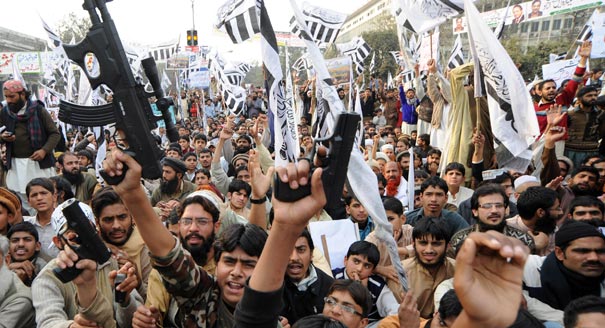
By leveraging Pakistani state support, Lashkar-e-Taiba has become one of the most powerful militant groups in the region.
Source: Foreign Policy

Like many other jihadist outfits, LeT's origins are found in the anti-Soviet jihad in Afghanistan. Its parent, the Markaz al-Dawa wal-Irshad (MDI), was born in 1986 in Afghanistan when Zaki-ur Rehman Lakhvi merged his militant outfit with a preaching organization run by Hafiz Saeed. The former is currently on trial for the 2008 Mumbai attacks, the latter remains LeT's amir. Both are adherents to Ahl-e-Hadith Islam, which is Salafist in orientation. MDI's leaders aimed to unite the Pakistani Ahl-e-Hadith movement and purify society through dawa and jihad. From the outset it was a missionary and a militant organization that for most of its history has placed an equivalent emphasis on reshaping society at home (through preaching and social welfare) and to waging violent jihad abroad. Not long after the Soviet withdrawal from Afghanistan, MDI launched LeT as its military wing. Technically, MDI was responsible for dawa (preaching) and Lashkar for jihad, but as one of its former members observed, "If you know their philosophy then you cannot differentiate between MDI and Lashkar."
Lashkar's jihad was not nation-centric, but rather pan-Islamist, and members fought on several fronts during the early 1990s. Indian-administered Kashmir was the most important of them. Lashkar leaders considered Kashmir to be part of Pakistan, meaning it was not simply a foreign land under occupation. Nor was this simply territory in need of liberation. The Kashmir jihad was part of a larger battle against Hindus, which the group's leaders assert (with little regard for history) has existed since the inception of Islam. Thus Kashmir was the most important front, though liberating it was not the apotheosis of Lashkar's jihad. Numerous other outfits were also active on this front, almost if not all of them receiving some level of support from the Pakistan army and its Inter-Services Intelligence Directorate (ISI). Lashkar was not initially the state's most favored proxy, but the over time it assumed this role. The ISI chose to channel increased support to the group for several reasons. Most important was its small size and lack of natural allies in Pakistan, where Lashkar's interpretation of jihad as an individual obligation for all Muslims estranged it from the country's small Ahl-e-Hadith movement. The assumption was the group could become powerful externally without building up a significant support base or threatening the state domestically, and hence that it would be easier to control than other outfits. This assumption proved only partly correct. Although twenty years later it remains Pakistan's most disciplined and obedient proxy, the group has become so powerful there is a strong chance it could destabilize the state if it chose to do so.
The offer of state sponsorship to promote the scale and lethality of Lashkar's participation in the Kashmir jihad was a significant opportunity, and the group seized it. Since that time, Lashkar's military activities have been informed both by its pan-Islamist rationale for jihad and its role as a proxy for the Pakistani state. Jihad against India to liberate Muslim land under perceived Hindu occupation aligned with LeT's ideological priorities and also with state interests. This enabled the group to become Pakistan's most reliable proxy, which brought with it substantial benefits including the support needed to construct a robust social welfare apparatus used for missionary and reformist purposes. In addition to this infrastructure in Pakistan and a powerful military apparatus, Lashkar wove together transnational networks which have been used primarily to support non-violent activism in Pakistan, military operations in Kashmir and terrorism against India. Thus, its ability to reconcile the two dualities that define it -- missionary and militant organization, pan-Islamist outfit and Pakistan proxy -- helped Lashkar to grow into the powerful and protected organization it is today.
Debates took place within Lashkar after 9/11, as they did in other jihadi organizations, about whether to alter its priorities or relationship with the state. Ultimately the group continued submitting to official oversight as well as prioritizing the fight against India. In return it enjoyed greater freedom of movement and operational support than any other Pakistani militant outfit. Its above-ground wing (the Jamaat-ud-Dawa, which replaced MDI in late 2001) remained legal, which enabled the group to keep its supply lines open. Its local and international fundraising surged, while recruitment remained steady. With its safe haven in Pakistan secure, the group also broadened its already robust transnational networks. However, Lashkar began playing its own double game after 9/11, using its infrastructure in Pakistan and transnational networks to contribute to the global jihad against America and its allies. A small number of Lashkar members were active in the Afghan insurgency by the middle of the decade when the group's organizational footprint on that front grew, though it has remained a minor player. Entrance into the Afghan theater necessitated greater integration with other outfits, some of which were at war with the Pakistani state. Opportunities for collaboration and conflict at the organizational as well as individual levels increased, with the former generally focused on Afghanistan and the latter ensuing as a result of diverging views regarding jihad against Pakistan. One consequence of the increased exposure of Lashkar members to other, sometimes more extreme, outfits was to put pressure on the leadership to expand the group's involvement in the global jihad against America and its allies. It was amidst this environment that the 2008 Mumbai attacks were launched.
Former Nonresident Scholar, South Asia Program
Tankel was a nonresident scholar at the Carnegie Endowment, where his research focuses on insurgency, terrorism, and the evolution of nonstate armed groups.
Recent Work
Stephen Tankel
Stephen Tankel
Carnegie does not take institutional positions on public policy issues; the views represented herein are those of the author(s) and do not necessarily reflect the views of Carnegie, its staff, or its trustees.

Russia is testing the waters of NATO’s mutual defense clause. What do strikes in Romanian territorial waters mean for the alliance’s posture toward Moscow?

Dimitar Bechev

With its public finances in shambles, the far right polling at 35 percent ahead of the 2027 presidential election, and a growing protest movement, is France’s crisis a threat to the EU’s geopolitical awakening?

Rym Momtaz, ed.

Europe is facing rising populism internally as well as external pressures from Russia, China, Turkey, and the United States.
Dimitar Bechev

The new U.S.–Denmark–Greenland agreement will help Washington exert political, economic, and financial dominance under the guise of security. Yet, it acknowledged Copenhagen’s and Nuuk’s sovereignty on the island.

Marc Pierini

A summer of escalation in the Black Sea has hurt Ukraine economically and is exacerbating world food security. A truce is needed—as is a broader reframing of Europe’s Ukraine strategy.

Thomas de Waal