

Commentary
European Commission President Ursula von der Leyen is about to give her annual address on the state of the EU. Here’s what she won’t—but should—say.
Rym Momtaz
{
  "authors": [
    "Mykola Siruk",
    "Lilia Shevtsova"
  ],
  "type": "legacyinthemedia",
  "centerAffiliationAll": "",
  "centers": [
    "Carnegie Endowment for International Peace",
    "Carnegie Russia Eurasia Center"
  ],
  "collections": [],
  "englishNewsletterAll": "",
  "nonEnglishNewsletterAll": "",
  "primaryCenter": "Carnegie Russia Eurasia Center",
  "programAffiliation": "",
  "programs": [],
  "projects": [],
  "regions": [
    "Caucasus",
    "Russia"
  ],
  "topics": [
    "Political Reform",
    "Domestic Politics"
  ]
}
Source: Getty
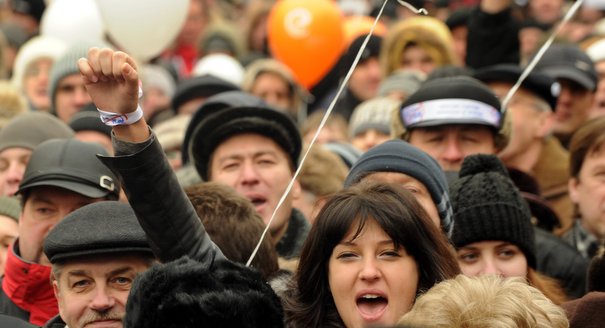
As popular pressure builds in Russia against the political status quo, it is increasingly clear that if the current opportunity to bring the authorities to a real dialogue is lost, Russia may have to wait another generation before another opportunity arises.
Source: Day

It is known that the Poles were the first in the post-Soviet space to try this method: they agreed on February 6, 1989 to convene a “roundtable” for the talks between the authorities and the opposition. The “roundtable” started its work on February 6, 1989 and finished on April 4 with signing the agreement whose main points were holding free elections, introducing the position of the president and the upper chamber of the Seim (the Senate). During the Orange Revolution in Ukraine in 2004 in Kyiv the “roundtable” was organized with the assistance of the former Polish President Aleksander Kwasniewski to find a compromise between the opposition and the government. Supported by Kwasniewski (who is considered Kuchma’s advocate in Europe), Yushchenko became the president and the former president evaded the legal prosecution.
Will the Russian “roundtable” help the Russians to compromise as it happened in Poland 20 years ago?
How might the Russian developments influence Ukraine and how might the Ukrainian question be resolved in renovated Russia? The senior associate of the Carnegie Moscow Center Lilia Shevtsova, participant of the forum told about it in the interview to The Day:
“This attempt was prepared long time ago, before the elections. It means that even before December 4 some of the representatives of the human rights community and unsystematic opposition thought over two issues: how to consolidate the Russian democratic community and create a platform needed for the dialog inside the opposition and between the opposition and the government during the crisis.
“After December 4 the developments have been so swift that it turned out that the talks about the roundtable seemed unreal a month ago. It seemed that we were so far from Poland and Ukraine. Now the developments are so dramatic that it turns out that the initiative to convene the roundtable is just out-dated and behind the changes happening in Russia.
“It is difficult to say whether this initiative will be successful of not. All the present, regardless of the disagreements in some approaches, agreed on one thing: the democratic forces of the widest range possible have to consolidate. We discussed several problems.
“Firstly, how to bridge the gap between the old traditional public society, human rights advocates and unsystematic opposition going back to the 1990s on the one hand, and the new network community, former virtual world, the generation of the people of 25-35-40 years old and even younger who used to sit at their computers but went out today and became a public society on the other hand. How to unite the older generation with the new generation: it is one of the main tasks discussed during the roundtable.
“Secondly, what principles can unite the opposition movement since a number of the communists’ and left radicals’ principles makes the cooperation with them possible in some areas. First of all, it is the principle of free and honest elections. One more question is how to prepare the political and constitutional reforms in case the government collapses or there is its vacuum. We will have to overcome this deadlock and find the new way. The new situation, the new angered generation in the streets of big cities makes the leaders of the public society, public opinion and, first of all, oppositionists feel the responsibility for the historical moment. It would be fatal to hesitate.
If the opposition loses this historical moment we will probably have to wait for another one for a long time, maybe for the whole generation.”
“Only the pressure of the society can make the power start a dialog. This power lost its instinct of self-preservation. Everything it does makes the country rot, the system degrade and the society demoralize. Any partial reforms will not help. Even the representatives of the political establishment I saw at the meeting on December 10 realize it. That is why the society has to put pressure. However, to make this pressure constructive and make the society behave in a non-violent way the democratic forces have to consolidate. So, we tried to consolidate these forces. To be honest, it is very difficult since a lot of mutual misunderstanding even between the democrats inside the unsystematic opposition has accumulated, not to mention the conflicts and tensions in the radical opposition. At the same time, some bridges have been rebuilt.
“Recently in the corridors of the radio station Ekho Moskvy I saw Gennadii Gudkov, member of the party Spravedlivaya Rossia [Fair Russia. – Ed.], former FSB colonel who told me: ‘I required my party that received a lot of protest votes to hand in their mandates.’ I asked him if the party had agreed. He said: ‘No, it did not. However, I am not alone.’
“There are some new moods and intellectual ferment. However, on the other hand, they have to be reciprocal. The opposition has to think about its responsibility and its situation. If it does not consolidate today, tomorrow it will not exist anymore. Tomorrow the new generation of leaders will come, probably, not only with the help of the democratic principles. However, its consolidation depends on the society that has to push it since now the opposition has activated because the mass did so. This mass went out independently. The people were not taken into the streets by the opposition but by the power. Impudent, shameless, and cynical power.”
“Gleb Pavlovsky is right to some extent. The power woke Russia by its impudence, corruption, and complete disregard of social needs and not only because it cannot resolve the problems of security and people’s social and economic problems. The power woke the dynamic part of the society because it humiliated its moral dignity. I think that in this concern we are similar to the Ukrainians. Hit on our moral dignity, lie and forgery. The people who went out to the streets are quite well-to-do. In this meaning Putin and Medvedev woke Russia as well as the spin doctors and propagandists like Gleb Pavlovsky did. However, the point is that Russia awakened this way will not thank those who woke it or their propagandists. Gleb Pavlovsky is one of those who helped establish this mercenary and corrupt regime. He was the person who explained this power to the society, strengthened it, and cleared the ground for it. That is why these ‘alarms’ are unlikely to be thanked. Moreover, the two ‘alarms’ are not going to leave. There is an axiom known in the world politics: the longer a rotted power lasts the more it will hurt when it collapses. Now, after the meeting the power did not step back even for a centimeter, not even for a millimeter. It is maneuvering, using various tricks, political technologies, and even repressions. We have the political prisoners, so the repressions work. Thus, on the one hand, the power is trying to let off steam and, on the other hand, to scare those who are still afraid of going into the streets.”
“As for the Russian-Ukrainian relations, I find it difficult to define their future vector. However, as for the nearest future, Putin’s foreign policy model concerning the neighboring countries seems evident since he has already demonstrated the propagandist paradigm he will use. He will look for the enemy that hinders. The West is paying to the opposition that also gums up. He will look for the enemies and return to the model of a besieged fortress. He skillfully used it in 2007 during the mass meeting at the Luzhniki Stadium where dozens of thousands members of the party Yedinaya Rossia [United Russia. – Ed.] gathered. Putin wore a black shirt and used front-line vocabulary. Now he is also addressing the front and not Yedinaya Rossia. He is also trying to use the front-line military symbolism. Proceeding from this it is obvious that not only the US and Europe are the enemies since they encircle us with their ABMs but the neighboring countries as well if they are not ready to be in the Kremlin’s pocket. So, I cannot see any reasons for the balanced, constructive, and friendly policy of the weakened Putin’s Kremlin towards Ukraine, Belarus, Georgia or the Baltic countries. Ukraine is the bad tooth, the test Moscow fails all the time. Ukraine is the weakest point of the Russian foreign policy. That is why it is possible that if Putin uses the image of enemy in the future, the Ukrainians will be the first enemies like they used to be with the Georgians.”
“Yes, it does. There is no renovated Russia so far. The moods in the Russian society have radically changed. The society is getting new. We can say that New Russia is Waking Up. However, there is old Russia in front of it: backward, overgrown with moss, traditional, rotted Russia that embodies the Kremlin and the political establishment. However, there are some turncoats in this political establishment. We have just mentioned one of them. Some of the rats are escaping from Titanic running headlong towards its iceberg.”
“You, probably, know the answer. Prokhorov declared himself a presidential candidate at the same time when Kudrin tried to make a liberal party. These two attempts were made when the power saw that the dynamic, aggressive, tough, and civilized minority went out in the streets with the liberal slogans. This is why the power had to neutralize this liberal minority somehow, influence and tempt it. For this the power has always had systematic liberal parties. One of them constantly changed its face: Gaidar’s, Chubais’s party that grew into Pravoye Delo [Just Cause. – Ed.]. Now this party has completely discredited itself. So, the new attempt to entice the liberal electorate is needed, to take it into another deadlock, and cheat it with the help of some other liberal rhetoric. That is why Prokhorov appeared. By the way, his friend Boris Nemtsov openly says that Prokhorov is the Kremlin’s project. I do not know the twists and turns of the Kremlin agreements. However, the time when Prokhorov suddenly appeared and the two systematic attempts to create liberal projects seem to be quite explicit. Prokhorov pretending to be a liberal candidate says: ‘I am not going to fight against Putin.’ But who is he going to support? Who will he fight against? He says he will fight to step on Surkov’s toes. However, there are probably other ways to vex Surkov.”
Mykola Siruk
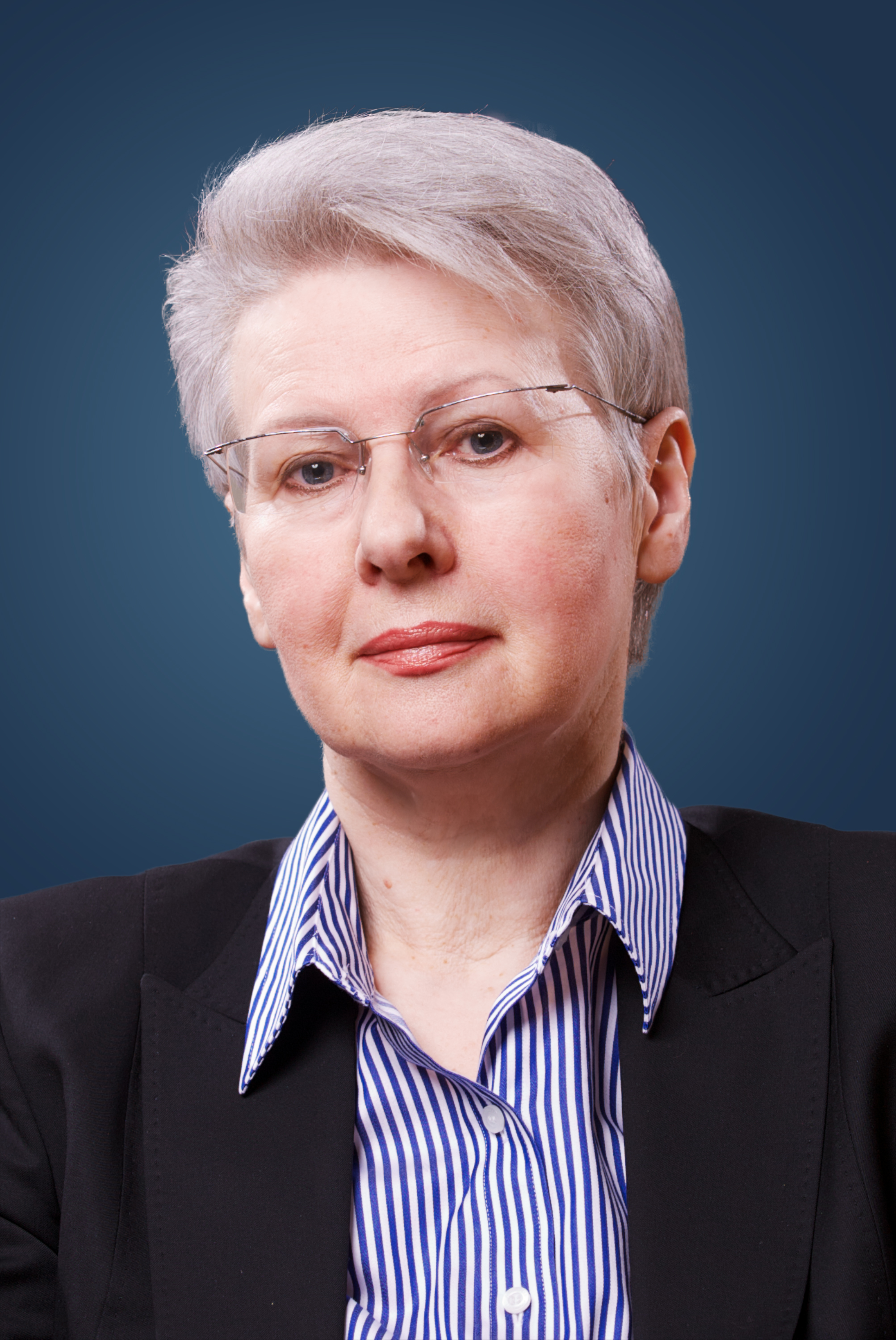
Former Senior Associate, Russian Domestic Politics and Political Institutions Program, Moscow Center
Shevtsova chaired the Russian Domestic Politics and Political Institutions Program at the Carnegie Moscow Center, dividing her time between Carnegie’s offices in Washington, DC, and Moscow. She had been with Carnegie since 1995.
Carnegie does not take institutional positions on public policy issues; the views represented herein are those of the author(s) and do not necessarily reflect the views of Carnegie, its staff, or its trustees.

European Commission President Ursula von der Leyen is about to give her annual address on the state of the EU. Here’s what she won’t—but should—say.

Rym Momtaz

The EU’s responses to two recent incidents expose the gulf between European perceptions and capabilities. Unless the union can bridge that gap, it will never become a real geostrategic power.
Rym Momtaz

European states control several Overseas Countries and Territories around the world that carry strategic, economic, and environmental weight. As great powers challenge the rules-based order, defending them is a geopolitical imperative for Europe.

Marc Pierini

In supporting Europe’s far-right, MAGA and Russia both want the same thing: a weaker EU. Europe must defend itself without abandoning the openness these forces exploit.

Armida van Rij

As we close out another season of Strategic Europe, it is worth taking stock of the deep shifts underway.
Rym Momtaz