

Commentary
Yukon Huang, Isaac B. Kardon, Matt Sheehan
{
  "authors": [
    "Yukon Huang"
  ],
  "type": "legacyinthemedia",
  "centerAffiliationAll": "dc",
  "centers": [
    "Carnegie Endowment for International Peace",
    "Carnegie China"
  ],
  "collections": [],
  "englishNewsletterAll": "asia",
  "nonEnglishNewsletterAll": "",
  "primaryCenter": "Carnegie China",
  "programAffiliation": "AP",
  "programs": [
    "Asia"
  ],
  "projects": [],
  "regions": [
    "North America",
    "United States",
    "East Asia",
    "China"
  ],
  "topics": [
    "Political Reform",
    "Economy",
    "Trade"
  ]
}
Source: Getty
The causes of China’s unbalanced growth are often misunderstood in the West. As national and global conditions change, however, the policies that served China well in the past may need to be reconsidered.
Source: OECD Observer

No country generates such heated views about its economy as China. Optimists see a rapidly emerging power that will soon overtake the US in the size of its economy. Pessimists see a house of cards that will soon implode in a major financial crisis. East Asian countries see China as the centre of a production sharing network that helped the region to recover from its own financial crisis a decade ago. But many in the OECD, especially the US, see China as resorting to unfair subsidies and an undervalued exchange rate to gain an advantage in export production.
These alternative realities stem partly from the fact that the China growth model does not fit the western stereotype. China’s economic institutions are fragile yet implementation of policies is strong. The costs of key inputs are distorted, yet what is being manufactured is exceptionally competitive in global markets. Income inequality has been deteriorating sharply over the past several decades yet some 500 million people have been lifted out of poverty. These paradoxes are shaped in part by differing ideological views, but they also reflect a misinterpretation about the nature of China’s growth process.
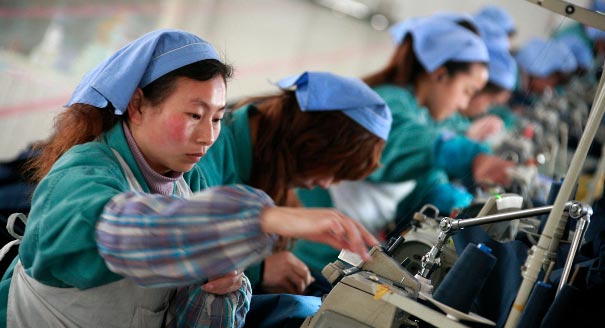
China’s rapid economic rise over the past three decades has shown that strong implementation capacity at the local level guided by centralised decision-making can substitute—at least temporarily—for the market-based financial and regulatory institutions that characterise developed economies. No one disputes the fact that in China wages are low, capital is cheap and land is misused. But since China’s products must compete in global and diverse national markets, competitive pressures discourage many of the gross inefficiencies that led to economic collapse in the former Soviet Union. And although widening urban-rural disparities in access to social services and opportunities have exacerbated inequalities, the rapidly increasing living standards among the poorest of society compare favorably with other middle- and low-income countries.
But these accomplishments took place when global and national conditions were quite different than what the future now portends. This suggests that policies that served China well in the past need to be reconsidered.
Foremost in everyone’s mind—including China’s senior leadership—is how to deal with what is widely perceived as an exceptionally unbalanced growth process. These imbalances are also seen as driving its trade surpluses with the US and the EU. Compared with other countries, China’s consumption to GDP ratio is exceptionally low, suggesting that consumers are being repressed. China’s investment to GDP ratio is exceptionally high, suggesting a bias toward exports and low efficiency. This leads most observers to a standard solution: China must increase domestic consumption and dampen investment. In the process, China’s trade surplus should then be moderated, making it easier for the US and Europe to generate the surpluses needed to revive growth.
But this view about China’s unbalanced growth may be misleading. Few pause to ask why these GDP numbers are so inconsistent with the prevailing impression that households have been indulging in a buying spree for years. How can one reconcile growth of around 20% annually in key consumption items with GDP numbers that show household consumption growing at less than 10%? Something is wrong.
Simple logic tells us that China’s domestic consumption is seriously understated. This is due in part to the difficulties in moving from the accounting system used during China’s central planning period to one used in market economies. As noted by China’s National Bureau of Statistics, more work is still needed to incorporate informal activities, non-cash transactions and the rising costs of housing services into the official GDP figures. Adjusting for these statistical discrepancies might account for about half of the unusually low consumption to GDP ratio, with the rest explained by the declining share of household income as a share of GDP.
While much attention has been given to how “financial repression”, in the form of exceptionally low interest rates paid to savers, has reduced household incomes and thus consumption, this has accounted for only a fraction of the decline in the share of income to GDP over the past decade. Far more important has been the structural shift of workers from rural to urban activities and within the urban areas. As more workers move out of agriculture and into industry—certainly a good thing—labour’s share of national income falls. This is because labour’s share of income in agriculture is nearly 90%, but in industry it is only 50%. So while workers enjoy higher earnings and productivity increases when they move from rural to urban activities, the percentage of income that goes directly to workers declines.
But even as household incomes expand, rising savings rates mean that consumption has not kept pace. This stems in part from “precautionary savings” by households that do not have total confidence in the newly created pension schemes and by the 200 million migrant workers who lack formal residency rights (hukou) and are therefore reluctant to spend as freely as established residents. Things will change, but it will take time.
The other major factor influencing the lower share of household consumption in China is that income from investments and government transfers accounts for a much smaller share of disposable income than in other countries. In a socialist economy with all land and major assets owned by the state, the returns from these assets accrue largely to the state and not to private households.
Under these conditions, the state needs to provide a much larger share of public social expenditures to supplement household consumption. But social expenditures in China as a share of GDP are way below the norm. Disagreements over China’s economic trajectory will continue, as these changes will not happen overnight. But if government spending for social services could be increased by say 3% of GDP—which would be beneficial for China—this could by itself eliminate China’s trade surpluses and reduce the protectionist sentiments that are now becoming a contentious issue in the West.

Senior Fellow, Asia Program
Huang is a senior fellow in the Carnegie Asia Program where his research focuses on China’s economy and its regional and global impact.
Recent Work


Yukon Huang, Isaac B. Kardon, Matt Sheehan
Yukon Huang, Genevieve Slosberg
Carnegie does not take institutional positions on public policy issues; the views represented herein are those of the author(s) and do not necessarily reflect the views of Carnegie, its staff, or its trustees.

The battle over free speech has taken center stage since U.S. Vice President JD Vance accused Europe of censorship. From travel bans to social media regulation, especially around the Israel-Palestine conflict, are liberal democratic governments weaponizing free speech?

Rym Momtaz, ed.

Amid uncertainty caused by the Iran war, the global drive for nonproliferation has stalled. With Europe diplomatically marginalized and countries reassessing their nuclear options, efforts to curb the spread of nuclear weapons risk becoming irrelevant.

Jane Darby Menton
Between the United States’ market-driven approach and China's state-led industrial strategy, Europe is reckoning with how it can remain competitive in the global economy. But is Europe in danger of becoming a U.S. or China colony?


Noah Barkin, Anu Bradford

Preparing candidate countries for EU membership is no longer enough. As the enlargement process becomes a reality, the union must also prepare its own societies.

Iliriana Gjoni
The full list of humiliations Europe has endured since Donald Trump returned to the White House makes for grim reading. But Washington’s adversarial approach to its allies undermines its own power base.
Rym Momtaz