Matthew Rojansky
{
"authors": [
"Matthew Rojansky"
],
"type": "legacyinthemedia",
"centerAffiliationAll": "dc",
"centers": [
"Carnegie Endowment for International Peace"
],
"collections": [],
"englishNewsletterAll": "ctw",
"nonEnglishNewsletterAll": "",
"primaryCenter": "Carnegie Endowment for International Peace",
"programAffiliation": "russia",
"programs": [
"Russia and Eurasia"
],
"projects": [],
"regions": [
"Caucasus",
"Russia"
],
"topics": [
"Political Reform",
"Foreign Policy"
]
}Source: Getty
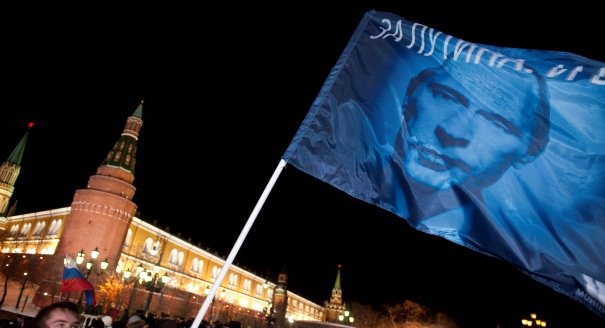
Is Putin's Victory Guaranteed?
It is not certain that Putin will win the elections on Sunday, but it is very likely. If Putin is elected, he will face implications in Russia's domestic policy and its relationship with the United States.
Source: CTV (Canada)


- Medvedev: Putin has made promises that Medvedev will be Prime Minister after the elections. However, “whether Medvedev will stay as Prime Minister I think is unlikely,” said Rojansky, adding that “in some ways, he is the perfect fall guy down the road.”
- Domestic Reforms: Given the extensive protests against Putin’s rule, and the likelihood of renewed protests after the election, “Putin is going to do what he has to do,” said Rojansky. There will be a veneer of modernization and Putin will have to make concessions to some demands, such as improving modern technology and creating more opportunities for IT and high-tech jobs. However, “Putin cannot adjust the basic bargain he has made with the oligarchs and Russia’s elite,” warned Rojansky. "If he starts to shake up that deal, those guys will turn against him.”
- Syria: Once it is clear that the Assad regime is falling, Putin cannot sustain Russia’s major financial and security interests in Syria and has no further reason for Russia to continue to support the Assad regime. “If Putin will, in fact, win on Sunday, it becomes much less important for him to draw that line in the sand that says public protests should never be allowed to bring down what he considers to be a legitimate government,” added Rojansky.
- U.S.–Russia Relations: There is a good reason to believe that Putin will sustain the reset relationship with the United States, Rojansky stated.
About the Author
Former Deputy Director, Russia and Eurasia Program
Rojansky, formerly executive director of the Partnership for a Secure America, is an expert on U.S. and Russian national security and nuclear-weapon policies.
- An Opportunity for Ambition: Ukraine’s OSCE ChairmanshipPaper
- Presiding Over the OSCE: Challenges and OpportunitiesIn The Media
Matthew Rojansky
Recent Work
Carnegie does not take institutional positions on public policy issues; the views represented herein are those of the author(s) and do not necessarily reflect the views of Carnegie, its staff, or its trustees.

More Work from Carnegie Europe
- Taking the Pulse: Is it NATO’s Job to Support Trump’s War of Choice?Commentary
Donald Trump has demanded that European allies send ships to the Strait of Hormuz while his war of choice in Iran rages on. He has constantly berated NATO while the alliance’s secretary-general has emphatically supported him.
Rym Momtaz, ed.
- Time to Merge the Commission and EEASCommentary
The EU is structurally incapable of reacting to today’s foreign policy crises. The union must fold the EEAS into the European Commission and create a security council better prepared to take action on the global stage.
Stefan Lehne
- Russia’s Imperial Retreat Is Europe’s Strategic OpportunityCommentary
The war in Ukraine is costing Russia its leverage overseas. Across the South Caucasus and Middle East, this presents an opportunity for Europe to pick up the pieces and claim its own sphere of influence.
William Dixon, Maksym Beznosiuk
- Is the Radical-Right Threat Existential or Overstated?Commentary
Amid increased polarization and the influence of disinformation, radical-right parties are once again gaining traction across Europe. With landmark elections on the horizon in several countries, are the EU’s geostrategic vision and fundamental values under existential threat?
Catherine Fieschi, Cas Mudde
- Europe and the Arab Gulf Must Come TogetherCommentary
The war in Iran proves the United States is now a destabilizing actor for Europe and the Arab Gulf. From protect their economies and energy supplies to safeguarding their territorial integrity, both regions have much to gain from forming a new kind of partnership together.
Rym Momtaz








