

Paper
Matthew Rojansky
{
  "authors": [
    "Matthew Rojansky"
  ],
  "type": "legacyinthemedia",
  "centerAffiliationAll": "dc",
  "centers": [
    "Carnegie Endowment for International Peace",
    "Malcolm H. Kerr Carnegie Middle East Center",
    "Carnegie Russia Eurasia Center"
  ],
  "collections": [],
  "englishNewsletterAll": "ctw",
  "nonEnglishNewsletterAll": "",
  "primaryCenter": "Carnegie Endowment for International Peace",
  "programAffiliation": "russia",
  "programs": [
    "Russia and Eurasia"
  ],
  "projects": [
    "Eurasia in Transition"
  ],
  "regions": [
    "Middle East",
    "Syria",
    "Caucasus",
    "Russia",
    "Levant"
  ],
  "topics": [
    "Security",
    "Foreign Policy"
  ]
}
Source: Getty
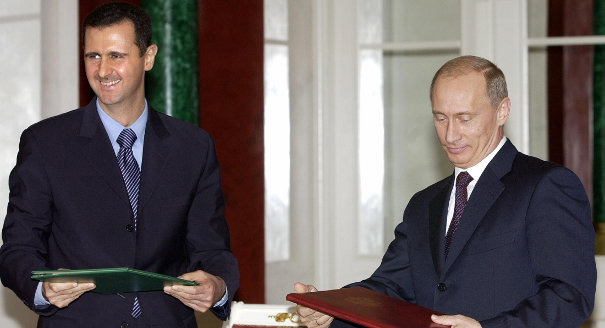
Russia’s intransigence in the face of intense international pressure to halt the violence in Syria is confusing to much of the world, but there are real Russian financial and strategic interests at stake over Syria.
Source: CNN

Yet, as seen from Moscow, there is a method to this madness. For anyone who still believes the conflict should be resolved with the backing of the U.N. Security Council, Russia cannot just be written off as an irrational actor. In fact, senseless as Moscow’s position might appear, there are real Russian interests at stake over Syria, and if we make an effort to understand them, it may be possible to find a solution that satisfies Vladimir Putin and saves Syrian lives.
So, what does Russia really want with Syria?
Follow the Money. A considerable amount of cash is at stake for Moscow in Syria. Since the 1950s, the Soviet Union and then Russia were intimately involved in developing Syria’s oil-processing, electric power, irrigation, transportation and other major infrastructure projects. These, together with massive arms sales, including equipping Syria’s armies for two major wars with Israel, resulted in over $10 billion in Soviet-era debt owed by Damascus to Moscow. The Russians forgave two thirds of that in 2005, but still expected the remaining $3.6 billion to be paid by 2015.In addition, Syria’s history as a Soviet client state has kept lucrative investment opportunities open for Russians in the post-Soviet era, including tens of millions invested in oil exploration, billions in oil and natural gas transit and refining, and some $4 billion in active arms contracts as of 2011 - not to mention the $550 million deal to sell Syria Yak-130 trainer jets signed in January while al-Assad was already pummeling Homs with Russian-built hardware.
The bottom line is that Russia’s billions of dollars in current and future accounts payable have Bashar al-Assad’s name on them, and no post-al-Assad government is likely to honor them. To win Russian support for a Syrian transition strategy will require a credible deal for compensating the Kremlin and powerful commercial interests close to it.
The “Syrian Gambit.” Putin sees Russia as a great power with global interests, and like a savvy chess player, he thinks several moves ahead. Russia’s navy base at Tartus may not be worth much today, when Russia’s skeletal navy can hardly spare vessels to patrol far-off Mediterranean waters, but Putin has a long-term plan for his country’s rearmament, which includes building dozens of new fighting ships and submarines to reassert Moscow’s global conventional military power. If al-Assad goes, Putin can hardly expect to keep his lease on Tartus, and Russia’s fleet may not find a single welcoming port of call from the Bosporus to Gibraltar.
Part of demonstrating Russia’s great power status is also proving that it is not beholden to any other global power center - especially the United States - and opposing Washington over Syria allows Russians to claim that unlike Europe or even the Arab League, they are not under America’s thumb. Whether others are persuaded matters less than that they can’t do much about it.
Above all, though, Putin would like to be the “indispensible actor” in international security. And on Syria, he must be pleased to note, he has nearly got his wish. The recent visit of the Red Cross chief to Moscow, and the entreaties of world leaders from Kofi Annan to William Hague signify to Putin that if a resolution to the conflict is possible, Moscow must be its architect. Unless the rest of the world is prepared to escalate without Security Council authorization, Putin is probably right.
Fear and Loathing. If there is one security issue that keeps Vladimir Putin awake at night, it is almost certainly the specter of Russia’s encirclement by NATO, which he and many Russians can see only as a hostile military alliance, made even more hostile and brought up to Russia’s very doorstep when former Soviet satellites joined the alliance during the last decade.
But NATO is not just encircling Russia by adding members - it is expanding its “area of operations” far outside Europe into the heart of Moscow’s former “spheres of influence.” If French planes can bomb Tripoli, and American troops can occupy Kabul, why not Bishkek, Minsk, or even Moscow? A line must be drawn, and Syria is as good a place as any to draw it. And speaking of drawing lines, Putin must make sure that Syria does not become another precedent for “people power” bringing down authoritarian regimes that once seemed impregnable. That problem hits especially close to home now, after tens of thousands of Russians marched in Moscow and elsewhere to condemn manipulated elections and call for Putin’s ouster.
Statesmen of goodwill around the world have pleaded with Putin, and have been left wondering why he cannot seem to appreciate the gravity of the slaughter that his intransigence has enabled, or at least is failing to stop. But it misses the point to conclude that Putin is simply indifferent to this tragedy.
True, the Soviet Union lost over 20 million civilians in the “Great Patriotic War” against Nazi Germany, many millions more died in Stalin’s purges, and tens of thousands of Russians were killed in two campaigns to suppress Chechen separatism, so it may be hard to persuade them that the slaughter of civilians in Syria is somehow unacceptable just because of its human cost. For Putin, Syria is not about humanitarian imperatives. Rather, it is about the way he understands Russia’s financial and strategic interests, and his own elemental insecurities. Find a way to placate these, and the road to Syria’s salvation may indeed run through Moscow.
Former Deputy Director, Russia and Eurasia Program
Rojansky, formerly executive director of the Partnership for a Secure America, is an expert on U.S. and Russian national security and nuclear-weapon policies.
Recent Work
Matthew Rojansky
Matthew Rojansky
Carnegie does not take institutional positions on public policy issues; the views represented herein are those of the author(s) and do not necessarily reflect the views of Carnegie, its staff, or its trustees.

The new U.S.–Denmark–Greenland agreement will help Washington exert political, economic, and financial dominance under the guise of security. Yet, it acknowledged Copenhagen’s and Nuuk’s sovereignty on the island.

Marc Pierini

A summer of escalation in the Black Sea has hurt Ukraine economically and is exacerbating world food security. A truce is needed—as is a broader reframing of Europe’s Ukraine strategy.

Thomas de Waal

Are Germany’s economic, industrial, and political struggles becoming a liability for the EU’s ability to rise to the geopolitical moment?

Rym Momtaz, ed.

European Commission President Ursula von der Leyen is about to give her annual address on the state of the EU. Here’s what she won’t—but should—say.
Rym Momtaz

The aftermath of the Ceuta crisis shows Europe has drawn the wrong lessons. Rather than doubling down on failed migration policies, the EU needs to address the underlying roots of such episodes.

Richard Youngs