

Commentary
Nikolay Petrov
{
  "authors": [
    "Nikolay Petrov"
  ],
  "type": "legacyinthemedia",
  "centerAffiliationAll": "",
  "centers": [
    "Carnegie Endowment for International Peace",
    "Carnegie Europe",
    "Carnegie Russia Eurasia Center"
  ],
  "collections": [],
  "englishNewsletterAll": "",
  "nonEnglishNewsletterAll": "",
  "primaryCenter": "Carnegie Russia Eurasia Center",
  "programAffiliation": "",
  "programs": [],
  "projects": [],
  "regions": [
    "Caucasus",
    "Russia"
  ],
  "topics": [
    "Political Reform"
  ]
}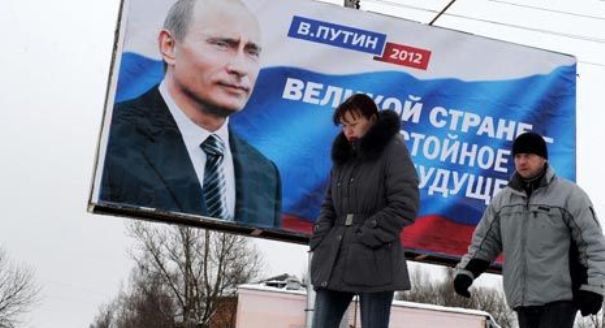
Source: Getty
There is no reason to believe that the protests and the problems associated with them will end now that the Duma and presidential elections are over.
Source: The Moscow Times

The other four candidates mounted surprisingly passive campaigns. Not only did they take pains to avoid criticizing Putin, but they were careful to maintain a low profile by making few campaign trips and showing little initiative. Liberal Democratic Party head Vladimir Zhirinovsky earned fewer votes than ever in a lackluster campaign where it seemed as if he went out of his way to lose votes.
Just Russia leader Sergei Mironov also failed to impress. He garnered fewer votes and suffered the largest decline in relation to his party's showing in the December State Duma elections than all four other candidates.Although Mikhail Prokhorov visited five regions — as compared to Putin's 18 — he focused his efforts on the Internet. The Kremlin guessed correctly that Prokhorov's participation would give a degree of novelty and added legitimacy to the presidential election.
Apparently, the methods used to rig elections have changed. The ballot box-stuffing and "carousel" voting, in which groups of people are bused to several polling places to cast multiple votes, have become less effective than before, while the use of administrative resources increased in size.
This was most obvious in Moscow and St. Petersburg, where the Kremlin solved the extremely difficult task of raising the number of votes for Putin to match his stronger showing in the regions while minimizing the vote-rigging so as to avoid scandals and protests. This was accomplished by busing in a large number of pro-Putin voters from several regions along with a large number of police and Interior Troops.
Sunday's election also apparently broke a record for the use of absentee ballots. And the wholesale use of "carousels" should logically result in the Central Elections Commission declaring a significantly higher voter turnout than for the Duma elections in December.
If we are witnessing a new side to Putin, it is only in the sense that he worked harder to win this election than he did in previous votes. It would seem that this election marked not so much the start of a new political era as the end of the current one. Putin, Mironov and Zhirinovsky appear to be approaching the end of their political careers. In all likelihood, none of them will take part in the next presidential election — which might be held earlier than 2018.
The Duma and presidential elections are over, but the process of change they have sparked will continue for years. The impetus for that change stems from mass protests over blatant electoral fraud.
What will happen next?
Much depends on how the authorities respond to future political protests and whether they, in response, institute meaningful reforms. There is no reason to believe, as many in the Kremlin do, that the protests and the problems associated with them will end now that the election is over.
The Kremlin has yet to adequately respond to the protesters' demands. This probably means that the protests will increase in size and intensity. What's more, Russians face hikes in their utility bills coupled with cuts to social spending and pensions, despite election promises to the contrary. This alone could be enough to prompt people to take to the streets demanding change.
Former Scholar-in-Residence, Society and Regions Program, Moscow Center
Nikolay Petrov was the chair of the Carnegie Moscow Center’s Society and Regions Program. Until 2006, he also worked at the Institute of Geography at the Russian Academy of Sciences, where he started to work in 1982.
Recent Work
Nikolay Petrov
Nikolay Petrov
Carnegie does not take institutional positions on public policy issues; the views represented herein are those of the author(s) and do not necessarily reflect the views of Carnegie, its staff, or its trustees.

Before the next wave of EU enlargement takes place, the union needs to grapple with thorny questions of how power is distributed among its members.


Emil Sondaj Hansen, Ditte Brasso Sørensen

A summer of escalation in the Black Sea has hurt Ukraine economically and is exacerbating world food security. A truce is needed—as is a broader reframing of Europe’s Ukraine strategy.

Thomas de Waal

European Commission President Ursula von der Leyen is about to give her annual address on the state of the EU. Here’s what she won’t—but should—say.

Rym Momtaz

The EU’s responses to two recent incidents expose the gulf between European perceptions and capabilities. Unless the union can bridge that gap, it will never become a real geostrategic power.
Rym Momtaz

European states control several Overseas Countries and Territories around the world that carry strategic, economic, and environmental weight. As great powers challenge the rules-based order, defending them is a geopolitical imperative for Europe.

Marc Pierini