

Q&A
- +1
Sheena Chestnut Greitens, Oriana Skylar Mastro, Yukon Huang, …
{
  "authors": [
    "Yukon Huang"
  ],
  "type": "legacyinthemedia",
  "centerAffiliationAll": "dc",
  "centers": [
    "Carnegie Endowment for International Peace"
  ],
  "collections": [],
  "englishNewsletterAll": "asia",
  "nonEnglishNewsletterAll": "",
  "primaryCenter": "Carnegie Endowment for International Peace",
  "programAffiliation": "AP",
  "programs": [
    "Asia"
  ],
  "projects": [],
  "regions": [
    "East Asia",
    "China"
  ],
  "topics": [
    "Economy",
    "Trade"
  ]
}
Source: Getty
China will need more than rhetoric to overcome the policy silos, entrenched interests, and adjustment costs that stand in the way of continued reform.
Source: Financial Times

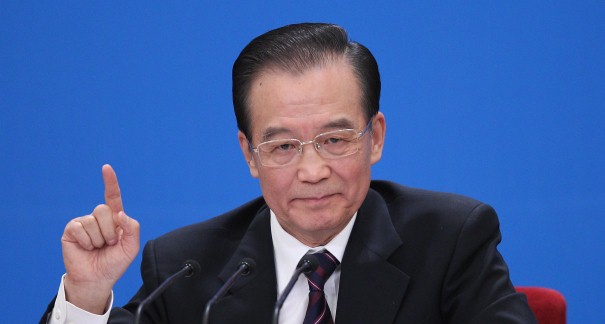
Premier Wen Jiabao’s report to the legislature covered every problem facing the country. He and his generation recognised China’s many ills. But these same issues have been highlighted every year—while the pace of reforms has slowed. It’s wise to separate good intentions from action.
Is there any way we can trust the policy messages coming out of the NPC?Mr Wen himself can help in this respect. He offered criteria to judge the Chinese leadership when he noted that the country’s growth process is “unbalanced, unsustainable, and uncoordinated.”
In doing so, once again, his intentions were laudable.
China’s leadership deserves an “A” for advocating more balanced growth. Much was made of the lower growth target of 7.5 percent for this year. But slower growth is consistent with Beijing’s intentions to achieve a soft landing. Declining trade surpluses will help the West by moderating global imbalances and facilitating China’s shift to a more flexible exchange rate system.
The leadership also deserves an “A” for recognising increasing “unsustainability”: incidents of social unrest and widening inequalities. The media’s attention to the land related protests in Wukan and labour issues at Foxconn, as well as the role that corruption and urban-rural disparities played in shaping Mr Bo’s rise and fall in Chongqing, illustrate the intricacies of the forces involved. Thus Mr Wen signaled that “social management” must be improved, disparities moderated, land transfers done properly, and workers protected.
But although the leadership gets an “A” for good intentions, it gets an “F” for not turning these intentions into reality.
The litmus test for the new leadership is how bold it will be in recalibrating the role of the state. China has failed to adequately coordinate the reform process. The increasingly complex and more market driven economy inherently means that structural weaknesses are now more interrelated. Policymakers face a logjam of distortions that require a more concerted approach than Deng’s celebrated “crossing the river by feeling the stones” strategy that served China so well in the past.
What worked before will not ensure China’s future prosperity.
The China of 2020 cannot be one where the state still controls the allocation of capital, interest and exchange rates, use of land, and movement of labor. But reforming the financial system is not possible without strengthening the fiscal system to take on more responsibilities. Liberalising interest rates cannot be handled without a more flexible exchange rate system. Eliminating residency restrictions for migrant workers cannot happen without land markets that allow them to monetize the value of their land use rights. And localities need more sustainable revenue options to support the services for incoming migrant families to make their inflows politically acceptable.
Perceptions that the pace of reforms in China is slackening reflects an illusion: policymaking is not as unified as it seems to the amateur observer. Responsibilities are compartmentalised under different senior leaders and “leading groups” and therefore they are vulnerable to capture by vested interests. The challenge for the new leadership is to stop this from happening.
Change begins by recognizing that unlike the past, solutions require more interrelated actions that cut across traditional policy making silos. It calls for political courage to deal with vested interests that only emerged over the past decade or so as privileged access to resources or positions became valuable in a quasi-market based economy. It acknowledges the need to cushion the cost of change for those who will lose out in the reform process. It needs dedicated task forces to spearhead reform initiatives that are seen by both the public and bureaucracy as having the full support of the State Council and in particular its top leadership.
Only then will China’s leadership get an “A” for its actions as well as for its intentions.
This article was originally published in the Financial Times.

Senior Fellow, Asia Program
Huang is a senior fellow in the Carnegie Asia Program where his research focuses on China’s economy and its regional and global impact.
Recent Work


Sheena Chestnut Greitens, Oriana Skylar Mastro, Yukon Huang, …

Yukon Huang, Isaac B. Kardon, Matt Sheehan

With its public finances in shambles, the far right polling at 35 percent ahead of the 2027 presidential election, and a growing protest movement, is France’s crisis a threat to the EU’s geopolitical awakening?

Rym Momtaz, ed.

While the EU and European governments are embracing the much-lauded middle-power moment, this entails three difficult conundrums.

Richard Youngs

Europe is facing rising populism internally as well as external pressures from Russia, China, Turkey, and the United States.

Dimitar Bechev

Much has been said of the changes Brussels is trying to make to the EU enlargement process. Here’s why gradual integration might—or might not—be the answer.
Dimitar Bechev

The European Commissioner for Trade is headed to China. But after President Xi’s bridge-building visit to Washington, can a more isolated EU overcome Beijing’s stranglehold on critical raw materials? Who will blink first?
Rym Momtaz, ed.