Nikolay Petrov
{
"authors": [
"Nikolay Petrov"
],
"type": "legacyinthemedia",
"centerAffiliationAll": "",
"centers": [
"Carnegie Endowment for International Peace",
"Carnegie Russia Eurasia Center"
],
"collections": [],
"englishNewsletterAll": "",
"nonEnglishNewsletterAll": "",
"primaryCenter": "Carnegie Russia Eurasia Center",
"programAffiliation": "",
"programs": [],
"projects": [],
"regions": [
"Caucasus",
"Russia"
],
"topics": [
"Political Reform"
]
}Source: Getty
Kremlin Fanning Ethnic And Religious Tensions
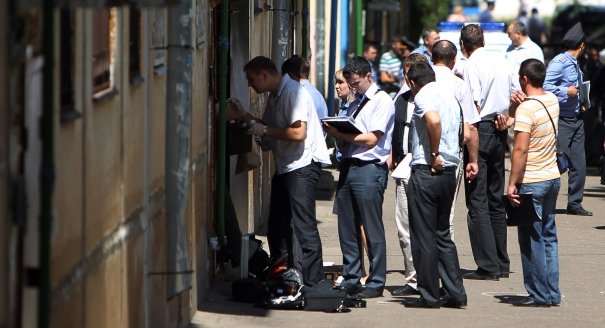
Inter-religious and interethnic relations are rapidly deteriorating in Russia, but the authorities lack the programs to cope with them, the mechanisms to create new programs, and the realization that both are urgently needed.
Source: The Moscow Times

This summer, Krasnodar Governor Alexander Tkachyov suggested organizing armed groups — composed of Cossacks. In fact, his initiative was not the first; other regions have revived the idea of using Cossack units to maintain order. Calls have also recently been made to form "Orthodox squads" in response to vandalized crosses and the desecration of Russian Orthodox churches.
The Kremlin, meanwhile, has used the Pussy Riot case as an ideological tool, defending traditional and Russian Orthodox values in a bid to consolidate its conservative electorate. But in doing so, it has polarized society and provoked the radicalization of opposing camps. That polarization is only heightened by the church's increasingly anti-modernist stance.
The Dagestan tragedy occurred almost simultaneously with a meeting of the new presidential council for interethnic relations, a blatantly ineffectual and ceremonial body that issues lofty statements about key problems even as the government cuts funding to the few programs intended to address them. And in true Soviet style, the council is not composed of specialists on interethnic relations but of leaders of the largest ethnic minorities and various officials.
Thus, as interethnic and inter-religious relations rapidly deteriorate, the authorities lack programs to cope with them, mechanisms to create new programs, and the realization that both are urgently needed. This leaves the police powerless. What's more, the reactionary measures being proposed on the regional level are likely to fan the flames.
About the Author
Former Scholar-in-Residence, Society and Regions Program, Moscow Center
Nikolay Petrov was the chair of the Carnegie Moscow Center’s Society and Regions Program. Until 2006, he also worked at the Institute of Geography at the Russian Academy of Sciences, where he started to work in 1982.
- Moscow Elections: Winners and LosersCommentary
- September 8 Election As a New Phase of the Society and Authorities' CoevolutionCommentary
Nikolay Petrov
Recent Work
Carnegie does not take institutional positions on public policy issues; the views represented herein are those of the author(s) and do not necessarily reflect the views of Carnegie, its staff, or its trustees.

More Work from Carnegie Europe
- How to Join the EU in Three Easy StepsCommentary
Montenegro and Albania are frontrunners for EU enlargement in the Western Balkans, but they can’t just sit back and wait. To meet their 2030 accession ambitions, they must make a strong positive case.
Dimitar Bechev, Iliriana Gjoni
- Rewiring the South Caucasus: TRIPP and the New Geopolitics of ConnectivityArticle
The U.S.-sponsored TRIPP deal is driving the Armenia-Azerbaijan peace process forward. But foreign and domestic hurdles remain before connectivity and economic interdependence can open up the South Caucasus.
Thomas de Waal, Areg Kochinyan, Zaur Shiriyev
- Russia’s Imperial Retreat Is Europe’s Strategic OpportunityCommentary
The war in Ukraine is costing Russia its leverage overseas. Across the South Caucasus and Middle East, this presents an opportunity for Europe to pick up the pieces and claim its own sphere of influence.
William Dixon, Maksym Beznosiuk
- Is the Radical-Right Threat Existential or Overstated?Commentary
Amid increased polarization and the influence of disinformation, radical-right parties are once again gaining traction across Europe. With landmark elections on the horizon in several countries, are the EU’s geostrategic vision and fundamental values under existential threat?
Catherine Fieschi, Cas Mudde
- Taking the Pulse: Is France’s New Nuclear Doctrine Ambitious Enough?Commentary
French President Emmanuel Macron has unveiled his country’s new nuclear doctrine. Are the changes he has made enough to reassure France’s European partners in the current geopolitical context?
Rym Momtaz, ed.









