• Research
  • Strategic Europe
  • About
  • Experts
Carnegie Europe logoCarnegie lettermark logo
EUUkraine
  • Donate
{
  "authors": [
    "Thomas de Waal"
  ],
  "type": "legacyinthemedia",
  "centerAffiliationAll": "dc",
  "centers": [
    "Carnegie Endowment for International Peace",
    "Carnegie Europe",
    "Carnegie Russia Eurasia Center"
  ],
  "collections": [],
  "englishNewsletterAll": "ctw",
  "nonEnglishNewsletterAll": "",
  "primaryCenter": "Carnegie Europe",
  "programAffiliation": "russia",
  "programs": [
    "Russia and Eurasia"
  ],
  "projects": [],
  "regions": [
    "Caucasus",
    "Georgia"
  ],
  "topics": [
    "Political Reform"
  ]
}
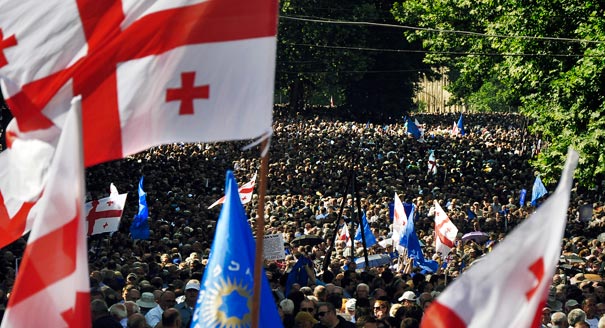
Source: Getty

In The Media
Carnegie Europe

Georgia’s Parliamentary Elections

With the ruling party’s loss to the opposition Georgian Dream coalition, the country’s leading political parties must find a way to share power and enable a peaceful political transition.

Link Copied
By Thomas de Waal
Published on Oct 1, 2012

Source: Worldview

In the wake of the recent parliamentary elections, Carnegie’s Thomas de Waal sat down with WBEZ's Worldview to discuss the short history of Georgia, President Saakashvili's legacy, and the factors behind his party's legislative defeat.

Topics discussed include:

  • A Post-Soviet Republic: The Rose Revolution brought Saakashvili to the presidency, where he enacted a number of reforms. But his legacy as a modernizer was not enough to overcome voter frustration with the country’s civil rights shortcomings, de Waal explained.
     
  • High Stakes: The victorious faction will name the new prime minister, a position that will gain a great deal of power once Saakashvili's presidential term ends in 2013, de Waal said. He added that the opposition's success has dealt another blow to the outgoing majority's legitimacy.
     
  • International Attention: Georgia has been the focus of a great deal of international attention, both positive, like the U.S. interest in promoting the country as a model developing democracy, and negative, like the country’s brief war with Russia, de Waal said.
     
  • The Future of the United National Movement (UNM): The UNM could become a vocal opposition, since the party remains very well organized in comparison with the Georgian Dream coalition, de Waal suggested.
     
  • The Leader of the Opposition: Bidzina Ivanishvili, the leader of the Georgian Dream coalition, remains an enigma despite his recent transformation from reclusive businessman to mainstream politician, de Waal said. His considerable fortune is subject to some controversy, as is his citizenship, although the Saakashvili government's attempt to strip his Georgian citizenship now appears to have been a strategic mistake.
     
  • This Election's Legacy: If there is international pressure to respect the ballot, this could be a positive step toward harmony in Georgia, de Waal said. A peaceful transfer of power would give the electorate confidence that its opinion is respected and matters, he concluded.

About the Author

Thomas de Waal

Senior Fellow, Carnegie Europe

De Waal is a senior fellow at Carnegie Europe, specializing in Eastern Europe and the Caucasus.

    Recent Work

  • Commentary
    Europolis, Where Europe Ends

      Thomas de Waal

  • Commentary
    Taking the Pulse: Is It Time for Europe to Reengage With Belarus?

      Thomas de Waal, ed.

Thomas de Waal
Senior Fellow, Carnegie Europe
Thomas de Waal
Political ReformCaucasusGeorgia

Carnegie does not take institutional positions on public policy issues; the views represented herein are those of the author(s) and do not necessarily reflect the views of Carnegie, its staff, or its trustees.

More Work from Carnegie Europe

  • Commentary
    Strategic Europe
    The EU Needs a Third Way in Iran

    European reactions to the war in Iran have lost sight of wider political dynamics. The EU must position itself for the next phase of the crisis without giving up on its principles.

      Richard Youngs

  • Turkey Erdogan Caucasus Central Asia
    Article
    How Turkey Can Help the Economies of the South Caucasus to Diversify

    Over the past two decades, regional collaboration in the South Caucasus has intensified. Turkey and the EU should establish a cooperation framework to accelerate economic development and diversification.

      • Feride Inan
      • Güven Sak
      • Berat Yücel

      Feride İnan, Güven Sak, Berat Yücel

  • Commentary
    Strategic Europe
    Can Europe Still Matter in Syria?

    Europe’s interests in Syria extend beyond migration management, yet the EU trails behind other players in the country’s post-Assad reconstruction. To boost its influence in Damascus, the union must upgrade its commitment to ensuring regional stability.

      Bianka Speidl, Hanga Horváth-Sántha

  • Commentary
    Strategic Europe
    Europolis, Where Europe Ends

    A prophetic Romanian novel about a town at the mouth of the Danube carries a warning: Europe decays when it stops looking outward. In a world of increasing insularity, the EU should heed its warning.

      Thomas de Waal

  • Commentary
    Strategic Europe
    Europe Falls Behind in the South Caucasus Connectivity Race

    The EU lacks leadership and strategic planning in the South Caucasus, while the United States is leading the charge. To secure its geopolitical interests, Brussels must invest in new connectivity for the region.

      Zaur Shiriyev

Get more news and analysis from
Carnegie Europe
Carnegie Europe logo, white
Rue du Congrès, 151000 Brussels, Belgium
  • Research
  • Strategic Europe
  • About
  • Experts
  • Projects
  • Events
  • Contact
  • Careers
  • Privacy
  • For Media
  • Gender Equality Plan
Get more news and analysis from
Carnegie Europe
© 2026 Carnegie Endowment for International Peace. All rights reserved.