

Commentary
Judy Dempsey
{
  "authors": [
    "Judy Dempsey"
  ],
  "type": "legacyinthemedia",
  "centerAffiliationAll": "",
  "centers": [
    "Carnegie Endowment for International Peace",
    "Carnegie Europe"
  ],
  "collections": [],
  "englishNewsletterAll": "",
  "nonEnglishNewsletterAll": "",
  "primaryCenter": "Carnegie Europe",
  "programAffiliation": "",
  "programs": [],
  "projects": [],
  "regions": [
    "Europe"
  ],
  "topics": [
    "EU"
  ]
}
Source: Getty
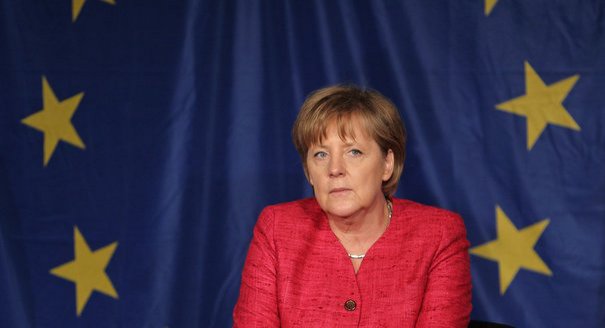
In her first term as chancellor, Angela Merkel put values at the top of her agenda. Now, her first priority is the euro crisis and Germany's economic position.
Source: New York Times

Ms. Merkel moved quickly to rebalance German foreign policy by rebuilding Germany’s relations with Washington and Warsaw. Her predecessor, the Social Democrat Gerhard Schröder, had concentrated on forging very close economic and business ties with Russia and China, at the expense of the trans-Atlantic relationship. Mr. Schröder’s vocal opposition to the U.S.-led invasion of Iraq led to a chill between Washington and Berlin. His particularly close friendship with President Vladimir V. Putin of Russia damaged German relations with Eastern Europe.
But Ms. Merkel did something else during her first term: She put values at the top of her agenda.Whether she was in Russia, China or the United States, she spoke openly about defending human rights and press freedom and against torture and the U.S. detention center at Guantánamo Bay, Cuba. She won praise from civil liberties organizations.
Seven years later, as Ms. Merkel plans her re-election bid, due in 10 months’ time, analysts say she is putting interests before values. “Except for her harsh criticism of Putin, Merkel is much milder about speaking out about human rights,” said Hugh Williamson, director for Europe and Central Asia at Human Rights Watch. “She is distracted by the euro crisis and its impact on the German economy. But does that mean she has to be mute over human rights?”
The euro crisis has affected German foreign policy in two ways.
First, Berlin is no longer making any effort to discuss the future of European security and military policy. “It is not on the agenda. But whose agenda is it on?” said Henrik Heidenkamp, a military expert at the Royal United Services Institute, a research group in London.
Astonishingly, said Graham Muir, head of policy and planning at the European Defense Agency, E.U. leaders have not discussed security and military issues for seven years. “The last time was at Hampton Court during the U.K. presidency in 2005. Ever since, there has not been a substantive discussion at summit level,” he added. The agency’s role is to encourage member states to cooperate on military planning and share their capabilities instead of duplicating them.
But E.U. leaders’ preoccupations with the global financial crisis and then the euro crisis are not the only reasons for their reluctance to discuss security and the military.
Any serious debate about the issue would mean having to agree about values and interests, and how to implement them, analysts say.
The first time the European Union attempted to set out a security strategy was in 2003. Despite some attempts to write a new one in 2007, Europe is still left without a security doctrine of any value. This is despite the extraordinary changes sweeping across the Middle East and Southeast Asia, and despite the Union being awarded the Nobel Peace Prize this year.
The second way in which the euro crisis has affected Ms. Merkel’s foreign policy is her determination to protect German jobs. That means ensuring that German industry has access, for example, to rare earth metals that are essential components for the renewable energy sector and for electric cars.
China produces nearly 95 percent of the world’s rare earth metals. Kazakhstan and Mongolia have sizable deposits, too. Over the past few years, Ms. Merkel has made big efforts to protect the German economy and its booming export sector by visiting or hosting the leaders of undemocratic and authoritarian countries.
Which Western leader wouldn’t do the same, given the same kind of industrial base?
Ms. Merkel has raised human rights issues with all these countries, but her interventions lack the fervor of her first term. “The economic and fiscal pressures are pushing aside values,” Mr. Heidenkamp said. “They have not vanished as such. Realpolitik has come into play.”
What this means is that until the next German elections, Ms. Merkel will tread a cautious foreign policy path, careful to protect jobs and exports.
“We can only hope that if she is re-elected, she will place values once again on top of her agenda,” said Mr. Williamson of Human Rights Watch. “It matters for Germany’s reputation, especially given its global economic presence.”
It also matters for the European Union. It can do little without German support.

Nonresident Senior Fellow, Carnegie Europe
Judy Dempsey is a nonresident senior fellow at Carnegie Europe
Recent Work
Judy Dempsey
Judy Dempsey

Funding Ukraine remains a priority for European leaders. As Russia’s war of aggression heads into another winter, two feasible options to mobilize support for Kyiv should be fast-tracked.


Vladyslav Rashkovan, Gregory P. Wilson

While the EU and European governments are embracing the much-lauded middle-power moment, this entails three difficult conundrums.

Richard Youngs

Europe is facing rising populism internally as well as external pressures from Russia, China, Turkey, and the United States.

Dimitar Bechev

A notable degree of participative democracy has firmly arrived in Europe. But to have more far-reaching impact, democratic deliberation needs to move into a radically new phase.
Richard Youngs

Much has been said of the changes Brussels is trying to make to the EU enlargement process. Here’s why gradual integration might—or might not—be the answer.
Dimitar Bechev