

Q&A
- +1
Sheena Chestnut Greitens, Oriana Skylar Mastro, Yukon Huang, …
{
  "authors": [
    "Yukon Huang"
  ],
  "type": "legacyinthemedia",
  "centerAffiliationAll": "dc",
  "centers": [
    "Carnegie Endowment for International Peace"
  ],
  "collections": [],
  "englishNewsletterAll": "asia",
  "nonEnglishNewsletterAll": "",
  "primaryCenter": "Carnegie Endowment for International Peace",
  "programAffiliation": "AP",
  "programs": [
    "Asia"
  ],
  "projects": [],
  "regions": [
    "East Asia",
    "China"
  ],
  "topics": [
    "Political Reform",
    "Economy"
  ]
}
Source: Getty
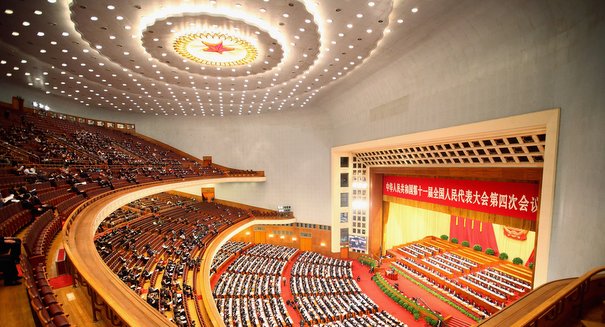
Given the collective nature of China’s decision-making, more attention needs to be given to whether China’s unique form of regional decentralization can continue unchanged.
Source: International Herald Tribune

But this focus on personalities may be misplaced, given the collective nature of China’s decision-making. More attention needs to be given to whether China’s unique form of regional decentralization — which triggered a remarkable economic transformation but discouraged political liberalization — can continue unchanged.
With an expanding middle class becoming more aware of the country’s potential, there is mounting speculation that political reform will happen — it’s a question of when and how, not if.Pressures for change are coming from the growing recognition that despite China’s remarkable material progress, the system is no longer equitable. This is reinforced by swelling complaints about how local officials deal with rising social consciousness, on display most recently in the protests over media censorship in southern China.
China is unique in its reliance on a regionally decentralized system to deal with both economic and political objectives. Beijing provides the regions with the flexibility to experiment with economic reforms. Promotion and the rotation of senior provincial officials, who are appointed by Beijing, are linked to the ability to achieve targets set by the center. So, unlike a Western-style federalist system, China’s regional leaders are more responsive to Beijing than to their local constituents.
This same approach is applied to political objectives that are largely designed to maintain stability. Regional officials must deal with concerns that manifest themselves through local protests in ways that discourage the escalation of tensions. Protests have become the natural form of popular expression in China given the absence of direct elections and a strong civil society.
These arrangements represent a form of “conditional autonomy” that allows provincial leaders to take whatever measures they feel appropriate to promote growth and maintain political stability as long as the legitimacy of the regime is not threatened.
But this conditional autonomy is also fraught with risks since excessive force can lead to more violent collective actions, and concessions may encourage protesters to extract even more from the system. Thus some form of concession with repression is typically used to resolve disputes and discourage future incidents. This approach provides incentives for provincial leaders to perform, but also shields Beijing from blame if something goes wrong locally.
Compared with other authoritarian regimes, the top leaders are generally perceived as having the people’s interests in mind, while the local authorities are blamed for what goes wrong in their daily lives.
This regionally decentralized system has proved exceptionally effective in promoting economic liberalization and for the most part has helped maintain social stability even though it discourages political liberalization. But there is a real fear that frustration with governance will continue to increase without political reform.
Conflicts over land and labor rights account for the majority of the incidents of social unrest — estimated at more than 160,000 annually. While these largely economic concerns can be dealt with fairly easily through concessions, protests that emanate from anger over widening disparities, corruption and a lack of personal rights challenge the role of the state and do not readily lend themselves to compromises.
Local authorities are often unable to address broader concerns, and attempts to do so might simply encourage more social unrest. While some see Chinese protests as “manageable” outlets for addressing complaints that can actually help stabilize rather than undermine the political system, the increasing frequency of such events and their cost — the budget for internal security now exceeds military spending — suggest an unsustainable situation.
Change is needed. The proposition that economic liberalization will give birth to political liberalization is an old one — and it has happened elsewhere. But China has been cautious. Can the new generation of senior leaders forge ahead with political liberalization in a way that is acceptable within the party system and does not jeopardize China’s hard-won economic success?
Back in 1998, a law establishing more competitive village-level elections gave hope that the roots of change could begin at local levels. The nature of such elections, however, with their lack of openness and lack of independence from party interventions, was disappointing.
But if these elections were truly representative, they could put officials in place who would be more responsive to the local populace, reducing the need for public protests, and making it less necessary to appeal to Beijing for intervention.
Xi Jinping and China’s other new leaders don’t need to revolutionize the country’s leadership now. Real political change can start by moving forward with more representative local elections that will create pressures for accountability from the bottom up. This would need to be supported by a more balanced approach in dealing with social unrest that looks at more than just security considerations when handling grievances.
All of this could be done while maintaining the supremacy of China’s one-party system — a precondition in today’s China. The hope for a political opening in China lies with Xi’s willingness to make local leaders more accountable to their constituents and not only to Beijing.
This article was originally published in the International Herald Tribune .
Senior Fellow, Asia Program
Huang is a senior fellow in the Carnegie Asia Program where his research focuses on China’s economy and its regional and global impact.
Recent Work


Sheena Chestnut Greitens, Oriana Skylar Mastro, Yukon Huang, …


Yukon Huang, Isaac B. Kardon, Matt Sheehan
Carnegie does not take institutional positions on public policy issues; the views represented herein are those of the author(s) and do not necessarily reflect the views of Carnegie, its staff, or its trustees.

With its public finances in shambles, the far right polling at 35 percent ahead of the 2027 presidential election, and a growing protest movement, is France’s crisis a threat to the EU’s geopolitical awakening?

Rym Momtaz, ed.

While the EU and European governments are embracing the much-lauded middle-power moment, this entails three difficult conundrums.

Richard Youngs

Europe is facing rising populism internally as well as external pressures from Russia, China, Turkey, and the United States.

Dimitar Bechev
A notable degree of participative democracy has firmly arrived in Europe. But to have more far-reaching impact, democratic deliberation needs to move into a radically new phase.
Richard Youngs
The European Commissioner for Trade is headed to China. But after President Xi’s bridge-building visit to Washington, can a more isolated EU overcome Beijing’s stranglehold on critical raw materials? Who will blink first?
Rym Momtaz, ed.