

Report
- +3
James M. Acton, Alexey Arbatov, Vladimir Dvorkin, …
{
  "authors": [
    "Petr Topychkanov"
  ],
  "type": "legacyinthemedia",
  "centerAffiliationAll": "",
  "centers": [
    "Carnegie Endowment for International Peace",
    "Carnegie Russia Eurasia Center"
  ],
  "collections": [],
  "englishNewsletterAll": "",
  "nonEnglishNewsletterAll": "",
  "primaryCenter": "Carnegie Russia Eurasia Center",
  "programAffiliation": "",
  "programs": [],
  "projects": [
    "Eurasia in Transition"
  ],
  "regions": [
    "North America",
    "United States"
  ],
  "topics": [
    "Foreign Policy"
  ]
}
Source: Getty
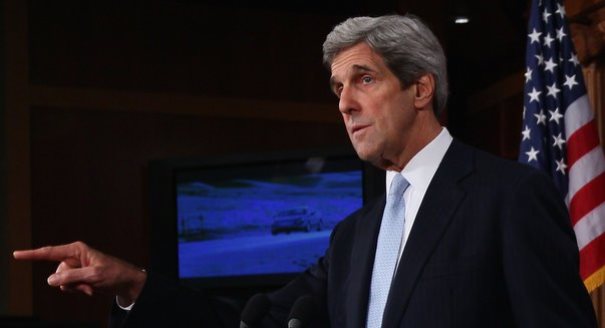
The United States will probably continue to limit its presence in global affairs because Barack Obama is committed to a more moderate U.S. role in foreign affairs.
Source: Voice of Russia
Petr Topychkanov, Member of Research Council of the Carnegie Moscow Center, about first tour of John Kerry as US State Secretary and prospects of US foreign policy.
I think that the United States will continue to limit its presence in global affairs because Barack Obama is committed to more moderate role of the United States in foreign affairs, and it was seen during his campaign in Iraq and also in Afghanistan. I think that Kerry agrees with this policy and he will provide support to the Barack Obama policy toward much more limited presence of the United States in the international relations.
Yes, I think so. Of course it doesn’t mean that we will see limited presence of the military of the United States in some regions, for example in Asia Pacific. We will see significant presence of the US mainly in this region, but as for political participation of the United States in the solution and maybe in the interference in domestic problems, I think that the United States will continue the trend, which could be seen during last several years.
Yes, it seems to me that Barack Obama wants to avoid this kind of relationship between the United States and other countries like patron and client. But of course he faces very strong opposition in the United States. For example regarding to his opposition on Israel, on Egypt or on the Middle East, you can see very strong world’s statement made by the Republicans in the United States that this policy of Barack Obama is not good for the United States and it will be disaster for the United States and so on and so force. So, from this point of view, yes, Barack Obama wants to avoid this kind of relationship but at the same time he cannot avoid this relationship and this ambiguousness may harm this approach and may harm the foreign policy of the White House during Barack Obama leadership because he sends mixed signals to the allies – from one hand he gives them money, but from another hand, he tried to leave them alone with their problems including the problems in the domestic policy, including religious extremism and so on.
It seems to me that this type of relations is outdated, I would agree with you. But of course it depends on the domestic policy in the United States, for example if after this presidential term of Barack Obama the opposition wins the elections, of course, the Republicans will try to restore the relations with the clients of the United States. But of course time will change the landscape in the Middle East, in Far East and in other regions. But what does it mean for Russia and for our policy? I think that it will mean that we will have to have more responsibility in the Middle East and in other countries because of limitation of the presence of the United States and White House foreign policy in these places.
Not to feel but to find ways to have more articulated foreign policy in this region because during the 1990s Moscow was in a very comfortable position. We could criticize the United States and Washington for the activities of the United States and its military but we avoided to bear responsibility, for example if you compare the participation of Russian peace-keepers in the international operation, it is a very small number comparing for example with China or Bangladesh or even Pakistan. But now, of course, it will not be good for Russia if we try to fill the vacuum after the United States but I think for international security it will be good if the international organizations including the UN first of all, of course, will try to fill this vacuum and to take more active role in the international relations.
Former Fellow, Nonproliferation Program, Moscow Center
Topychkanov was a fellow in the Carnegie Moscow Center’s Nonproliferation Program.
Recent Work

James M. Acton, Alexey Arbatov, Vladimir Dvorkin, …
Petr Topychkanov
Carnegie does not take institutional positions on public policy issues; the views represented herein are those of the author(s) and do not necessarily reflect the views of Carnegie, its staff, or its trustees.

The new U.S.–Denmark–Greenland agreement will help Washington exert political, economic, and financial dominance under the guise of security. Yet, it acknowledged Copenhagen’s and Nuuk’s sovereignty on the island.

Marc Pierini

A summer of escalation in the Black Sea has hurt Ukraine economically and is exacerbating world food security. A truce is needed—as is a broader reframing of Europe’s Ukraine strategy.

Thomas de Waal

Are Germany’s economic, industrial, and political struggles becoming a liability for the EU’s ability to rise to the geopolitical moment?

Rym Momtaz, ed.

European Commission President Ursula von der Leyen is about to give her annual address on the state of the EU. Here’s what she won’t—but should—say.
Rym Momtaz

Radical-right parties are expected to do well in upcoming elections in four of the EU's biggest member states. If successful, they could prevent the union from addressing key challenges ahead.

Stefan Lehne