

Commentary
Dmitri Trenin
{
  "authors": [
    "Dmitri Trenin"
  ],
  "type": "legacyinthemedia",
  "centerAffiliationAll": "",
  "centers": [
    "Carnegie Endowment for International Peace",
    "Malcolm H. Kerr Carnegie Middle East Center",
    "Carnegie Russia Eurasia Center"
  ],
  "collections": [
    "Arab Awakening"
  ],
  "englishNewsletterAll": "",
  "nonEnglishNewsletterAll": "",
  "primaryCenter": "Carnegie Russia Eurasia Center",
  "programAffiliation": "",
  "programs": [],
  "projects": [
    "Eurasia in Transition"
  ],
  "regions": [
    "Egypt",
    "Levant",
    "Maghreb",
    "Middle East",
    "North Africa",
    "Russia"
  ],
  "topics": [
    "Political Reform",
    "Foreign Policy"
  ]
}
Source: Getty
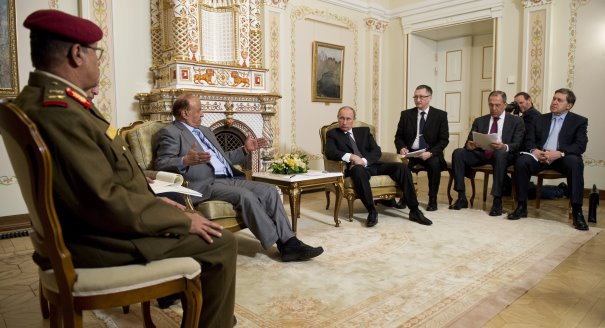
Russia is clearly concerned with the rise of Islamist extremists in the Middle East and is looking for ways to prevent destabilization in the region. At the same time, it is seeking to improve ties with various Arab countries.
Source: World Politics Review
Last month, Russian President Vladimir Putin hosted Mohammed Morsi, a former Muslim Brotherhood leader and Egypt’s first post-Arab Spring president, even as Russia continued to back Bashar al-Assad’s regime in Damascus against an assorted opposition that includes the Syrian branch of the Brotherhood. This apparent contradiction illustrates the challenges Russia is facing in the post-Arab Spring Middle East.Like virtually everyone else, Moscow was surprised by the groundswell of change that began in the Arab world in early 2011. Experts advising the Russian government call this a tectonic shift and compare its impact to that of the two defining periods in the region’s 20th-century history: the fall of the Ottoman Empire and the secular revolutions of the 1950s and 1960s. The present “Arab Awakening,” they opine, may take years, even decades, to unfold and is likely to transform the entire shape and fabric of the region. Its future course and dynamics are hard to predict, but in the end it will give a boost to the processes of social and political modernization that so far have largely bypassed the Arab Middle East and North Africa. ...
Read the full text of this article in World Politics Review.
Former Director, Carnegie Moscow Center
Trenin was director of the Carnegie Moscow Center from 2008 to early 2022.
Recent Work
Dmitri Trenin
Dmitri Trenin
Carnegie does not take institutional positions on public policy issues; the views represented herein are those of the author(s) and do not necessarily reflect the views of Carnegie, its staff, or its trustees.

Are Germany’s economic, industrial, and political struggles becoming a liability for the EU’s ability to rise to the geopolitical moment?

Rym Momtaz, ed.

European Commission President Ursula von der Leyen is about to give her annual address on the state of the EU. Here’s what she won’t—but should—say.
Rym Momtaz

The aftermath of the Ceuta crisis shows Europe has drawn the wrong lessons. Rather than doubling down on failed migration policies, the EU needs to address the underlying roots of such episodes.

Richard Youngs

Canadian Prime Minister Mark Carney has twice inspired praise for standing up to U.S. President Donald Trump: at the 2026 World Economic Forum in Davos and on Canada-U.S. trade negotiations. Is Carney showing a third way better than the EU has in dealing with the Trump administration?
Rym Momtaz, ed.

The EU’s responses to two recent incidents expose the gulf between European perceptions and capabilities. Unless the union can bridge that gap, it will never become a real geostrategic power.
Rym Momtaz