

Commentary
Maria Lipman
{
  "authors": [
    "Maria Lipman"
  ],
  "type": "commentary",
  "centerAffiliationAll": "",
  "centers": [
    "Carnegie Endowment for International Peace",
    "Carnegie Russia Eurasia Center"
  ],
  "collections": [],
  "englishNewsletterAll": "",
  "nonEnglishNewsletterAll": "",
  "primaryCenter": "Carnegie Russia Eurasia Center",
  "programAffiliation": "",
  "programs": [],
  "projects": [],
  "regions": [],
  "topics": []
}
Source: Getty
The current Russian regime may not explicitly present itself as a successor of the Soviet regime and its policies, but it firmly defends them against their detractors.
Forty-five years ago, the news of the Soviet invasion in Czechoslovakia reached me through the radio. For many in the USSR “radio” in those days meant foreign radio broadcasts, such as the Voice of America, the BBC, or Radio Liberty.
I was in Lithuania on vacation with my parents. We had already gone to bed and I was falling asleep to the murmur of my father’s radio. Then I was awoken by his voice: Oni vveli voiska. They brought in the troops. My father turned up the sound and the three of us listened to the newscast in gloomy silence.
The next day, on the beach and in the town itself everyone was listening to the radio—in the Baltics the jamming of foreign “voices” was not as effective as in Moscow. Portable transmitters were seen all over the place. In time for newscasts ground floor residents opened their windows, placed their radios on the window sills, and small crowds gathered outside to listen—in the same gloomy silence. Gloom and distress seemed to be overwhelming: Lithuania, as well as the other Baltic republics, regarded themselves as victims of the same regime that was now suppressing the Prague Spring.
A few days later, a small group of dissidents launched a protest rally in the Red Square. They were promptly arrested and beaten (one person’s teeth were knocked out). A few weeks later, several of them were sentenced to years in jail. Among their “crimes” the verdict cited “manufacturing signs” such as “Hands off Czechoslovakia,” “For your and our freedom” and others. In the verdict they were qualified as “knowingly false insinuations defiling the Soviet political and social system.” One person was locked up in a psychiatric asylum.
The period of Communist stagnation that in 1968 was at its early stages was marked by persecutions of dissidents. After about fifteen years, the Soviet dissident movement was all but crushed. The audacious opponents of the oppressive Communist regime were in jail or in psychiatric asylums, a few were forced to leave Russia. Yet by late 1980s, the USSR withdrew its troops from Czechoslovakia, and Czechs and Slovaks finally got their freedom. The Baltic nations were fighting and soon gained their own freedom by effectively seceding from the Soviet Union. By late 1991, the Soviet Communism collapsed.
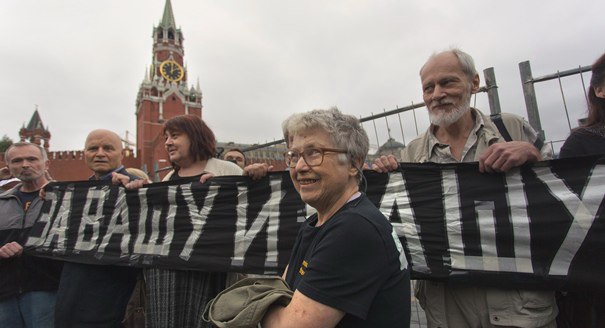
Last week, a small group came to the Red Square to commemorate the anniversary of the 1968 protest rally, one of them, Natalya Gorbanevskaya had also participated in the original demonstration. They were holding a single sign “For your and our freedom.” They were promptly detained by the police and taken to a police station. No beating, arrests, or prosecution this time. All were soon released. After all their message was related to the events long past.
But even if the modest commemorative event did not aim to “defile” Russia’s current government, it is likely seen as inherently hostile by the Kremlin and its loyalists. The current Russian regime may not explicitly present itself as a successor of the Soviet regime and its policies, but it firmly defends them against their detractors. The infallibility of the state remains the cornerstone of President Putin’s governance, and the same principle is persistently extended to the defunct Communist regime built on mass repression and fear. This explains why exposure of perpetrators of Stalin’s rule by terror or analysis of the nature if his regime are discouraged and sidelined. Or why Russia does not have a national memorial of the victims of mass repressions? Or why access to state archives has been steadily limited? Or why a pro-government newspaper commemorated the August 1968 events in Czechoslovakia by running a sympathetic interview with a serviceman who took part in the Soviet invasion? The only way the interviewer mentions those who dared raise their voices in protest is as the “so-called dissidents who poured streams of dirt on our soldiers.”
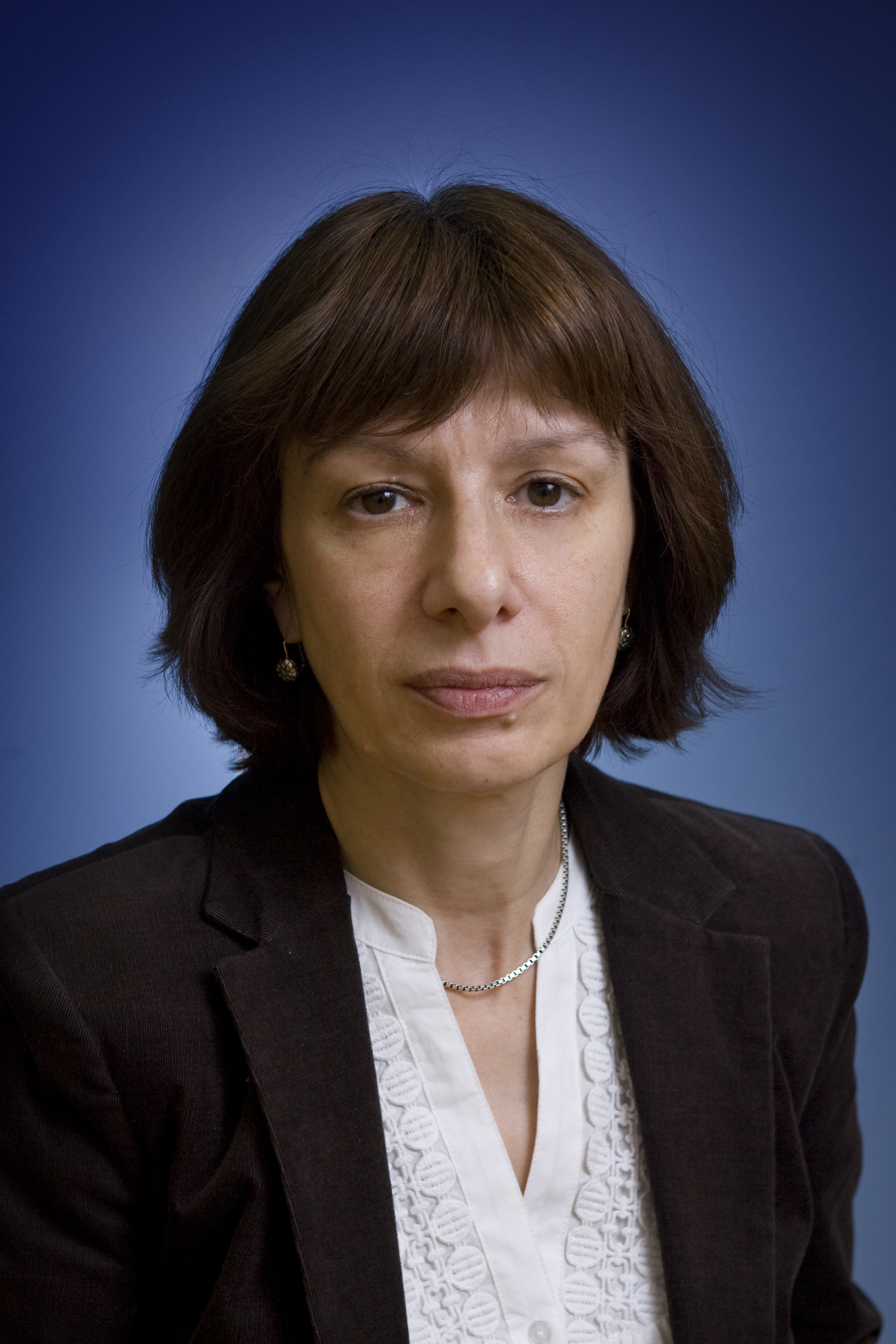
Former Scholar in Residence, Society and Regions Program, Editor in Chief, Pro et Contra, Moscow Center
Lipman was the editor in chief of the Pro et Contra journal, published by the Carnegie Moscow Center. She was also the expert of the Carnegie Moscow Center’s Society and Regions Program.
Recent Work
Maria Lipman
Maria Lipman
Carnegie does not take institutional positions on public policy issues; the views represented herein are those of the author(s) and do not necessarily reflect the views of Carnegie, its staff, or its trustees.