

Q&A
Suzanne Maloney, Aaron David Miller, Karim Sadjadpour
{
  "authors": [
    "Karim Sadjadpour"
  ],
  "type": "legacyinthemedia",
  "centerAffiliationAll": "dc",
  "centers": [
    "Carnegie Endowment for International Peace",
    "Malcolm H. Kerr Carnegie Middle East Center"
  ],
  "collections": [
    "Iranian Proliferation"
  ],
  "englishNewsletterAll": "menaTransitions",
  "nonEnglishNewsletterAll": "",
  "primaryCenter": "Carnegie Endowment for International Peace",
  "programAffiliation": "MEP",
  "programs": [
    "Middle East"
  ],
  "projects": [],
  "regions": [
    "Middle East",
    "Iran"
  ],
  "topics": [
    "Foreign Policy",
    "Nuclear Policy"
  ]
}
Source: Getty
The Obama administration’s ambitions of reducing America’s role in the Middle East are contingent upon a better relationship with Iran.
Source: BBC
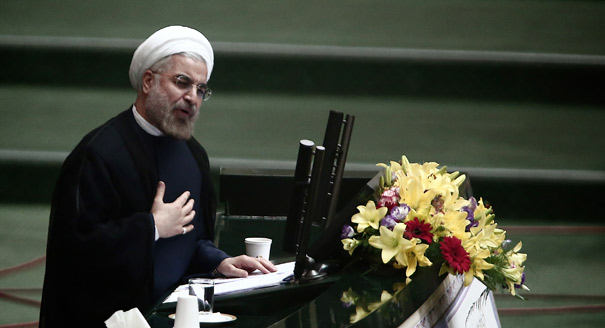
With Iranian president Hassan Rouhani expressing interest in improving ties with the West and reversing Iran’s economic isolation and Supreme Leader Ayatollah Khomeini reiterating his religious opposition to having nuclear weapons, is a potential breakthrough in U.S. relations with Iran possible? Speaking on the BBC, Carnegie’s Karim Sadjadpour argued that it’s clear that the Iranians are floating trial balloons. While Khomeini has been famously inflexible throughout his 24-year term, Sadjadpour said, he recently stated that Iran should be prepared to display “heroic” flexibility, a term uncommon for him. Many people are seeing it as a sign that Iran is preparing its public for some type of a nuclear compromise, Sadjadpour contended.
“The mistrust and ill-will between the two sides has been building for 35 years and it’s not going to be bridged easily but I think that this is the first time in 12 years in which we’ve had a moderate president in Tehran and a moderate president in Washington who’re interested in repairing the relationship,” Sadjadpour explained. While the Obama administration is interested in reducing America’s role in the Middle East, Sadjadpour noted, it will be contingent upon a better relationship with Iran.

Senior Fellow, Middle East Program
Karim Sadjadpour is a senior fellow at the Carnegie Endowment for International Peace, where he focuses on Iran and U.S. foreign policy toward the Middle East.
Recent Work


Suzanne Maloney, Aaron David Miller, Karim Sadjadpour

Aaron David Miller, Karim Sadjadpour, Robin Wright
Carnegie does not take institutional positions on public policy issues; the views represented herein are those of the author(s) and do not necessarily reflect the views of Carnegie, its staff, or its trustees.

A summer of escalation in the Black Sea has hurt Ukraine economically and is exacerbating world food security. A truce is needed—as is a broader reframing of Europe’s Ukraine strategy.

Thomas de Waal

Are Germany’s economic, industrial, and political struggles becoming a liability for the EU’s ability to rise to the geopolitical moment?

Rym Momtaz, ed.

European Commission President Ursula von der Leyen is about to give her annual address on the state of the EU. Here’s what she won’t—but should—say.
Rym Momtaz

The aftermath of the Ceuta crisis shows Europe has drawn the wrong lessons. Rather than doubling down on failed migration policies, the EU needs to address the underlying roots of such episodes.

Richard Youngs

Canadian Prime Minister Mark Carney has twice inspired praise for standing up to U.S. President Donald Trump: at the 2026 World Economic Forum in Davos and on Canada-U.S. trade negotiations. Is Carney showing a third way better than the EU has in dealing with the Trump administration?
Rym Momtaz, ed.