

In The Media
John Judis
{
  "authors": [
    "John Judis"
  ],
  "type": "legacyinthemedia",
  "centerAffiliationAll": "",
  "centers": [
    "Carnegie Endowment for International Peace",
    "Malcolm H. Kerr Carnegie Middle East Center"
  ],
  "collections": [],
  "englishNewsletterAll": "",
  "nonEnglishNewsletterAll": "",
  "primaryCenter": "Carnegie Endowment for International Peace",
  "programAffiliation": "",
  "programs": [],
  "projects": [],
  "regions": [
    "North America",
    "United States",
    "Middle East",
    "Syria",
    "Levant"
  ],
  "topics": [
    "Political Reform",
    "Security",
    "Foreign Policy"
  ]
}
Source: Getty
There is at least as good evidence against the United States administration’s claim of rising moderation in Syria as there is for it.
Source: New Republic
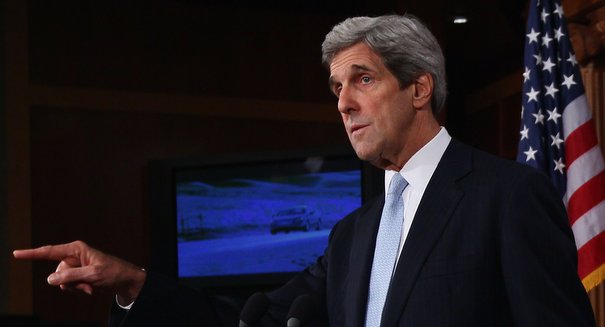
When pressed during the Senate Foreign Relations Committee hearings, Secretary of State John Kerry admitted that the goal of an American military strike against Bashar al Assad’s Syrian government would not merely be to punish him for his use of chemical weapons, but to inflict “collateral” damage that would have a “downstream impact” on his regime’s survival.
That position was affirmed by the Foreign Relations Committee, which in approving a resolution authorizing a military strike added an amendment proposed by Senators John McCain and Chris Coons that the American objective was to “change the momentum on the battlefield.” In other words, an important purpose of the military strike would be to get rid of Assad by weakening his military.
But that stance has invited the question of whether, in replacing Assad, the United States would be paving the way for Islamist rebels allied with al Qaeda to take power in at least a part of Syria. Senators Ron Johnson and Tom Udall, both of whom voted against the resolution, voiced this objection in the Senate hearings. Texas Rep. Michael McCaul raised the same point in the House Foreign Affairs Committee hearing last Wednesday. “Who are the rebel forces?” McCaul asked. “My concern is any strike against this regime, as bad as it is, will empower these radical Islamists, these extremists.”
Until this summer, the administration had expressed similar concerns. It had opposed sending lethal aid to the rebels for fear it would fall into the hands of Islamist extremists. But in the hearings, Kerry expressed confidence that the “moderates” of the Free Syrian Army (FSA) now had the upper hand in the struggle and could be expected to benefit from an American military strike. Kerry assured Johnson that “the opposition has increasingly become more defined by its moderation.” And in the House hearings, he told McCaul that “there is real moderate opposition that exists” and that it is “getting stronger.”
Is the administration right about rebels? Or has it changed its line to accord better with the case it wants to make for military action in Syria? One cannot answer this question definitively. Reporters and independent researchers have very limited access to Syria; and the situation on the ground continues to shift. When I asked Yezid Sayigh, who is a senior associate with the Carnegie Middle East Center in Beirut, about the relative strength of the moderates and extremists, he said, “None of use really knows, not us outsiders and not most Syrians.” But this much can be said: There is at least as good evidence against the administration’s claim of rising moderation as there is for it.
Kerry, McCain, and others who claim that moderates have gained the upper hand cite a report on the Wall Street Journal op-ed page by Elizabeth O’Bagy. (It is a “very interesting article, which I commend to you,” Kerry told McCaul.) O’Bagy is identified by the Journal as a senior analyst at the Institute for the Study of War, but she is also the political director of, and under contract to, the Syria Emergency Task Force, which is lobbying the White House and Congress to aid the rebels. That makes O’Bagy a less-than-disinterested researcher. And her op-ed itself, which paints the “moderate opposition forces” leading the struggle against Assad includes claims that I found difficult to believe.
O’Bagy, for instance, says that the opposition forces, which are led by ex-Assad military people “have struggled to ensure that their fight against Assad will pave the way for a flourishing civil society.” Really? Post-Assad Syria as the Levant’s answer to the Netherlands? Bagley acknowledges that the extremists have won control in parts of the north, but writes that during her visit to Syria, she “witnessed nearly daily protests by thousands of citizens” against the Islamist groups that have taken control in parts of the north. When I looked for other accounts, I did find reports and videos of demonstrations against groups like Islamic State of Iraq, but they didn’t appear to involve “nearly daily protests by thousands of citizens.”
Thomas Pierret, who is a lecturer in contemporary Islam at the University of Edinburgh, makes a more credible case for the moderate opposition in Foreign Policy. Pierret acknowledges that by the end of 2012, “the rise of hardline Salafi factions like the al Qaeda-affiliated Jabhat al-Nusra and the Syrian Islamic Front (SIF) led by Ahrar al-Sham, a faction with strong roots among Syrian veteran fighters of the Iraq war, was apparently irresistible, as FSA-affiliated battalions played the second roles in the rebels' major conquests at the time.”
But Pierret argues that the Islamist forces have been weakened by internal rifts, popular resistance to Islamist rule, and by the growing importance of state-aid to those fighting Assad. Writes Pierret:
There are, however, a credible array of reports that the Islamist role in the opposition remains significant and worrisome. Chairman of the Joint Chiefs of Staff Martin Dempsey voiced these concerns in a letter to Rep. Elliot Engel last month. But he appears to have been echoing analyses from government intelligence. At the Aspen Institute’s Security Forum in late July, David Shedd, the deputy director of the Defense Intelligence Agency, warned that groups affiliated to al Qaeda “have grown in size, grown in capability and ruthlessly grown in effectiveness. Their ability to take the fight to the regime and Hezbollah in a very direct way has been, among those groups, the most effective." They “would not go home” if Assad were ousted, he said, but will “fight for” a place in a post-Assad Syria.
British intelligence experts have also warned of growing extremist influence in Syria’s opposition. Charles Lister, an analyst at IHS Jane's Terrorism and Insurgency Centre, wrote recently that “the most notable trend in Syria in 2013 has been the increasing strategic supremacy of Islamist groups, particularly in the northern half of the country. Every major opposition military victory since September 2012 has been Islamist-led.” He concludes that “there is a power shit underway within the Syrian insurgency and it is not one that will be welcomed in western government circles.”
There have been also repeated reports of disarray within the Free Syrian Army and its coordinating group, the Supreme Military Council (SMC), that belie the Obama administration’s current optimism about the opposiiton. In a report in late August, Justapha al-Sheikh, a defector from the Syrian army and a member of the FSA, cast doubt on the group’s strength. The West’s lack of support has turned the FSA, Al-Sheikh said, into “an empty address without any real substance,” while leaving Islamists as “the real power on the ground.”
This month, Kirk Sowell, the head of an Arab language research firm, reported that the FSA and the Supreme Military Council appeared to be “on the verge of unraveling.” Sowell claimed that on August 22, four of the SMC’s five commanders threatened to resign, calling for the group to work with “all forces fighting in Syria,” a reference to the Islamists. “The SMC has been something of a shell for months… and when opportunities have arisen to make command decisions, it has fallen flat,” Sowell writes.
Sowell notes that “even more embarrassing are major operations in which the jihadists clearly out-organize and out-fight the SMC groups. This happened a few weeks ago in the rebel Latakia offensives, in which the jihadists formed a ‘Mujahidin Operations Center’ and bore the brunt of the battle.” Pierret acknowledges this point. He writes, “Hardline Salafis certainly remain important players in Syria, as recently illustrated by their role in the capture of a dozen Alawite villages in the province of Latakia,” but he claims that they now face “unprecedented difficulties” in fighting Assad’s forces.
I think that anyone reading these different accounts has to admit to confusion and to be skeptical of the administration’s contention that “the opposition has increasingly become more defined by its moderation.” If the administration is going to make its case over the next days for a military strike, it needs to take this into account. If it is going to argue that its purpose is not only to enforce a norm against the use of chemical weapons, but to aid in Assad’s overthrow, it has to lay out a credible scenario by which that could happen without ceding parts of Syria to groups allied to the perpetrators of September 11. They have yet to do so.
Former Visiting Scholar
As a visiting scholar at Carnegie, Judis wrote The Folly of Empire: What George W. Bush Could Learn from Theodore Roosevelt and Woodrow Wilson.
Recent Work
John Judis
John Judis
Carnegie does not take institutional positions on public policy issues; the views represented herein are those of the author(s) and do not necessarily reflect the views of Carnegie, its staff, or its trustees.

A summer of escalation in the Black Sea has hurt Ukraine economically and is exacerbating world food security. A truce is needed—as is a broader reframing of Europe’s Ukraine strategy.

Thomas de Waal

Are Germany’s economic, industrial, and political struggles becoming a liability for the EU’s ability to rise to the geopolitical moment?

Rym Momtaz, ed.

European Commission President Ursula von der Leyen is about to give her annual address on the state of the EU. Here’s what she won’t—but should—say.
Rym Momtaz

Radical-right parties are expected to do well in upcoming elections in four of the EU's biggest member states. If successful, they could prevent the union from addressing key challenges ahead.

Stefan Lehne

The aftermath of the Ceuta crisis shows Europe has drawn the wrong lessons. Rather than doubling down on failed migration policies, the EU needs to address the underlying roots of such episodes.

Richard Youngs