

Report
- +3
James M. Acton, Alexey Arbatov, Vladimir Dvorkin, …
{
  "authors": [
    "Petr Topychkanov"
  ],
  "type": "commentary",
  "centerAffiliationAll": "",
  "centers": [
    "Carnegie Endowment for International Peace",
    "Carnegie Russia Eurasia Center"
  ],
  "collections": [],
  "englishNewsletterAll": "",
  "nonEnglishNewsletterAll": "",
  "primaryCenter": "Carnegie Russia Eurasia Center",
  "programAffiliation": "",
  "programs": [],
  "projects": [],
  "regions": [
    "Russia"
  ],
  "topics": [
    "Political Reform",
    "Civil Society"
  ]
}
Source: Getty
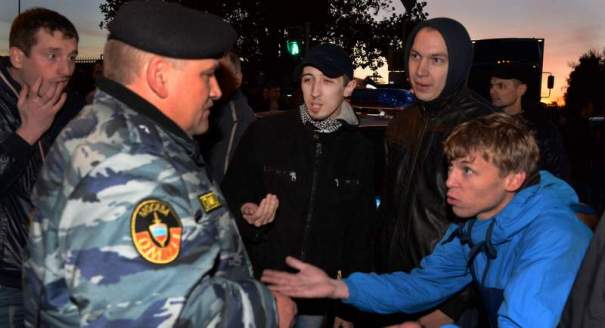
Last weekend, two districts of Moscow became a battlefield between the police and the people described as nationalists by mass media or as hooligans by the authorities. Moscow has been a place of pogroms many times, but this time the authorities were more efficient than in previous cases.
Last weekend, two districts of Moscow became a battlefield between the police and the people described as nationalists by mass media or as hooligans by the authorities. The pretext was a murder of a Muscovite by a person of a South Caucasus origin. The Ministry of Internal Affairs launched an operation Vulcan to prevent proliferation of the riots and detain suspect organizers and activists of those events. Over 200 people were arrested. About a dozen police were injured.
Moscow has been a place of pogroms many times, including several incidences after the Soviet Union collapse. It seems that last weekend the authorities were more efficient than in previous cases, yet still not enough. The question is, how efficient they can be?
According to several studies of the mass violence phenomenon worldwide, the first wave of pogroms is often missed by the law enforcement agencies, despite their awareness of a high probability of pogroms. It can be explained in two ways. On the one hand, these agencies need some time to assess probability and possible scale of pogroms in order to deploy an appropriate number of troops.
On another hand, the agencies can actually let rioters initiate pogroms attempting to achieve two goals. One of them is the canalization of feelings of disobedience of people. The second goal may be to exert pressure on some communities which become the target of such pogroms.
Anyway, the perception of a pogrom as chaos does not reflect the reality. According to Natalie Zemon Davis, “Even in the extreme case of religious violence, crowds do not act in a mindless way”. This can be witnessed in many incidences. For instance, Ian Talbot in his study of The 1947 Violence in Punjab demonstrated the existence of an organized effort behind the mass violence and a certain structure to support it.
What we can do if the pogrom is not totally unavoidable? I absolutely agree with doctor Davis, who argues that if we want to secure trust and ensure safety in society and to guarantee that the violence it generates will take the least cruel of forms, then we must think more about changing the central values of the society to emphasize tolerance and the use of non-violent ways of conflict resolution.
Former Fellow, Nonproliferation Program, Moscow Center
Topychkanov was a fellow in the Carnegie Moscow Center’s Nonproliferation Program.
Recent Work

James M. Acton, Alexey Arbatov, Vladimir Dvorkin, …
Petr Topychkanov
Carnegie does not take institutional positions on public policy issues; the views represented herein are those of the author(s) and do not necessarily reflect the views of Carnegie, its staff, or its trustees.

Before the next wave of EU enlargement takes place, the union needs to grapple with thorny questions of how power is distributed among its members.


Emil Sondaj Hansen, Ditte Brasso Sørensen

A summer of escalation in the Black Sea has hurt Ukraine economically and is exacerbating world food security. A truce is needed—as is a broader reframing of Europe’s Ukraine strategy.

Thomas de Waal

European Commission President Ursula von der Leyen is about to give her annual address on the state of the EU. Here’s what she won’t—but should—say.

Rym Momtaz

Radical-right parties are expected to do well in upcoming elections in four of the EU's biggest member states. If successful, they could prevent the union from addressing key challenges ahead.

Stefan Lehne

The EU’s responses to two recent incidents expose the gulf between European perceptions and capabilities. Unless the union can bridge that gap, it will never become a real geostrategic power.
Rym Momtaz