

Commentary
As we close out another season of Strategic Europe, it is worth taking stock of the deep shifts underway.
Rym Momtaz
{
  "authors": [
    "Zhao Kejin"
  ],
  "type": "legacyinthemedia",
  "centerAffiliationAll": "",
  "centers": [
    "Carnegie Endowment for International Peace",
    "Carnegie China"
  ],
  "collections": [],
  "englishNewsletterAll": "",
  "nonEnglishNewsletterAll": "",
  "primaryCenter": "Carnegie China",
  "programAffiliation": "",
  "programs": [],
  "projects": [],
  "regions": [
    "East Asia",
    "China"
  ],
  "topics": [
    "Foreign Policy"
  ]
}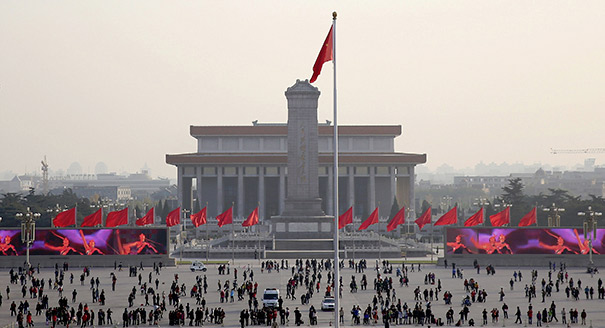
Source: Getty
As China seeks a more balanced diplomatic approach after decades of enhanced exchanges with Western powers, it should pay more attention to its Asian neighbors.
As China seeks a more balanced diplomatic approach after decades of enhanced exchanges with Western powers, it should pay more attention to its Asian neighbors.
After the founding of the People's Republic of China in 1949, the focus of the nation's foreign strategy was to lean to the Soviet Union and other socialist countries. Later on, with the worsening of relations with the Soviet Union, Beijing adjusted its strategic focus to strengthen unity and cooperation with Third World countries in Asia, Africa and Latin America.
After the launch of reform and opening-up, China began engaging with the West, first with the United States, and actively participating in the globalization process, on the basis of enhancing cooperation with developing countries, to create a favorable international environment for the country's modernization drive. Keeping a low profile strategically and concentrating on economic construction were the mainstays of China's diplomacy.In recent years, however, China's economic rise has brought the country not only confidence and global influence, but also suspicions about its strategic intentions from neighboring countries that have territorial disputes with China. Moreover, the US' rebalancing strategy in the Asia-Pacific has added to the strategic pressure China faces.
In the face of the complex and profound domestic and international changes that have taken place in recent years, how to provide strategic and institutional backup for China's growing influence and create a favorable international and regional environment for China's peaceful development have become pressing problems, which require China to make adjustments to its diplomatic strategy making neighboring regions the focus.
If China can take the initiative and undertake sound diplomatic work in neighboring regions and consolidate its friendly cooperation with neighboring countries, Beijing will not have to fear any mounting pressure from the US or any other country.
At a conference held in October on diplomacy, President Xi Jinping said that the neighboring region has major strategic significance and dealing with neighboring countries should have a three-dimensional, multi-element perspective, beyond time and space.
A three-dimensional perspective means strengthening top-level design and strategic planning and promoting the deepening of both official and people-to-people friendly exchanges, so as to build a three-dimensional diplomatic network that consolidates the strategic and social foundation of relations between China and neighboring countries.
A multi-element perspective means working out measures that suit local conditions and striving for a sound regional environment in an active and well-advised way. In Northeast Asia, the priority is to maintain peace and stability on the Korean Peninsula - efforts should be made to restart the Six-Party Talks - and the establishment of a free trade area covering China, Japan and the Republic of Korea. In Southeast Asia, on the basis of taking into full consideration regional diversity, efforts will be made to hasten interconnectivity by establishing a new maritime "Silk Road" and the Trans-Asian Railway and properly handling disputes in the South China Sea. In Central Asia, the focus will be on strengthening the strategic partnership with Russia, establishing a Silk Road economic belt and enhancing the role of the Shanghai Cooperation Organization. To the west, the focus will be on strengthening strategic coordination and pragmatic cooperation with India, and the construction of the BCIM (Bangladesh, China, India and Myanmar) economic corridor and the China-Pakistan economic corridor.
Beyond time and space means that while carrying out diplomacy with neighboring countries the overall domestic and international situations must be taken into full account. Xi stressed the necessity of good diplomatic work in neighboring countries to realize the "centenary goals" of a moderately prosperous society by 2021 and a strong, modern socialist country by 2049.
In the near future, China's periphery strategy should focus on four aspects. The first is maintaining overall peace and stability in neighboring regions. Beijing will continue to seek a peaceful solution to the territorial disputes with some of its neighbors through dialogue and consultation, though it will also oppose any party's provocative acts that stir up trouble in the region.
The second is creating a neighboring geo-economic circle featuring mutually beneficial cooperation and forming crossed economic corridors from south to north and west to east. On the basis of hastening interconnectivity and infrastructure construction, China will work with its neighbors to build an overall opening-up pattern.
The third is to create a common security circle in neighboring regions and actively participate in regional and sub-regional security cooperation, and enhance cooperation mechanisms and strategic mutual trust. China will continue to pursue an independent policy of peace and adhere to a security concept featuring mutual trust, mutual benefit, equality and coordination, and promote security cooperation with neighboring countries, and positively provide public products for regional security to create a regional common security circle.
The fourth is to establish a community of common destiny and promote friendly exchanges through various channels, cultivate more friends and partners and share weal and woe with them.
The realization of the Chinese Dream is closely related to the aspiration of all peoples in all countries for a better life and regional prosperity. With the sense of common destiny taking root with neighboring countries and greater integration of interests, China's periphery diplomacy will embrace a bright future and China's development will offer more benefit to its neighbors and make them feel safe.
This article was originally published on China Daily Europe.

Zhao Kejin
Former Resident Scholar, Carnegie-Tsinghua Center for Global Policy
Zhao Kejin was a resident scholar at the Carnegie-Tsinghua Center until June 2020.
Carnegie does not take institutional positions on public policy issues; the views represented herein are those of the author(s) and do not necessarily reflect the views of Carnegie, its staff, or its trustees.

As we close out another season of Strategic Europe, it is worth taking stock of the deep shifts underway.

Rym Momtaz

The hybrid warfare landscape is evolving rapidly, leaving policymakers without clear strategies. To better inform their work in addressing emerging challenges, governments must dig deeper into the underlying dynamics at play.


Raluca Csernatoni, Alicia Wanless
The EU had to compromise to adopt a twenty-first sanctions package against Russia, exposing growing cracks in the union’s resolve. Is this latest, weaker round worth it to keep pressure on Moscow?
Rym Momtaz, ed.

Trump is distracted and Ukraine wants Europe to step up. The continent’s leaders must find their voice and assert it in talks with Russia.

Alissa de Carbonnel

Mounting economic strain and battlefield losses will not necessarily make the Kremlin less dangerous. They could instead push Moscow toward a more aggressive hybrid campaign designed to test NATO’s Eastern flank, exploit allied hesitation, and fracture European resolve.

Maksym Beznosiuk