

In The Media
Lilia Shevtsova
{
  "authors": [
    "Lilia Shevtsova"
  ],
  "type": "commentary",
  "centerAffiliationAll": "",
  "centers": [
    "Carnegie Endowment for International Peace",
    "Carnegie Russia Eurasia Center"
  ],
  "collections": [],
  "englishNewsletterAll": "",
  "nonEnglishNewsletterAll": "",
  "primaryCenter": "Carnegie Russia Eurasia Center",
  "programAffiliation": "",
  "programs": [],
  "projects": [],
  "regions": [
    "Russia"
  ],
  "topics": [
    "Political Reform"
  ]
}
Source: Getty
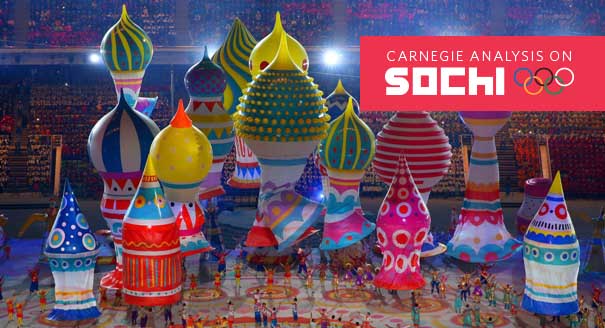
The Sochi Olympics are the Kremlin’s attempt to create the fairy tale myth of Russia that does not exist.
I think that despite the mocking depictions of unfinished Sochi hotels that lack running water and sport cracks in the walls, the Kremlin will succeed in creating the image of the Fairy Tale Russia. And millions of TV viewers will actually believe in this fairy tale. Its creators will use sporting events and glittering shows to amaze millions of people—both in Russia and overseas—and get them hooked on Russia’s great-power mystique. But people will be amazed by Putin’s Russia—the country that belongs to the Kremlin and its main resident.
After watching the Olympics’ opening ceremony—a 3-hour long spectacle that featured 5,000 participants—many of my friends told me in unison: “This is the most brilliant performance I have ever seen!” They are not President Vladimir Putin’s admirers at all; nevertheless, they were amazed. Actually, this is exactly what the Kremlin political strategists want. They did not need a performance that glorified Putin. The show that they created sought to engender patriotic sentiments, which can always be exploited to the regime’s and state’s advantage.
But the opening ceremony was indeed a fairy tale—an artists’ myth of Russia that does not exist. The popular Russian joke that proclaims Russia to be the elephants’ birthplace which means that Russia is an embodiment of absurdities is actually about the Olympic Russia. It is the place you cannot really find in reality. It is the Potemkin village that the Russian elite have become so experienced in building through the centuries.
The real Russia is quite another animal. It is the first in the world when it comes to:
At the same time, Russia is also first when it comes to generals, billionaires, direct individual investment in foreign countries, as well as whiskey imports.
Welcome to the Sochi Olympics!
Former Senior Associate, Russian Domestic Politics and Political Institutions Program, Moscow Center
Shevtsova chaired the Russian Domestic Politics and Political Institutions Program at the Carnegie Moscow Center, dividing her time between Carnegie’s offices in Washington, DC, and Moscow. She had been with Carnegie since 1995.
Recent Work
Lilia Shevtsova
Lilia Shevtsova
Carnegie does not take institutional positions on public policy issues; the views represented herein are those of the author(s) and do not necessarily reflect the views of Carnegie, its staff, or its trustees.

As we close out another season of Strategic Europe, it is worth taking stock of the deep shifts underway.

Rym Momtaz

The hybrid warfare landscape is evolving rapidly, leaving policymakers without clear strategies. To better inform their work in addressing emerging challenges, governments must dig deeper into the underlying dynamics at play.


Raluca Csernatoni, Alicia Wanless
The EU had to compromise to adopt a twenty-first sanctions package against Russia, exposing growing cracks in the union’s resolve. Is this latest, weaker round worth it to keep pressure on Moscow?
Rym Momtaz, ed.

Trump is distracted and Ukraine wants Europe to step up. The continent’s leaders must find their voice and assert it in talks with Russia.

Alissa de Carbonnel

Mounting economic strain and battlefield losses will not necessarily make the Kremlin less dangerous. They could instead push Moscow toward a more aggressive hybrid campaign designed to test NATO’s Eastern flank, exploit allied hesitation, and fracture European resolve.

Maksym Beznosiuk